
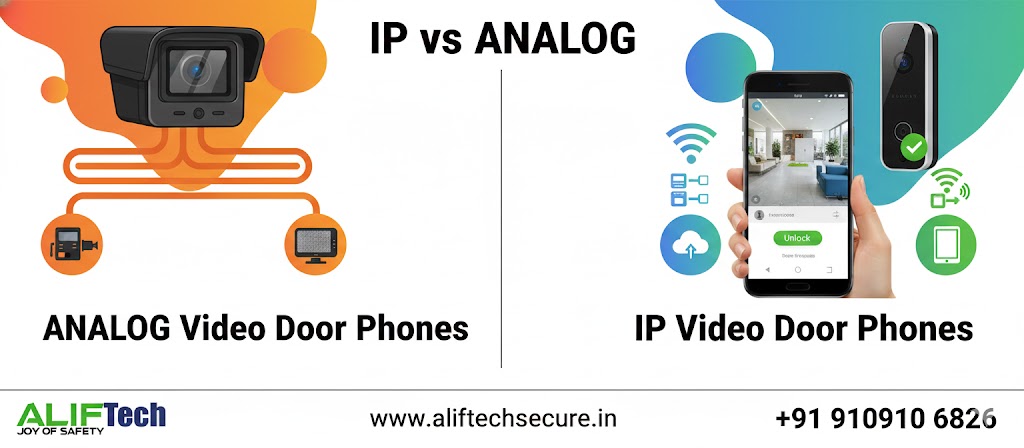
IP vs Analog Video Door Phones: Feature Comparison
Choosing between IP and analog video door phones can be confusing. Both systems allow you to see and speak with visitors, but they differ significantly in technology, features, and costs. This guide compares both systems to help you make an informed decision for your property.
Understanding the Basics
Analog Video Door Phones use traditional wired connections transmitting audio and video signals through dedicated cables. These systems have been the standard for decades and operate independently without requiring internet connectivity.
IP Video Door Phones transmit audio and video over your network (Internet Protocol) using Ethernet cables or WiFi. Consequently, they function like networked cameras, offering advanced features through smartphone apps and cloud connectivity.
Technology Comparison
Analog Systems
Analog door phones transmit signals in their original form through coaxial or multi-core cables. First, the outdoor camera captures video and audio. Then, it sends these signals directly to the indoor monitor through dedicated wiring. Finally, the monitor displays the video and plays audio in real-time.
Additionally, analog systems operate on closed circuits, meaning they’re completely independent from your internet or home network. Therefore, they work reliably regardless of WiFi stability or internet outages.
IP Systems
IP door phones convert video and audio into digital data packets transmitted over your network. First, the camera digitizes the video feed. Then, it compresses and transmits data via Ethernet cable or WiFi. Finally, this data can be received by indoor monitors, smartphones, tablets, or computers anywhere with network access.
Moreover, IP systems integrate with your existing network infrastructure, allowing remote access and advanced features through internet connectivity.
Feature-by-Feature Comparison
Video Quality
Analog Systems: Typically offer standard definition video (480p to 720p). While adequate for identifying visitors, the image quality is lower compared to modern standards. Furthermore, analog video can degrade over long cable runs, reducing clarity.
IP Systems: Provide high-definition video (1080p to 4K) with superior clarity. Additionally, digital transmission maintains consistent quality regardless of cable length. Moreover, many IP systems offer Wide Dynamic Range (WDR) for better performance in varying light conditions.
Winner: IP systems deliver significantly better video quality.
Remote Access
Analog Systems: Require you to be physically present at the indoor monitor to answer the door. Consequently, you cannot check visitors when you’re away from home or in another part of the building.
IP Systems: Enable remote access through smartphone apps from anywhere with internet connection. Therefore, you can answer your door while at work, traveling, or in another room. Additionally, receive push notifications when someone rings the doorbell.
Winner: IP systems offer unmatched flexibility with remote access.
Installation Complexity
Analog Systems: Installation is straightforward with dedicated wiring between outdoor unit and indoor monitor. However, running these cables through walls can be labor-intensive. Nevertheless, most electricians can install analog systems without specialized training.
IP Systems: Can be more complex, especially for WiFi models requiring network configuration. Moreover, PoE (Power over Ethernet) systems need compatible switches or injectors. However, integration with existing network infrastructure can simplify cable management.
Winner: Analog systems are generally simpler to install, though IP PoE systems can be equally straightforward with proper infrastructure.
Reliability
Analog Systems: Extremely reliable with minimal points of failure. Since they don’t depend on network connectivity, they work consistently without interruption. Additionally, simple technology means fewer components that can malfunction.
IP Systems: Generally reliable but dependent on network stability. WiFi-based systems may experience connectivity issues, while wired IP systems are more stable. Furthermore, software bugs or firmware issues can occasionally affect performance.
Winner: Analog systems edge ahead for pure reliability, though wired IP systems are highly dependable.
Recording Capabilities
Analog Systems: Limited or no recording capabilities in basic models. Some advanced systems offer SD card recording on the monitor, but storage is limited. Additionally, recorded footage quality matches the lower analog resolution.
IP Systems: Excellent recording options including local storage (SD cards, NAS), cloud storage with extended retention, continuous or motion-triggered recording, and easy access to recorded footage through apps.
Winner: IP systems provide far superior recording and storage options.
Integration and Smart Features
Analog Systems: Minimal integration capabilities. They function as standalone systems with basic intercom functionality. Consequently, they cannot connect with smart home systems, security cameras, or automation platforms.
IP Systems: Extensive integration possibilities including smart home platforms (Alexa, Google Home), integration with IP camera systems, connection to access control systems, automation triggers (unlock doors, turn on lights), and API access for custom integrations.
Winner: IP systems dominate with advanced integration capabilities.
Scalability
Analog Systems: Limited scalability. Adding additional monitors requires running new cables from the outdoor unit. Moreover, most systems support only 2-4 monitors, making expansion difficult for larger properties.
IP Systems: Highly scalable. You can add unlimited monitors, smartphones, or tablets to the system through network connectivity. Furthermore, upgrading components doesn’t require complete system replacement.
Winner: IP systems offer superior scalability.
Cost
Analog Systems: Lower initial cost (₹3,000-12,000 for complete system). Additionally, no ongoing subscription fees or network equipment required. Installation costs are moderate (₹1,500-3,000).
IP Systems: Higher upfront investment (₹8,000-35,000 for complete system). Moreover, some features require monthly subscriptions (₹200-800) for cloud storage. However, they may utilize existing network infrastructure, potentially reducing installation costs.
Winner: Analog systems are more budget-friendly initially, though IP systems may offer better long-term value.
Side-by-Side Comparison Table
| Feature | Analog | IP |
|---|---|---|
| Video Quality | 480p-720p | 1080p-4K |
| Remote Access | No | Yes (via app) |
| Installation | Moderate complexity | Varies (simple to complex) |
| Reliability | Excellent | Good to excellent |
| Recording | Limited | Extensive |
| Smart Integration | None | Extensive |
| Scalability | Limited (2-4 monitors) | Unlimited devices |
| Initial Cost | ₹3,000-12,000 | ₹8,000-35,000 |
| Monthly Fees | None | ₹0-800 (optional) |
| Internet Required | No | Yes (for remote features) |
| Power Outage Impact | Works with backup | Network dependent |
| Best For | Budget, reliability | Features, flexibility |
Which System Should You Choose?
Choose Analog Systems If:
- Your budget is limited (under ₹15,000 total)
- You don’t need remote access capabilities
- Internet connectivity is unreliable in your area
- You want maximum reliability with minimal maintenance
- Simple intercom functionality meets your needs
- You prefer standalone systems independent of networks
- Installation is for elderly users who prefer basic technology
- Your building has existing analog infrastructure
Choose IP Systems If:
- You want remote access through smartphone apps
- High-definition video quality is important
- You need recording and playback capabilities
- Smart home integration is desired
- You manage multiple properties remotely
- Scalability for future expansion is needed
- You want advanced features like facial recognition or AI detection
- Budget allows for ₹20,000+ investment
Installation Considerations
Analog Installation Requirements
First, plan cable routes from outdoor unit to indoor monitor. Then, use 4-core or 6-core cables depending on features (basic systems need 4-core). Additionally, ensure cables are rated for outdoor use if running externally.
Moreover, mount outdoor unit at 1.5-1.7 meters height for optimal face capture. Finally, connect power supply (typically 12V DC) and test all functions before sealing walls.
IP Installation Requirements
First, decide between wired (PoE) or wireless (WiFi) installation. For PoE systems, ensure you have a compatible switch or injector providing adequate power. Alternatively, for WiFi models, verify strong signal strength at installation location.
Then, configure network settings including assigning static IP addresses and setting up port forwarding if remote access is needed. Additionally, install smartphone apps and create user accounts. Finally, configure recording settings and notification preferences.
Maintenance and Support
Analog Systems
Maintenance is minimal for analog systems. First, clean camera lens quarterly to maintain clear video. Then, check cable connections annually for corrosion. Additionally, test backup power supply if installed.
Moreover, replacement parts are widely available and affordable. However, finding technicians familiar with older analog technology may become challenging as the industry shifts to IP systems.
IP Systems
IP systems require more active maintenance. First, update firmware regularly (quarterly) for security patches and new features. Then, monitor network connectivity and bandwidth usage. Additionally, manage cloud storage subscriptions and review recorded footage retention.
Furthermore, technical support is generally better for IP systems from manufacturers. Moreover, remote diagnostics can often resolve issues without on-site visits.
Future-Proofing Your Investment
Technology trends clearly favor IP systems. First, manufacturers are increasingly focusing development on IP products with advanced AI features. Consequently, analog systems receive fewer updates and new models.
Additionally, smart home integration continues expanding, making IP systems more valuable over time. Therefore, if you plan to stay in your property for 5+ years, IP systems offer better long-term value despite higher initial costs.
However, analog systems remain relevant for specific use cases where simplicity and reliability outweigh advanced features.
Common Misconceptions
Myth 1: “IP systems are always better than analog”
Reality: For basic intercom needs with limited budget, analog systems work perfectly well. Not everyone needs smartphone access or cloud recording.
Myth 2: “Analog systems are obsolete”
Reality: Analog technology remains reliable and cost-effective for many applications. Furthermore, they’re ideal where internet connectivity is poor or unnecessary.
Myth 3: “IP systems are difficult to use”
Reality: Modern IP door phones feature intuitive apps and simple setup wizards. Additionally, once configured, they’re often easier to use than analog systems.
Myth 4: “IP systems require constant internet”
Reality: While internet enables remote access, local network functionality works during internet outages. Moreover, wired IP systems are highly reliable on local networks.
Conclusion
Both IP and analog video door phones serve their purpose effectively. Analog systems excel in reliability, simplicity, and affordability, making them perfect for budget-conscious users wanting basic intercom functionality. In contrast, IP systems offer superior video quality, remote access, recording capabilities, and smart home integration for users willing to invest more.
Ultimately, your choice depends on budget, desired features, technical comfort level, and future needs. For most modern homes and apartments, IP systems provide better value with their advanced capabilities. However, analog systems remain excellent choices for straightforward installations where reliability and low cost are priorities. Evaluate your specific requirements against the comparison above to make the right decision for your property.
Frequently Asked Questions
Q: Can I upgrade from analog to IP later?
A: Unfortunately, no. Analog and IP systems use completely different technologies and wiring. Upgrading requires complete replacement of both outdoor and indoor units. However, you may be able to reuse some physical mounting hardware.
Q: Do IP door phones work without internet?
A: Yes, they work on your local network without internet for basic functions (viewing and unlocking). However, remote access through smartphone apps when away from home requires internet connectivity.
Q: Which system has better night vision?
A: IP systems generally offer superior night vision with infrared LEDs and better low-light processing. Nevertheless, higher-end analog systems also provide adequate night vision for most residential applications.
Q: Are IP door phones harder to hack than analog?
A: IP systems face cybersecurity risks like any networked device. However, using strong passwords, enabling encryption, and keeping firmware updated minimizes these risks. In contrast, analog systems are physically secure but offer no remote access.
Q: What happens during power cuts?
A: Both systems stop working unless connected to UPS backup. However, battery-powered wireless IP models continue functioning on battery power during outages.
Q: Can multiple people receive notifications on IP systems?
A: Yes, IP systems support multiple user accounts. Consequently, family members can install the app on their smartphones and receive notifications simultaneously when someone rings the doorbell.
Q: Do analog systems work with smartphones?
A: Standard analog systems don’t support smartphone connectivity. However, some hybrid models exist with analog base but WiFi modules for smartphone access, though these cost more than pure analog systems.
Q: Which system is better for apartments?
A: For individual apartments, either works well. However, for building-wide systems, IP intercoms offer better scalability, centralized management, and easier integration with building access control system


1 Comment. Leave new
Thanks for finally talking about > IP vs Analog Video Door
Phones: Feature Comparison | AlifTech Secure < Liked it!