
By AlifTech Secure | CCTV & Security Solutions, Indore | June 2026 | www.aliftechsecure.in
Most shops that get robbed have cameras. The cameras were running the whole time.
What went wrong was placement, resolution, or storage. Footage from three weeks ago had already been overwritten, or the camera pointed at the door instead of the counter, or the face on screen was a grey smudge.
This is a checklist you can walk your shop with. It covers where cameras go, what specification actually matters in retail, which layers most shops skip, and what changed in the rules this April.
Quick Checklist
- Cameras at entrance, billing counter, stockroom entry and high-value display zones.
- Burglar alarm with door contacts and a motion detector, monitored if you carry high-value stock.
- Access control on the stockroom and staff-only areas.
- 30 days of storage minimum. Seven days is not enough for retail.
- Remote access on your phone, set up during installation.
- BIS-registered cameras for anything bought after April 2026.
- A CCTV notice at the entrance.
Why Retail Systems Fail When You Need Them
Three failures account for most of it.
Storage runs out before discovery. Retail theft surfaces at a stock count or in a transaction mismatch, which means weeks later. A recorder set to seven days has already lost the answer.
The counter is not covered. Plenty of shops mount cameras at ceiling height pointing out toward the entrance. That captures customers walking in and misses the billing counter almost entirely, which is where small amounts skimmed from cash transactions add up over months.
Face capture is too poor to use. A camera showing that somebody was at the counter is not evidence. A camera showing who was at the counter is.
Fix those three and the system starts earning its cost.
Where Cameras Go in a Retail Shop
Retail placement follows different logic from a factory. The priorities are face capture at entry, transaction points, and high-value zones.
Main entrance, the one camera to get right
One camera at the entrance facing inward, covering the full width, mounted at a height that catches faces rather than the tops of heads.
If you only ever buy one camera, buy this one. In most retail thefts, the person is identifiable when the entrance angle is correct and unidentifiable when it is not.
Billing counter and cash drawer
A dedicated camera angled tightly on the counter, the drawer, and the billing person’s hands. Not the general shop floor.
For jewellery, electronics and pharmacy, add a second camera covering the customer side, since sleight-of-hand happens at an angle the counter-side camera cannot see.
Display and high-value zones
Showrooms with display cases want coverage of each section, capturing both browsing and removal. In clothing retail, cover the changing room corridor entry and high-value rack sections.
Cameras inside changing rooms or toilets are prohibited. Do not let any installer suggest otherwise.
For aisles, a camera at the end looking down the length covers a lot of shelf area from few units.
Stockroom and back office doors
Every door to the stockroom, back office, safe area or staff-only zone needs a camera on the entry point.
This is the zone shops skip most often. Money goes into shop-floor coverage while the stockroom door records nothing, which is exactly where internal loss happens.
Exterior
A camera at the shop front captures the approach, loitering before opening or after closing, and number plates nearby. In malls this may belong to the building, so confirm coverage exists and that you can actually get footage when you ask.
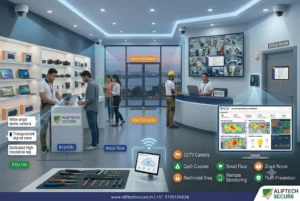
| Zone | Priority | Applies to |
|---|---|---|
| Entrance, face capture | Critical | Every shop |
| Billing counter and drawer | Critical | Every shop |
| Display and high-value merchandise | High | Jewellery, electronics, pharmacy |
| Stockroom or back office entry | High | Any shop with a back area |
| Changing room corridor entry | Medium | Clothing retail |
| Shop front exterior | Medium | Standalone shops |
Camera Specification for Retail
Dustproofing and vibration resistance matter less here than in a factory. Face capture, low light and form factor matter more.
4MP at transaction points
Use 4MP on the entrance and billing counter cameras. At 2MP you can see somebody is at the counter but often cannot confirm who, and that difference decides whether footage helps in an investigation or an insurance claim.
2MP is fine for stockroom and general floor cameras, and it saves storage.
Low light performance
Most after-hours entry happens in whatever light comes from emergency lighting or the street. Infrared cameras that switch to black and white are adequate. Cameras with genuine colour night vision are better for identification, since clothing colour is often the detail that matters.
Dome cameras indoors
A dome camera makes it harder for a browsing thief to work out exactly where it points, and it suits a retail ceiling better than a bullet. Vandal-resistant domes rated IK08 or IK10 survive tampering.
BIS registration, and what to actually check
From 1 April 2026, cameras that do not meet MeitY’s Essential Requirements cannot be manufactured, imported or sold in India. So any camera you buy now has to be compliant, and this is where most shop owners get sent to the wrong place.
Ask for the BIS registration number, the R-number, for the exact model. That is the licence to sell a camera in the Indian market, and the packaging should carry the Standard Mark alongside it. Under the Compulsory Registration Scheme, nobody may manufacture, store for sale, import, sell or distribute goods lacking that mark and number.
STQC certification is a separate, deeper route required for government and PSU procurement. As a shop owner you will find nothing useful there, so do not let a dealer wave an STQC reference at you in place of a BIS number.
Compliance is granted model by model, never brand by brand. A brand you trust can still have an uncertified model on the shelf. Our guide to the 2026 CCTV import and BIS rules covers the timeline, and our made in India camera brands piece covers what is actually available.
The Layers Most Shops Skip
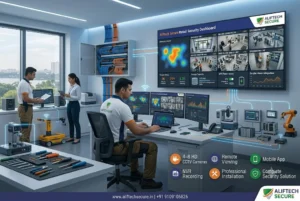
Cameras record. Alarms and access control prevent and limit.
Burglar alarm
A camera documents a break-in. An alarm interrupts one. A basic retail setup is door and window contacts on every external opening, a PIR motion detector on the shop floor, and a siren.
The siren alone deters most opportunistic after-hours entry. A monitored alarm, one that alerts a response centre, adds an actual response pathway rather than a noise nobody attends.
For jewellery and gold shops, monitored is the sensible baseline rather than an upgrade. Check your insurance policy too, since coverage conditions for high-value retail increasingly reference monitoring.
Door and window contacts
Every external door and window needs a magnetic contact sensor. These trigger the moment an opening is forced, before a motion detector sees anything, so the response starts at entry rather than after the intruder is inside.
At a few hundred rupees each, this is the cheapest security per rupee a shop can buy.
Access control on the stockroom
A keypad or RFID card system on the stockroom, safe area and back office creates a log of who entered and when.
That log is the most direct tool for investigating internal theft. When stock goes missing from a room three people could enter, the log narrows it immediately. It also ends the key duplication problem, where a former employee still has a working key nobody thought about.
By Shop Type
Jewellery and gold shops
The highest risk category in Indian retail. Beyond cameras: a monitored alarm, panic buttons at the counter and behind display cases, security film on display glass, and a safe bolted down. Cover every display case at 4MP or better, from more than one angle.
Electronics showrooms
High value in concealable form, so the specific risk is substitution, where an item is swapped for a decoy or a cheaper model goes into the box. Cover every display area at face height and put access control on the stockroom, since sealed stock leaving through the back door is the quieter loss.
Clothing and fashion
Shoplifting from fitting room areas and high-value racks, plus internal shrinkage. Cover the changing room corridor entry, the high-value sections and the counter. Add a camera on the delivery door, which is a real loss channel that rarely gets discussed.
Pharmacies
Controlled medicines carry resale value, so access control on the dispensing area and camera coverage of the prescription counter and storage access point are the core. Footage of dispensing events is increasingly useful for record-keeping too, not only for theft.
Supermarkets and general retail
With a large floor and many aisles, cover exits rather than trying to watch every aisle. Every checkout gets a camera. Every exit door gets a camera. Then add dedicated coverage on high-value sections and overhead cameras on any self-checkout.
Storage, Access and Evidence
Thirty days minimum
Retail loss is discovered late, so a seven-day recorder has usually already overwritten the answer. Thirty days is the practical floor, and 45 to 60 days suits high-value showrooms where disputes run longer.
Size the hard disk against your camera count, resolution and recording mode rather than accepting whatever the package includes. Our guide on how long to keep CCTV footage works through the calculation.
Remote access from day one
Set it up during installation, not later. Checking opening and closing from your phone, confirming staff arrived, and pulling up footage when a question comes in is the everyday benefit that justifies the whole system. Our step-by-step guide to phone viewing covers the setup.
Cloud backup on two cameras
The entrance and counter cameras produce the footage that matters most. Backing up just those two to cloud storage protects you if the recorder itself is stolen or damaged, which does happen in planned incidents.
Two legal points specific to shops
A notice at the entrance. Under the Digital Personal Data Protection Act, footage of identifiable people is personal data. A home camera watching your own gate sits outside that, since the Act exempts purely personal or domestic use. A shop does not. You are processing customer and staff data, so display a notice and write down how long you keep footage and why.
Footage has to be admissible. The Bharatiya Sakshya Adhiniyam has been in force since 1 July 2024, and its Section 63 governs electronic records. A CCTV clip needs a certificate under Section 63(4), which is a two-part document signed by the person in charge of the device and by an expert, and it must carry the file’s hash value.
The practical consequence for a shop owner: do not film the monitor with a phone. Export the original file from the recorder, note the hash at export, and preserve the drive if the matter looks like it will reach court. Footage that exists but cannot be admitted is worth nothing.
What It Costs in Indore
Equipment plus professional installation, based on certified cameras.
| Shop type | System | Cost |
|---|---|---|
| Small shop, 500 to 1,000 sqft | 4 cameras, 2TB recorder, basic alarm | ₹28,000 to ₹50,000 |
| Medium shop, 1,000 to 2,000 sqft | 6 to 8 cameras, 4TB, access control, monitored alarm | ₹70,000 to ₹1.5 lakh |
| Large showroom, 2,000 to 5,000 sqft | 8 to 12 cameras, full system | ₹1.2 to ₹3 lakh |
| Jewellery or gold shop | 8+ cameras at 4MP, monitored alarm, panic buttons, cloud backup, 45 to 60 days storage | ₹1.2 to ₹3 lakh |
| Annual AMC | Full system service | ₹15,000 to ₹40,000 |
The medium and large bands vary mainly on camera specification and whether alarm monitoring is included, so ask for an itemised quote rather than a package figure.

Frequently Asked Questions
How many cameras does my shop actually need?
Four covers the critical zones in most shops under 1,000 square feet: entrance, billing counter, stockroom entry and general floor. Larger shops need one per additional risk zone. The right number comes from walking the floor, since a camera in the wrong position adds cost without adding security.
Is CCTV enough, or do I need an alarm too?
Cameras alone work for documentation and general deterrence in ordinary retail. For jewellery, gold, electronics and luxury goods they are not enough, because a camera records an event without interrupting it. A monitored alarm creates the response pathway, and insurers increasingly expect it on high-value stock.
Do I need to display a CCTV notice in my shop?
Yes, display one. Footage of identifiable customers and staff is personal data under the DPDP Act, and a shop is not covered by the personal or domestic exemption that applies to a home camera. A simple sign at the entrance plus a written note of your retention period covers the practical requirement.
Can I keep using my existing Hikvision or Dahua cameras?
Yes. The April 2026 restriction covers new sales, not systems already installed. But any replacement or addition has to be a compliant model with a BIS registration number. Plan a gradual transition as cameras age out, typically over five to seven years.
How do I verify a camera is certified before buying?
Ask the seller for the BIS registration number for that exact model and check the packaging carries the Standard Mark. Registration is per model, not per brand, so a familiar brand name is not the check. STQC is a separate route for government procurement and is not what a shop needs to verify.
Walk Your Shop With This
Take the checklist at the top and go round your own floor. Mark what is covered and what is not.
The entrance and the counter come first. Storage set to thirty days is next. After that the stockroom door, then the alarm if you carry stock worth stealing at 2 AM.
Most shops find two or three gaps in ten minutes, and the gaps are rarely the expensive ones.
| AlifTech Secure — Indore Call / WhatsApp: +91 9109106826 www.aliftechsecure.in | aliftechsecure@gmail.com 112 Basement, Akbar Ali Complex, MG Road, Palasia Square, Indore — 452001 |
| Book a Free Retail Security Assessment We visit your shop, identify gaps in your current setup, and recommend the right system for your budget. Call / WhatsApp: +91 9109106826 | www.aliftechsecure.in |
AlifTech Secure | CCTV & Security Solutions, Indore MP | +91 9109106826 | www.aliftechsecure.in


1 Comment. Leave new
[…] give you evidence and daily oversight. The alarm gives you the interruption and the alert. Our retail security checklist covers how the two combine for shops and […]