
Factory fire safety compliance in MP is not a single certificate you frame and forget. It is a fire NOC from the local body. It is equipment that works on the day, and a workforce that knows where the door is.
Under the fire safety bill the MP assembly passed in July 2026, running a building without a valid fire NOC will attract a penalty of up to Rs. 5 lakh once the Act is notified.
Most owners find this out during a renewal, an inspection, or worse, an insurance claim. Madhya Pradesh has now passed its own fire and emergency services legislation, with real money attached to non-compliance. If your plant is in Pithampur, Dewas or the Indore belt, this is the year to get the file in order.
TL;DR
- Section 38 makes escape routes, equipment and worker training a legal duty.
- The fire safety bill the MP assembly passed in July 2026 provides for penalties up to Rs. 5 lakh.
- MP averaged about 23% of India’s reported fire accidents between 2014 and 2022.
- Detection, alarm, suppression and drills are one system, audited together.
What does factory fire safety compliance in MP actually cover?
It covers four things: prevention, detection, escape and proof. Prevention is electrical layout, storage discipline and hot-work control. Detection is smoke and heat sensors wired to a panel. Escape is marked routes, signage and outward-opening doors. Proof is the paperwork — the NOC, the drill register, the test records.
Owners invest in the third and forget the fourth. Inspectors do not guess whether a system works; they read the records. An untested hooter and an empty drill register say more than a brand-new panel on the wall.
Scope also depends on what you make. A plastics unit storing granules and a food packing line carry very different fire loads, and the code treats them differently. See the full range on our safety and security solutions page.
Why does fire compliance decide whether your factory keeps running?
Because every other approval leans on it. Occupancy certificate, factory licence renewal, insurance cover and customer audits all ask for the same fire clearance. One expired document stalls all four.
Then there is the claim. Insurers pay against evidence that the protection you declared was in place and maintained. A plant that cannot produce test records for its alarm system argues from a weak position after a loss, however genuine the fire was.
Madhya Pradesh averaged roughly 23% of all fire accidents reported nationally between 2014 and 2022 — the highest of any state — on National Crime Records Bureau data analysed by FACTLY. That count covers all settings, not factories alone. It is still the backdrop your inspector works against.
Which laws, standards and codes actually apply to your factory?
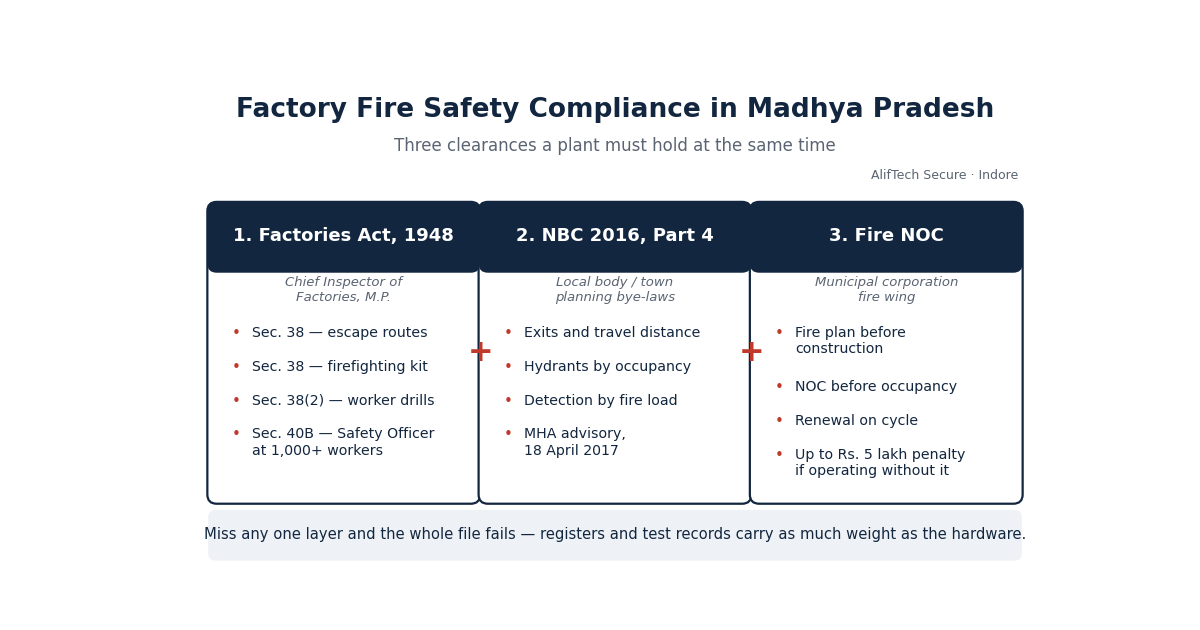
Section 38 of the Factories Act, 1948 is the base. It requires every factory to take “all practicable measures” to prevent outbreak and spread of fire, and to provide and maintain safe means of escape plus the equipment to fight a fire. Sub-section (2) adds that workers must be familiar with the escape routes and trained in the routine.
Section 40B separately requires a Safety Officer wherever 1,000 or more workers are ordinarily employed.
Above it sits the National Building Code. The Ministry of Home Affairs’ fire services directorate records an advisory of 18 April 2017 asking all states to put NBC 2016 Part 4, “Fire and Life Safety”, into their building bye-laws. The Code is recommendatory on its own. Once a state folds it into bye-laws, it binds.
Indian Standards fill in the detail: IS 2189 for detection and alarm, IS 2190 for portable extinguishers. Then the state layer — the M.P. Factories Rules 1962, which prescribe the forms, registers and inspection procedure under the Act.
| Instrument | Who enforces it | What it demands |
|---|---|---|
| Factories Act 1948, Sec. 38 & 40B | Chief Inspector of Factories, MP | Escape routes, firefighting equipment, worker training, Safety Officer above 1,000 workers |
| NBC 2016 Part 4 (via state bye-laws) | Local body / town planning | Building design, exits, hydrants, detection by occupancy class |
| Fire NOC (MP fire services) | Municipal corporation fire wing | Approved fire plan before construction, NOC before occupancy |
| IS 2189 / IS 2190 / IS 15683 | Referenced in tenders and audits | Detector spacing, extinguisher type and rating, maintenance intervals |
What decides the cost of a compliant fire safety system?
A compliant system costs what your occupancy class and built-up area demand, not what the brand costs. National Building Code 2016 Part 4 puts factories in Group G, industrial occupancy, split into G-1 low hazard, G-2 moderate and G-3 high hazard. That subdivision and your floor area decide whether you stop at detection and extinguishers or must add a hydrant ring, pump house and sprinklers.
Three drivers move the number most: how many detection zones you need, whether a hydrant ring and pump house are required, and how much conduit must be pulled through a running building. Retrofitting into a live plant always costs more than building it in.
AlifTech Secure takes on integrated safety and security projects from a minimum project value of Rs. 40,000, and every invoice is a GST invoice, so the tax paid is available as Input Tax Credit against your business.
| Layer | What it does | Usual trigger to add it |
|---|---|---|
| Portable extinguishers | First response within seconds | Every factory, without exception |
| Detection and alarm panel | Warns everyone before smoke reaches the floor | Any enclosed production or storage area |
| Hydrant and hose reel | Sustained water at pressure | Larger built-up area or high fire load |
| Sprinkler or suppression | Controls fire without a human present | Warehousing, server rooms, high-value stock |
| Emergency lighting and signage | Keeps the escape route usable in smoke | Any building with an internal exit path |
How do you get a factory fire NOC without losing three months?
A factory fire NOC here is issued in two stages. The fire plan is approved alongside the building permission, before construction starts. Then, once the building is up and the system has been inspected on site, the local body’s fire wing issues the occupancy NOC, renewed on the cycle your municipal corporation prescribes. What delays owners is rarely the fire department. It is the file.
Get the plan approved before you build
The fire plan is scrutinised against the building drawing. If the shed is already up and the exit widths fall short, the fix is civil work, not paperwork.
Match the drawing to the site
The commonest rejection is a drawing that no longer matches reality: a partition added, a door blocked by racking, a mezzanine never drawn back in. Walk the site with the drawing in hand.
Keep the registers from day one
Drill records, refill dates, panel test logs. Ten minutes a month, and the difference between a smooth renewal and a re-inspection. Put the fire system on an annual maintenance contract.
Do not treat the NOC as the finish line
When the MP assembly passed the fire safety bill with fines up to Rs. 5 lakh, it also provided up to Rs. 50,000 for neglecting prescribed measures and Rs. 5,000 a day for continuing violations.
What actually goes wrong on factory sites in Indore and Pithampur?
Dhar district, which contains the Pithampur belt, is dense with manufacturing — the district administration’s own profile lists 1,406 industrial units in production, employing 101,508 people. Fires here are rarely exotic. They start in a panel board, in stored packaging, or during welding near something nobody moved.
Across 585+ AlifTech installations since 2012, one pattern dominates this belt. A detection system is sized for the building as designed, then never re-zoned after the plant grows. A new storage bay goes up along the boundary wall and sits outside every detection loop. On paper the system is compliant. In practice there is a blind zone. We find it by walking the detection drawing against the current floor layout before quoting anything.
The second pattern is dust. Indore’s dry season loads detectors quickly, and units grinding or packing powder foul smoke sensors far faster than the manual assumes. Heat detectors belong in those bays. See how the specification shifts by sector across the industries we serve.
Key Takeaways
- Factory fire safety compliance in MP is one file, not three errands — Act, code, NOC.
- Section 38 makes worker fire training a legal duty — run drills and record them.
- Submit the fire plan with the building permission; retrofitting exits is civil work.
- Re-zone detection every time the plant layout changes, not when the licence expires.
- Pick detector type by process — heat detectors where dust or fumes are heavy.
- Keep refill, test and drill registers current; they carry more weight than new hardware.
Frequently Asked Questions
Is a fire NOC compulsory for every factory in Madhya Pradesh?
Effectively yes for any factory building needing an occupancy clearance. The bill passed by the MP assembly in July 2026 provides for mandatory fire plan approval and a fire NOC, with penalties up to Rs. 5 lakh for operating without one. Confirm the commencement date with your local fire authority before assuming it applies to your renewal.
Does the Factories Act require fire drills?
Yes. Section 38(2) of the Factories Act 1948 requires effective measures so all workers are familiar with the means of escape and adequately trained in the routine to be followed. In practice that means scheduled drills with a signed register the inspector can read.
When does a factory need a full-time Safety Officer?
Section 40B of the Factories Act 1948 requires Safety Officers where 1,000 or more workers are ordinarily employed. It also applies where the process carries risk of bodily injury, poisoning, disease or other health hazard. The state government prescribes qualifications and duties.
Is the National Building Code legally binding on my factory?
The Code is recommendatory in itself. It binds once a state writes it into building bye-laws. That is what the Ministry of Home Affairs asked states to do for NBC 2016 Part 4, in its advisory of 18 April 2017. Check your local body’s bye-laws.
How often should extinguishers and alarm panels be checked?
Follow the manufacturer’s schedule and IS 2190 for extinguishers, with visual checks monthly and refilling as specified. Alarm panels should be function-tested on a fixed cycle and the result logged. An annual maintenance contract makes this routine instead of something remembered before an inspection.
What is the fastest way to fix an old factory that was never compliant?
Start with a survey that maps fire load, exits and existing equipment against the code. Fix escape routes and detection coverage first, since those carry the most weight in an inspection, then phase suppression. A staged plan is usually accepted; an unplanned shutdown is not.
The bottom line
Factory fire safety compliance in MP rewards owners who treat it as a running system, not a one-time approval. The law now has teeth, and the paperwork trail matters as much as the hardware on the wall. None of it is complicated — a correct survey, the right detection for your process, honest registers and a maintenance schedule carry you through almost any audit. The factories that struggle grew faster than their fire plan did.
Written by Usman Gani, Founder & Director, AlifTech Secure. AlifTech Secure has completed 585+ ELV and safety installations across Madhya Pradesh since 2012, including 10,000+ cameras, and works with 100+ partner brands. Published 27 August 2026. This article is general guidance, not legal advice — confirm current requirements with your local fire authority and factory inspectorate.

