
Most owners in Indore treat MP Fire Services Act compliance as a one-time NOC errand. That reading is out of date. Madhya Pradesh now has its own fire statute. The Governor signed it on 31 August 2026. It brings penalty ceilings up to Rs 5 lakh, a supervisor you have to name, and a duty to keep your kit working.
There is a catch. The Act is not in force yet. Section 1(3) says it starts on a date the State Government must notify, and different areas may get different dates. So you have time. You do not have a reason to wait.
Quick answer: The Madhya Pradesh Agnishaman Evam Apatkalin Sevayen Adhiniyam, 2026 is Act No. 16 of 2026. The Governor assented on 31 August 2026. Section 1(3) says it begins only when the State Government notifies a date. The ceiling for holding no fire safety certificate is Rs 5 lakh.
TL;DR
- MP’s fire law is Act No. 16 of 2026, signed but not yet in force.
- Section 14 lets the authority seal a dangerous building, after a hearing.
- Section 12(3) makes the fire safety certificate the owner’s own duty.
- No occupancy certificate until the fire measures are in place.
- No certificate: the penalty may reach Rs 5 lakh, plus Rs 10,000 a day.
- Day-to-day control sits with your urban local body, not with Bhopal.
What is the new MP fire law, and has it started yet?
It is a State Act that is signed but not switched on. Its legal name is the Madhya Pradesh Agnishaman Evam Apatkalin Sevayen Adhiniyam, 2026, or in English the Madhya Pradesh Fire and Emergency Services Act. So the term people search for is not the legal name, which matters at the counter.
The dates are on the record. The MP Vidhan Sabha list of bills passed in 2026 shows the bill came in on 20 July 2026, passed on 21 July and took assent on 31 August. The Act as printed in the MP Gazette (PDF, 2 MB) carries 3 September 2026.
Section 1(3) of Act No. 16 of 2026 says the Act “shall come into force on such date, as the State Government may, by notification in the official Gazette, appoint”. The clause also lets the State fix different dates for different areas and parts.
On 3 November 2026 we could not confirm a start notice, or any rules under Section 34. The MP gazette portals were down when we checked. Treat the Act as not yet started, and confirm with your local body.
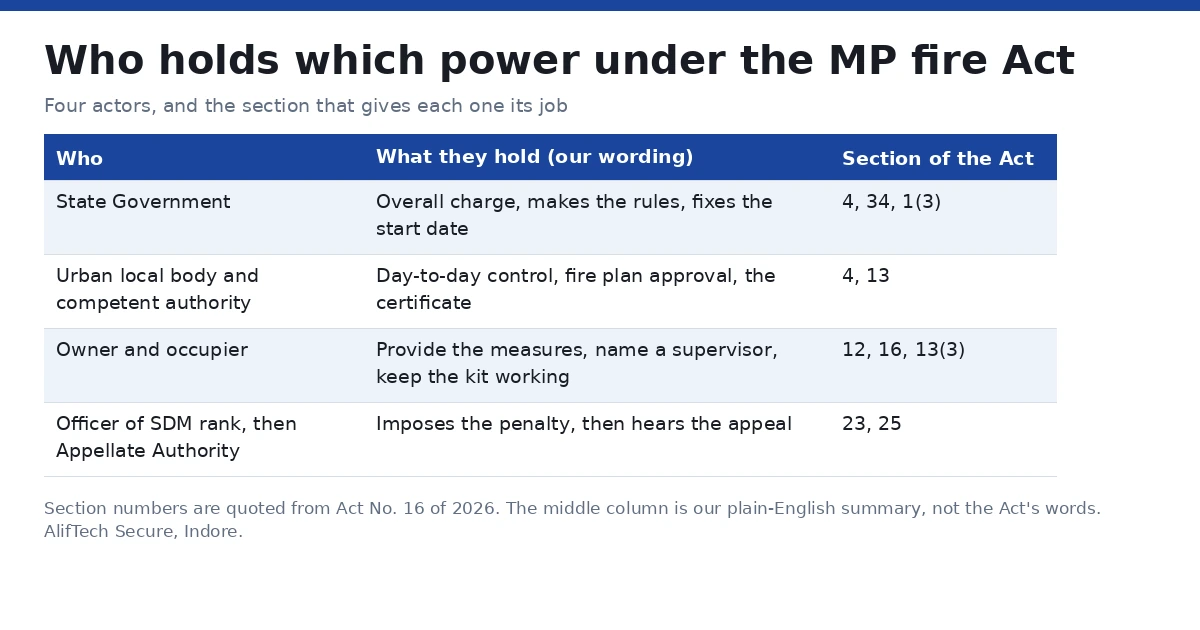
Who does the Act hold responsible, the owner or the occupier?
The Act names both, and often holds them together. Section 12(1) puts the duty to provide fire and life safety measures on “the owner or the occupier, who are either individually or jointly responsible for a building”. A landlord cannot send the tenant alone to the hearing, and a tenant cannot blame the landlord.
Three duties flow from that. Under Section 12(3) the owner shall get fire plan approval or a fire safety certificate. Section 13(1) sets the route. You apply, the authority checks your building against Section 12 and the rules, then issues the approval or certificate in a time the rules will fix. Section 16 then adds a fire safety supervisor, trained as the rules will prescribe, named by owner and occupier alike, plus a compliance report. The kit itself must stay “at all times” in optimal working order, under Section 13(3).
That line changes habits. A panel that passed in March and sits in fault in October is a live breach, not a pending job. Section 21 then widens the net. Where a company offends, the person in charge of the business and the company are both treated as guilty, after a hearing.
Which buildings will need a fire safety certificate?
The Act does not list them. It hands that job to rules and notices, so today the honest answer is a range. Section 12(3) even lets the State Government leave any building out of the certificate net. Until those rules land, the national standard shows where the bar sits.
That standard comes from the Bureau of Indian Standards. The fire part was Part 4 of the National Building Code of India 2016, which BIS still lists as SP 7:2016 on a page last updated in December 2018. The 2026 revision renames the work National Building Construction Standards and the fire part Part F. Its opening page calls fire services a State subject, and a municipal function under Article 243(w) of the Constitution. That is why a State Act was needed.
| Occupancy | Height above which it applies | Floor area above which it applies |
|---|---|---|
| Residential | 24 m | 750 sq m |
| Educational | 9 m | 500 sq m |
| Institutional | 15 m | 500 sq m |
| Assembly | 9 m | 750 sq m |
| Business | 15 m | 750 sq m |
| Mercantile | 15 m | 1,000 sq m |
| Industrial, low or moderate hazard | Any height | 2,000 sq m total |
| Industrial, high hazard | 15 m | 500 sq m |
| Storage or hazardous | 9 m | 500 sq m |
| Mixed use | 15 m | 1,000 sq m |
Read Table 1 as a guide, not a rule. Clause 1.2 of the BIS fire and life safety standard (PDF, 5 MB) adds that a “State/Local Authority may consider modifying the above values depending on the fire vulnerability and preparedness”, and calls this Part “only for guidance and referral”.
What does getting it wrong cost under the new Act?
MP Fire Services Act compliance carries penalty ceilings from Rs 10,000 to Rs 5 lakh. Every amount in Section 18 is worded “may extend upto”. That makes each one a ceiling, not a fixed fine you pay on the spot. The Act also bars any penalty order unless you are first given a fair chance to be heard.
Worse than any fine: Section 14 lets the competent authority seal a building it finds dangerous to life or property, after a hearing, and order the occupants out.
| What went wrong | Section | Ceiling | If it continues |
|---|---|---|---|
| No fire plan approval or fire safety certificate | 18(8) | Rs 5,00,000 | Up to Rs 10,000 a day |
| Breaking a seal placed under Section 14 | 18(5) | Rs 5,00,000 | Not stated |
| No fire prevention and life safety measures | 18(4) | Rs 1,00,000 | Up to Rs 5,000 a day |
| Blocking firefighting staff | 18(7) | Rs 1,00,000 | Not stated |
| Not clearing fire-risk goods a fire officer directed you to remove | 18(3) | Rs 50,000 | Up to Rs 5,000 a day |
| A false report of a fire | 18(1) | Rs 20,000 | Not stated |
| Refusing water from a source you control during firefighting | 18(2) | Rs 15,000 | Up to Rs 3,000 a day |
| No fire safety supervisor within 30 days of notice | 18(6) | Up to Rs 10 per sq m, common areas counted | Up to Rs 10,000 a day |
| Anything else with no stated penalty | 18(9) | Rs 10,000 | Not stated |
Two clauses decide how a penalty lands. It is imposed by an officer not below the rank of Sub-Divisional Magistrate, so the first decision is administrative. If the demand is unpaid fifteen days after notice, Section 32 allows recovery with costs and interest. That can reach sale of goods or attachment of property. An appeal goes to the Appellate Authority within thirty days, and its word is final.
How should an owner prepare before the Act commences?
Work on what will not change when the rules land.
- Find your current file. Pull the last fire approval, the drawing behind it, and its date. In our files, disputes start with a missing drawing more often than missing hardware.
- Measure against Table 1. Height and area decide whether the standard touches you.
- Pick your supervisor now. Section 16 wants a trained person, and Section 18(6) allows 30 days from a notice.
- Clear known faults. Section 13(3) asks for working order at all times, so a dead sounder is a breach from day one.
- Keep the test log. A dated log is cheap. Keep it for the hearing.
Across 585+ AlifTech installations since 2012, the gap we find most often, in a Pithampur shed as much as an Indore showroom, is not missing hardware. It is a panel in permanent fault with its buzzer taped over, because one dusty detector kept going off. Under Section 13(3) the tape is the breach.
Factories keep an older layer. Our guide to factory fire safety compliance in MP covers the Factories Act, 1948 and the NOC side. Section 36 says this Act adds to that.
What will MP Fire Services Act compliance look like in Indore?
MP Fire Services Act compliance in Indore runs closer to home than Bhopal. Section 4 keeps overall charge with the State Government. Day-to-day control sits with the urban local body and the competent authority. Inside city limits that points at the Indore Municipal Corporation, and the bill came from the Urban Development and Housing department. So you deal with the people you already meet for building permission.
Money may arrive the same way. The fire tax in Section 27 is a surcharge on property tax, so in Indore it would land on a bill you already get.
Occupancy shapes the local picture too. On the Super Corridor a housing tower passes the 24 m line in Table 1 while it is still rising, so the BIS standard bites early. Section 12(2) then blocks the occupancy certificate until the measures MP notifies are done. In Pithampur the BIS standard turns on area: past 2,000 sq m, whatever the roof height. We see both tested across the industries we serve.
Key Takeaways
- Ask your local body in writing whether the Act is notified for you.
- Name a fire safety supervisor before a notice starts a 30-day clock.
- Clear every standing panel fault this quarter, not after it starts.
- Builders: budget the fire works before the occupancy certificate, not after.
- Start a dated test log now, or book a fire safety audit in Indore.
- Check your height and floor area against Table 1 before you buy kit.
Frequently Asked Questions
Is the MP fire law in force right now?
It is signed but not switched on. The Governor assented on 31 August 2026 and the assent was printed in the MP Gazette of 3 September 2026. Section 1(3) says the Act starts on a date the State Government notifies, and different areas may get different dates.
Does it replace the fire rules my building follows today?
Partly, and only once it starts in your area. Section 38 repeals any matching local law on the day the Act comes into force there, so far as matters this Act covers. Section 36 says the Act adds to other laws. Your factory and municipal duties do not vanish.
What is the biggest penalty in the Act?
Rs 5 lakh, and two things reach it. Section 18(8) covers not getting a fire plan approval or fire safety certificate, plus up to Rs 10,000 a day while it runs on. Section 18(5) covers breaking a seal. Both are ceilings, so an officer may charge less.
Who is a fire safety supervisor, and do I need one?
You need one if your building needs a fire safety certificate. Section 16 asks every owner and occupier to name a trained supervisor and send a compliance report. Section 18(6) sets a penalty of up to Rs 10 per square metre if you miss the 30-day deadline in a notice.
Can an outside agency do the paperwork for me?
Yes, if it holds a licence. Section 15 lets the Director licence a qualified agency skilled in fire, civil, mechanical or electrical engineering, industrial safety, disaster management or chemical science. Such an agency may file the fire plan, inspect when asked, give third party certificates and write audit reports.
Will there be a new fire tax in Indore?
Maybe, but not as a separate bill. Section 27 allows a fire tax only as a surcharge on property tax, in areas where the Act is in force, at a percentage the State Government decides. A building the State exempts pays nothing, and the Act sets no rate.
The bottom line
MP Fire Services Act compliance has moved from a municipal habit to a written duty with section numbers behind it. The Act is Act No. 16 of 2026, assented on 31 August 2026, and it now waits on a start notice that nobody can date for you.
Every item on the five-step list above is work you would do anyway. Doing it before the clock starts is cheaper than doing it after a notice. Get your drawing, supervisor and panel in order while the deadline is still yours. See our fire and security solutions for where that work begins.
Not sure whether your building crosses the height or area line? Call +91 9109106826 or ask us on WhatsApp for a free fire safety site survey. See what MP clients say about our work.

