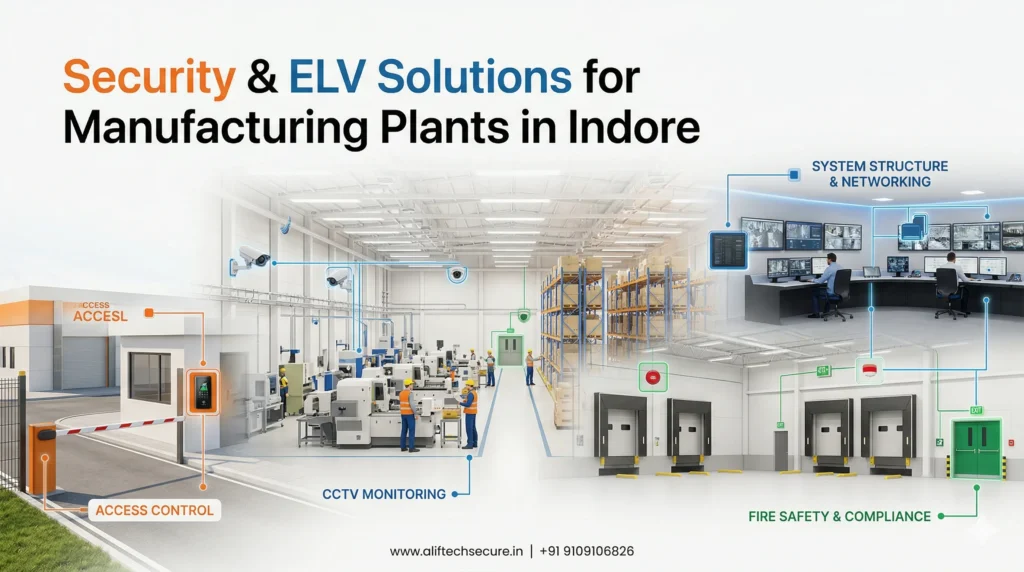
Security & ELV Solutions for Manufacturing Plants in Indore

Running a manufacturing facility is no small task. Managing shifts, tracking machinery, ensuring worker safety, and protecting raw materials all create an enormous operational load. Unfortunately, security tends to become an afterthought — until something goes wrong.


At AlifTech Secure, we work with manufacturing plants across Indore and Central India. We design and deploy integrated security and ELV (Extra Low Voltage) systems. We don’t simply sell equipment. Instead, we study your floor layout, your shift patterns, and your compliance requirements. Then we build a system that actually works for your plant.


Whether you run a small component unit or a large production facility, this page covers exactly what systems matter, why they matter, and how we implement them.

Real-World Security Challenges in Manufacturing Facilities

Most plant managers we speak to in Indore share the same concerns. Material theft — whether by outsiders or insiders — is one of the most common and quietly damaging problems. A few kilograms of copper wire or finished goods going missing every week adds up to significant losses over a year.

Unauthorised access to sensitive production areas, machinery zones, or chemical storage is another serious issue. When anyone can walk anywhere, it becomes very difficult to maintain accountability or prevent accidents. Similarly, in multi-shift operations, tracking who entered which zone at what time can be critical — especially after an incident.

Fire risks in manufacturing environments are higher than in most other settings. Dust, lubricants, electrical panels, and storage areas all carry ignition potential. Many plants still rely on manual fire watches or outdated smoke detectors that don’t meet current norms — and that creates liability.

Then there’s communication. A large plant with multiple departments, machine floors, admin blocks, and security posts needs a reliable internal communication system. Shouting across the floor or relying only on mobile phones doesn’t work during a real emergency or even for day-to-day coordination.

CCTV Surveillance Systems for Manufacturing Plants in Indore

A well-designed surveillance system for a manufacturing plant is very different from what you’d put in an office. You need cameras that can handle dust, heat, vibration, and varying light conditions — and you need placement that covers not just the main gate, but every movement point across the facility.

We typically work with HD IP cameras with vandal-proof and weatherproof ratings for outdoor and heavy-floor zones. For areas like chemical rooms, electrical rooms, or server spaces, we recommend specialised cameras with appropriate protection ratings. In areas where lighting is inconsistent, we use cameras with wide dynamic range or IR capability so footage stays usable around the clock.

We store camera footage on NVR systems with adequate capacity — usually calculated for a 30 to 60-day retention period. Plant managers and owners can access the system from anywhere via a mobile app or desktop interface. Furthermore, we set up motion-based alerts so your security team receives instant notifications when movement occurs in restricted zones after hours.

Key Coverage Points We Plan For

  • Main entry/exit gates and vehicle lanes
  • Production floor and machine zones
  • Raw material stores and finished goods warehouse
  • Electrical rooms, server areas, and chemical stores
  • Loading/unloading docks
  • Perimeter and parking areas
  • Admin blocks, canteen, and common areas

Access Control & Biometric Systems

In a manufacturing plant, not everyone should have access to every area. A production worker doesn’t need to enter the quality lab. An outsider visiting for a meeting shouldn’t be able to walk onto the floor unescorted. Access control systems enforce these boundaries automatically — without depending on a security guard to remember every policy.

We install biometric readers, RFID card-based systems, or a combination of both — depending on your requirement and the sensitivity of each zone. Entry to restricted areas gets logged automatically, giving you a clear, time-stamped record of who accessed what and when. If there’s ever an incident, this data is invaluable.

For plants that run multiple shifts, the system can also enforce shift-based access — so night-shift workers can’t enter during the day without proper authorisation. Visitor management is another module we often set up alongside this, giving you a formal process for logging visitors, issuing temporary passes, and tracking their movement while on-site.

Fire Alarm & Safety Systems — Compliance and Beyond

Fire safety in a manufacturing environment isn’t just a legal requirement — it’s the difference between a contained incident and a catastrophic loss. We design and install fire alarm systems that are appropriate to your specific industrial setting, using detectors suited to the type of risk in each zone.

In areas with smoke from welding or machining, heat detectors are more suitable than smoke detectors. In chemical storage zones, gas detection may be required. Outdoor or dusty environments need beam detectors or aspirating systems. This level of nuance matters — a wrong detector type leads to constant false alarms, which causes people to stop taking the system seriously.

Our installations comply with NBC (National Building Code) norms and relevant IS standards. We prepare full documentation — important if your facility undergoes factory licensing renewal, insurance audits, or third-party safety assessments. We also run training sessions for your safety team during commissioning.

What a Complete Fire Safety System Includes

  • Smoke, heat, and multi-sensor detectors as per zone risk
  • Manual call points at emergency exits and key locations
  • Fire alarm control panel with zone-wise indication
  • Hooters, strobes, and PA announcements for evacuation
  • Integration with access control for automatic door releases
  • Monthly testing and annual maintenance under AMC

Intrusion Alarm Systems for After-Hours Plant Security

Even with CCTV running 24/7, you need an active detection system that alerts your security team when someone enters a zone they shouldn’t — especially after working hours. Intrusion alarm systems use PIR (Passive Infrared) sensors, door/window contacts, vibration sensors, and perimeter beam detectors to create a real-time alerting layer.

When the system detects a breach, it triggers a loud local siren and simultaneously sends an alert to the security control room and — if configured — to a central monitoring station. This kind of layered response is important for large plants where a single guard cannot physically cover the entire perimeter.

We design intrusion alarm zones to match your facility layout, so you know exactly where a breach has occurred without ambiguity. The system can also be armed and disarmed zone-by-zone, which is useful for multi-shift operations where some parts of the plant remain active while others are secured.

IP-PBX, Intercom & Communication Systems

Large manufacturing facilities need structured internal communication — not just mobile numbers shared in a WhatsApp group. A properly configured IP-PBX or EPABX system gives every department, supervisor station, and security post a dedicated extension, making internal coordination much faster and more reliable.

For plants that have separate blocks or shop floors spread across a large area, we also install industrial-grade intercom systems at key points. This ensures that even someone standing on the production floor near noisy machinery can reach the security desk or admin office quickly in case of an emergency.

These systems also work alongside your fire alarm and public address systems. In an emergency, a single command from the control room can broadcast an evacuation announcement across the entire facility — a capability that can save lives.

Industrial Networking & IT Infrastructure

Modern security and ELV systems rely on a robust network infrastructure to function properly. IP cameras, access control panels, fire alarm systems, and attendance terminals all communicate over the network — and if that network is unreliable or poorly structured, the entire security ecosystem suffers.

We design and implement structured cabling and networking infrastructure specifically for industrial environments, where cable runs are longer, environments are harsher, and uptime requirements are much higher. We use industrial-grade switches, proper cable management, and segregated VLANs to keep your security network isolated and stable.

For plants where Wi-Fi coverage is needed across a large area — for mobile barcode scanners, attendance systems, or wireless cameras — we do a proper RF site survey and deploy enterprise-grade access points for reliable wireless coverage without dead zones.

GPS Tracking & Fleet Management for Manufacturing Operations

If your manufacturing business has a our fleet GPS of delivery vehicles, raw material trucks, or company vehicles, GPS tracking gives you full visibility into where your vehicles are at any point in time. This matters for route optimisation, driver accountability, and ensuring that material reaches its destination without unnecessary delays or deviations.

We install GPS tracking devices on your vehicles and connect them to a web-based fleet management dashboard. You can see live locations, review trip history, get overspeed alerts, and monitor idle time. For larger fleets, we can also set up geo-fencing alerts — so you’re notified if a vehicle leaves a defined area or reaches a specific location.

Our End-to-End Services for Manufacturing Clients

What sets AlifTech Secure apart from most vendors is that we stay involved from the very first conversation to the day the system goes live — and well beyond that. We don’t hand over equipment and disappear.

We start with a site survey and consultation, where we walk through your facility, understand your specific risks, and map out a system design. This includes camera placement drawings, zone layouts, cable routing plans, and a bill of material — all before any work begins. You know exactly what you’re getting before you sign off.

Our installation teams are trained on all major brands and system types. We handle structured cabling, device mounting, panel programming, and system integration in-house — with minimal disruption to your operations. After installation, we provide commissioning documentation and basic training for your team.

Finally, we offer Annual Maintenance Contracts (AMC) covering periodic servicing, software updates, remote support, and emergency response. For manufacturing plants where systems run continuously in demanding conditions, an AMC ensures you catch issues before they become failures — rather than after an incident occurs.

Our service offering at a glance:

  • Site survey, risk assessment and system design
  • Equipment supply from trusted brands
  • Professional installation and commissioning
  • System integration across all ELV sub-systems
  • Staff training and handover documentation
  • Annual Maintenance Contracts (AMC)
  • Remote monitoring support and emergency response

Why Choose AlifTech Secure?

We distinguish ourselves by staying involved from the initial survey to long-term maintenance. Our team understands that a camera angle for a parking lot is useless on a high-speed production line. We design for your specific environment.

  • Site Surveys: We map every cable route and camera angle before work begins.

  • Professional Setup: Our in-house teams handle installation with minimal downtime.

  • Ongoing Support: Our Annual Maintenance Contracts (AMC) ensure your system never goes offline when you need it most.

Frequently Asked Questions

Q1. We already have some old cameras installed. Do you replace them entirely or can you work with existing hardware?

It depends on the condition and compatibility of the existing equipment. In many cases, we can retain functional cameras and integrate them into a new, upgraded system. We’ll assess what you have during the site visit and recommend the most cost-effective approach — whether that’s a partial upgrade or a full replacement.

Q2. How long does it take to install a complete security system for a manufacturing plant?

For a mid-size facility, a full installation covering CCTV, access control, fire alarm, and networking typically takes 2–4 weeks, depending on the size of the plant and the complexity of the system. We plan the project in phases to ensure there’s no major disruption to your operations.

Q3. Is fire alarm installation mandatory for manufacturing units in Madhya Pradesh?

Yes, fire safety systems are mandatory under the Factories Act and are typically required during factory license renewal. The exact requirements depend on the type of manufacturing activity, the size of the facility, and the category of goods produced. We help you understand what’s required for your specific unit and design a compliant system accordingly.

Q4. Can the CCTV system be viewed remotely from our head office or my phone?

Absolutely. All IP-based CCTV systems we install support remote viewing via a secure mobile app or web interface. You can view live feeds, play back recorded footage, and receive motion-based alerts from anywhere — whether you’re at your head office, at home, or travelling.

Q5. What is an AMC and do we really need one for a manufacturing plant?

An AMC (Annual Maintenance Contract) covers scheduled servicing of all installed systems, software updates, remote support, and on-site response for breakdowns. For a manufacturing plant where systems run continuously in demanding conditions, an AMC is strongly recommended. It ensures your systems stay functional, and any issues are caught before they become failures — rather than after an incident occurs.

Q6. Can access control be integrated with our existing attendance or HR system?

In many cases, yes. Modern access control systems support integration with HR and payroll software via standard APIs or export formats. This means your entry/exit data can flow directly into your attendance records, reducing manual data entry. We assess your existing HR system during the design phase and advise on the best integration approach.

Q7. Do you provide service support after installation, or only during the warranty period?

We provide ongoing support well beyond the warranty period through our AMC plans. Our AMC clients get scheduled quarterly maintenance visits, remote troubleshooting support, and priority response for service calls. We’ve maintained relationships with many of our manufacturing clients for several years — that’s the kind of partnership we aim for.

© AlifTech Secure | Indore, Madhya Pradesh | https://aliftechsecure.in/