
Security & Safety Solutions for Hospitals and Healthcare Facilities in Indore

A hospital is one of the most complex places to secure. It stays open around the clock, looks after vulnerable patients, stores controlled medicines and costly equipment, and runs with hundreds of staff across many departments — all at the same time.

Security in a hospital is not just about stopping theft or trespassing. It is about creating a safe, calm space where patients can heal, staff can work without fear, and sensitive areas like ICUs, pharmacies, and operation theatres stay protected at all times.

At AlifTech Secure, we work with hospitals, clinics, diagnostic centres, and nursing homes across Indore to design and install security and ELV systems built for healthcare. This page walks you through the key challenges, the systems that solve them, and how we approach every project.
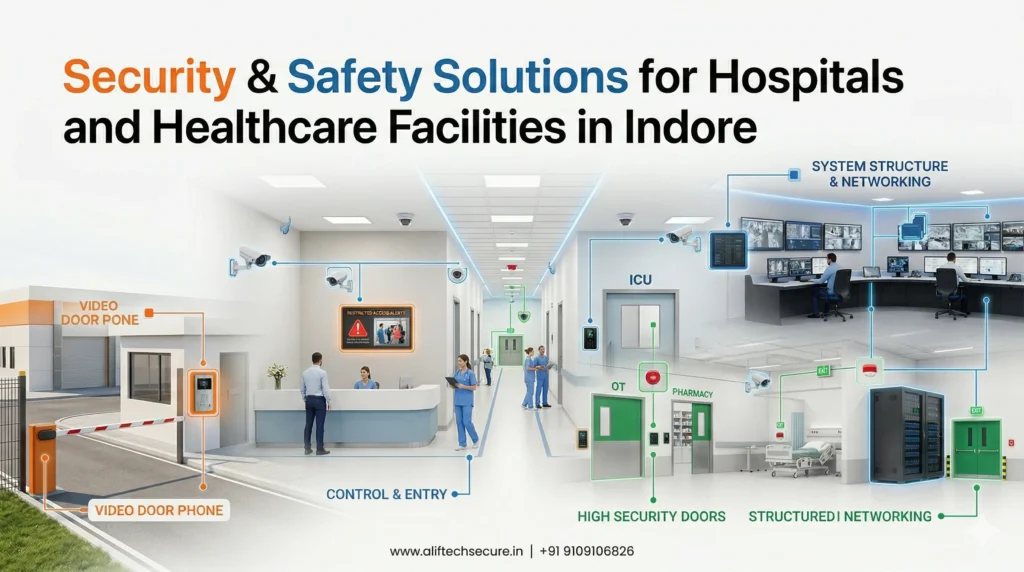
Security Challenges Unique to Hospitals and Healthcare Facilities

Unauthorised Access to Restricted Areas

One of the most common problems hospital managers face is people entering areas they should not. Visitors sometimes wander into ICUs, neonatal units, or OT corridors out of worry or confusion. In serious cases, this puts the sterile environment at risk and endangers patients. Without a proper access control system, enforcing these boundaries depends entirely on staff availability — which is never guaranteed.

Medication Theft and Pharmacy Security

Medication theft is a real and growing concern. Pharmacy stores, medicine dispensing rooms, and narcotic storage areas are high-risk zones. They need controlled entry and a clear record of who accessed them and when. However, many hospitals we visit in Indore still rely on manual registers for this — which is both unreliable and inadequate for compliance.

Violence Against Healthcare Staff

Violence against hospital staff has become an increasingly reported problem across India, including in Madhya Pradesh. Doctors, nurses, and admin staff sometimes face aggressive behaviour from distressed family members, especially during emergencies. As a result, having visible cameras, controlled entry at sensitive points, and a quick-response alert system makes a significant difference to staff safety and confidence.

Fire Safety in a Healthcare Environment

Fire safety is especially critical in hospitals. Patients in ICUs or operation theatres cannot evacuate on their own. Therefore, a hospital fire alarm system must not only be reliable — it must be smart enough to alert the right people without causing unnecessary panic, and designed so that evacuation can happen zone by zone.

CCTV Surveillance Systems for Hospitals in Indore

Surveillance in a hospital needs careful thought about placement, privacy, and coverage. You need clear visibility in corridors, reception areas, car parks, and service zones. However, cameras near patient wards or consultation rooms need very specific positioning that respects patient dignity and follows privacy norms.

We install HD IP cameras across all common areas, entry and exit points, stairwells, lifts, pharmacy zones, and the hospital perimeter. For areas with low or changing light — like overnight corridors or basement parking — we use cameras with infrared or low-light capability so footage stays clear and usable at any hour.

All footage is stored on NVR systems with enough capacity for 30 to 60 days of retention. Hospital managers and security teams can access live feeds and recorded footage remotely via a secure app or browser. In addition, motion-based alerts can be set up for high-risk zones like the pharmacy, equipment store, or server room — so your security team is notified the moment something unusual is detected.

Typical Camera Coverage in a Hospital

Main entrance, reception, and visitor waiting areas

Emergency and casualty entry points

OT corridors, ICU entry, and neonatal unit access

Pharmacy, medicine store, and dispensing areas

Stairwells, lifts, and all internal corridors

Car park, ambulance bay, and perimeter

Admin offices, cash counters, and server rooms

Staff entry and exit points

Access Control and Biometric Systems for Healthcare Facilities

In a hospital, controlled access protects patients just as much as it protects property. Restricting the ICU, OT complex, neonatal ward, and pharmacy to authorised staff only reduces infection risk, prevents interference with patients, and cuts medication theft — all through one system.

We design zone-based access control where each area of the hospital has a defined access level. Doctors, nurses, admin staff, and support staff each get access profiles that match their role. A housekeeping worker can enter patient corridors but not the pharmacy. A visiting consultant can reach OT corridors only during scheduled hours. This level of control is simply not possible with physical keys or manual security.

Visitor Management

For hospitals with multiple entry points and high visitor traffic, we also set up visitor management systems at reception. Visitors register their identity, receive a temporary pass, and their entry and exit are logged automatically. This is increasingly required during NABH accreditation, and we make sure the system meets those documentation standards.

Key Features of Our Hospital Access Control Systems

Biometric and RFID-based access for all restricted zones

Role-based access profiles for different staff categories

Time-based access rules for visiting consultants and contractors

Visitor registration, temporary pass issuance, and auto-logging

Full audit trail of zone entry and exit for compliance

Integration with CCTV for visual verification at entry points

Fire Alarm and Safety Systems Designed for Healthcare

Why Hospitals Need a Different Approach

Fire safety in a hospital is a category of its own. You cannot simply install standard smoke detectors and consider the job done. A hospital fire alarm system must account for the fact that many patients may be unable to move, sedated, or connected to life-support equipment. Furthermore, panic during an evacuation can be as dangerous as the fire itself.

Addressable Panels for Zone-by-Zone Control

We design hospital fire alarm systems using an addressable fire alarm panel. Each detector is individually identified. When an alarm triggers, the panel shows exactly which device activated and in which zone — so the response team knows precisely where to go, without sending the whole facility into panic. As a result, evacuation can be managed floor by floor or zone by zone, with staff guiding patients in an orderly way.

The Right Detector for Every Zone

For areas like OTs, ICUs, and kitchens, we choose detector types based on the specific risks in each space. Beam detectors work well in large open areas such as atriums or assembly halls. Heat detectors are preferred in generator rooms and kitchens, where smoke from normal operations could cause false alarms. In laundry and linen storage areas, multi-sensor detectors add an extra layer of reliability.

All our fire alarm installations comply with NBC norms and IS 2189 standards, which are commonly checked during hospital licensing and accreditation. We provide complete as-built drawings, test certificates, and maintenance records — documentation that hospital administrators genuinely need during inspections.

What Our Hospital Fire Safety Systems Include

Addressable fire alarm control panel with zone-wise display

Smoke, heat, and multi-sensor detectors as per zone risk

Manual call points at all emergency exits and stairwell entries

Hooters, strobes, and voice evacuation PA for controlled response

Automatic door release for fire-rated doors

Integration with lifts for automatic ground-floor recall

Full documentation for NABH, factory inspection, and insurance

Nurse Call Systems and IP-PBX Communication for Hospitals

Internal communication in a hospital is life-critical. A patient in distress must be able to alert nursing staff instantly. A ward nurse needs to reach the duty doctor without walking down two corridors. The emergency room needs to talk to the pharmacy, the OT, and the admin desk at the same time — and all of this must work reliably, every single time.

We install nurse call systems in patient wards, ICUs, and recovery rooms. A single button press alerts the nursing station with the bed number, and a response can be sent back. For ICUs and high-dependency units, we use more advanced systems where each call is also logged with a timestamp for compliance and quality review.

Alongside nurse call, we set up IP-PBX systems that give every department its own extension — pharmacy, radiology, emergency, OT, front desk, and security — all reachable through a clear internal directory. This reduces the chaos of everyone relying on personal mobile numbers and ensures that in an emergency, the right person is reached within seconds.

Intrusion Alarm and Perimeter Security

Most hospitals have a staffed main entry during the day but find it hard to fully monitor at night. After visiting hours, secondary access points — side entrances, service doors, stairwell exits — can become entry points for trespassers if not properly secured.

We install intrusion alarm systems that cover all secondary access points with door contacts and motion sensors. When a secured door opens outside permitted hours, an alert goes immediately to the security desk and optionally to a duty manager’s phone. For larger hospital complexes, perimeter beam detectors can be added to actively monitor the outer boundary.

For hospitals where staff safety is a concern, panic alarm buttons can also be placed at key locations — reception, pharmacy, cash counters, and nursing stations. These give staff a discreet way to trigger a security alert without making a situation worse.

Video Door Phones and Smart Entry Management

For smaller clinics, nursing homes, and specialist centres, a video door phone at the main entrance lets staff visually check a visitor before allowing entry — without leaving the reception desk. This is a simple but effective layer of security that is often overlooked in smaller healthcare facilities.

For larger hospitals, we combine video door phones at secondary entrances with the central access control system. As a result, all entry points are managed from a single interface. Night-time entry for authorised staff is handled through biometric or card-based verification at the door, with every entry event recorded on video.

IT Infrastructure and Networking for Healthcare Facilities

A modern hospital runs on its network. Electronic health records, PACS systems for radiology, billing software, diagnostic equipment interfaces, and security systems all depend on a stable, well-structured network.

We design and install structured cabling and networking for healthcare facilities. We make sure the clinical network, admin network, and security network are kept separate. This prevents a failure or breach in one part of the network from affecting the others — which is especially important where clinical systems are involved.

We also plan for reliable Wi-Fi coverage across the facility. This is increasingly needed for mobile nurses using tablet-based patient management tools, wireless nurse call extensions, and visitor Wi-Fi access that stays separate from clinical systems.

Our End-to-End Services for Healthcare Clients

Minimal Disruption During Installation

We approach every healthcare project knowing that the facility cannot be disrupted. Hospitals run around the clock, and the systems we install are often near active patient zones. Consequently, our teams plan every stage to reduce impact on clinical spaces and work in phases that respect the facility’s schedule.

From Site Survey to Handover

We begin with a detailed site survey and consultation. We learn the facility layout, department structure, staff movement patterns, and the specific compliance needs — whether for NABH, state licensing, or insurance. From this, we produce a detailed system design with drawings, zone maps, and a clear bill of materials.

After installation and commissioning, we provide full documentation, staff training, and handover support.

Priority AMC for Healthcare Clients

Our Annual Maintenance Contracts for healthcare clients include priority response SLAs. In a hospital, a failed camera or a broken access reader is not a minor issue — it is a security gap that must be fixed the same day. We treat it accordingly.

Our Service Offering for Hospitals and Healthcare Facilities

Site survey, risk assessment, and system design with drawings

Equipment supply from trusted, warranted brands

Professional installation with minimal disruption to operations

System integration — CCTV, access control, fire alarm, intercom

Staff training and complete handover documentation

NABH and compliance-ready documentation packages

Priority-response Annual Maintenance Contracts (AMC)

Why Healthcare Facilities in Indore Trust AlifTech Secure

Healthcare security is not a field where a general vendor can show up with cameras and cable. It needs sensitivity to the environment, an understanding of compliance rules, and the ability to work inside a live facility without causing disruption. These are things we have learned through direct experience with hospitals and healthcare clients across Indore.

We understand what healthcare accreditation documentation actually requires — and we design our installations so that the test reports, system drawings, and maintenance records we provide genuinely support your compliance process rather than adding to your paperwork.

Our AMC clients in the healthcare sector receive scheduled quarterly servicing visits, remote monitoring support, and a committed response time for service calls. We know a hospital cannot wait two days for a faulty camera to be fixed — so we do not make them wait.

We are a long-term partner to our healthcare clients, not a one-time installation vendor. Several hospitals and clinics in Indore have been with us for years. That continuity means we know your facility as well as you do — which makes every future upgrade or expansion faster and more efficient.

for all types of installation visit us

Frequently Asked Questions

Q1. Can cameras be installed near patient areas without breaking privacy rules?

Yes, with careful planning. Cameras in patient areas must be positioned to cover corridor access and nursing stations rather than directly facing patients. We follow healthcare-specific placement guidelines to ensure full coverage without compromising patient dignity or privacy. Moreover, all placements are discussed and approved during the design phase.

Q2. Is access control required for NABH accreditation?

NABH standards include requirements around environment safety, staff identification, and restricted area management. While NABH does not require a specific technology, having a structured access control system with audit logs strongly supports your compliance with relevant NABH criteria — particularly around medication safety and restricted zone management. We provide documentation aligned with these requirements.

Q3. We are a smaller clinic — do these systems make sense for us?

Absolutely. Even a small clinic or nursing home benefits from a basic CCTV system at the entrance, a video door phone for after-hours entry, and a simple fire alarm system. We design solutions that match the size and budget of your facility. You do not need a full hospital-scale system to meaningfully improve security. Furthermore, we can start small and scale as you grow.

Q4. Can the nurse call system connect with the IP-PBX or staff mobiles?

Yes. Modern nurse call systems can send alerts to nursing station panels, IP-PBX extensions, and even to staff mobile phones via a SIP-based app. This is particularly useful in smaller facilities where a dedicated nurse is not always at the panel. We assess your setup and recommend the right level of integration during the design stage.

Q5. How does a hospital fire alarm system differ from a regular commercial one?

The key difference is in how the system responds and communicates. A hospital system uses addressable panels that identify the exact detector location. This allows zone-by-zone evacuation rather than a single full-facility alarm. In addition, voice evacuation announcements replace or support standard hooters — this keeps staff informed and reduces panic. Detector types are also chosen based on the specific risks in each zone, from the kitchen to the OT to the laundry.

Q6. What happens to the security systems during a power failure?

All our installed systems include UPS backup. This ensures that cameras, access control panels, fire alarm systems, and communication equipment continue to work during power cuts. For critical hospital systems, we also recommend battery backup sized for a minimum of 4 to 8 hours of operation — configurable based on your requirements.

Q7. Do you handle projects for multi-floor hospital buildings?

Yes. Multi-floor hospital projects are something we handle regularly — from structured cabling across floors to zone-wise fire alarm design and access control for each department level. We plan cabling routes, riser management, and floor-level distribution carefully so the system is easy to maintain and expand as the facility grows.

© AlifTech Secure | Indore, Madhya Pradesh | https://aliftechsecure.in/