
Logistics GPS Tracking in Madhya Pradesh — What MP Fleet Operators Need in 2026
By AlifTech Secure | FleetNow GPS — Vehicle Tracking Solutions, Indore | July 2026 www.aliftechsecure.in
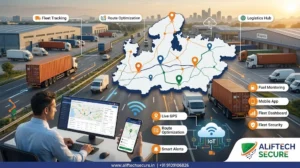
A transport owner in Indore runs trucks on three routes: Indore to Bhopal, Indore to Nagpur, Indore to Ratlam. Last month one truck dropped out of contact near Dewas for four hours. The driver said his phone died. The owner had no tracker, so he could not check the claim, could not confirm the goods were safe, and had nothing to hand the insurer when he filed the complaint.
Four hours of silence costs more than the device would have. This guide covers what MP routes actually demand from a tracking setup, what each feature earns you, and roughly what the whole thing costs.
TL;DR
- Dual SIM with BSNL matters more here than anywhere else, because private networks thin out across rural MP.
- Location tracking alone misses fuel theft. Only a tank-level sensor catches siphoning.
- AIS-140 certification is the legal floor, and the Vahan record matters as much as the device.
- Mineral transport carries an extra layer through the state’s Mahakhanij portal.
- A ten-truck fleet runs roughly ₹58,000 to ₹1 lakh in the first year, all in.
Why MP Routes Break Generic Tracking Setups
Madhya Pradesh is India’s second-largest state by area. Its freight corridors carry heavy daily volume out of Indore, and the Pithampur industrial belt feeds traffic toward Dewas, Ujjain and beyond. Those same corridors create problems that a generic tracker never sees in Gujarat or Maharashtra.
Network gaps swallow hours of tracking
Private 4G coverage holds up well on most Gujarat and Maharashtra highway stretches. MP has real gaps, particularly through the Narmadapuram belt and rural Vindhya sections.
A single-SIM 4G device simply goes dark there. Dual SIM devices switch to BSNL, which still reaches further into rural MP than most private operators, and keep the trail intact. This matters most on overnight runs, because a device that loses three hours of signal loses them during exactly the window when things go wrong.
Overnight hauls invite fuel siphoning
Long night runs from Indore toward Nagpur or Jabalpur create opportunity. Drivers stop at dhabas, small amounts leave the tank, and the vehicle never sits still long enough to trip a basic idle alert.
A fuel monitoring sensor logs tank level continuously and flags every unexplained drop with a timestamp and a location. Route deviation alerts do the same job for the road itself, catching the moment a truck leaves its assigned path.
Mineral transport adds a second rulebook
Operators moving minor minerals in MP register vehicles on the state’s Mahakhanij portal, which requires AIS-140 certified devices on those vehicles. This sits on top of the national mandate rather than replacing it.
Vehicles that appear on Mahakhanij without a compliant device run into permit trouble and dispatch holds. So if even a few of your trucks carry minerals, confirm your provider supports Mahakhanij integration before you sign anything.
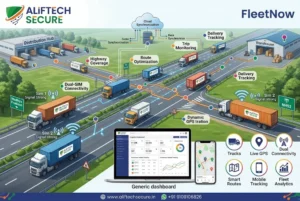
What Actually Earns Its Place on an MP Fleet
Not every feature in a vendor’s brochure pays for itself here. These do.
Dual SIM with BSNL fallback
The single most important hardware choice for MP long-haul. The device picks between private networks and BSNL on its own, based on whichever signal it can find, so your trail stays unbroken through the dead zones.
Fuel sensor integration
A capacitive sensor reads tank level directly. That differs from engine-data fuel estimation, which drivers can manipulate. The sensor gives you a specific event with a time and a place attached, which turns a suspicion into something you can act on.
Geofencing around loading and delivery points
Draw boundaries around your major customer sites, the Pithampur belt, and any restricted zones. The platform pings you the moment a vehicle crosses one. For anyone juggling several deliveries at once, this replaces the constant round of confirmation phone calls.
AIS-140 certified VLTD
The legal minimum for commercial vehicles, and the part operators most often get half right. Buy from a maker on ARAI’s approved VLT device list, then make sure your vendor completes the Vahan IMEI registration afterwards. A certified device that nobody registered on Vahan still reads as non-compliant at a checkpost.
Temperature monitoring for perishable cargo
Pharma, agricultural produce and cold chain clients increasingly ask for temperature logs as standard documentation. The sensor records cargo temperature against vehicle location, which also gives you evidence if a client disputes cargo quality later.
Feature Priority for MP Logistics
| Feature | Priority | Why |
|---|---|---|
| AIS-140 certified VLTD | Mandatory | Legal requirement; permits depend on it |
| Panic button (SOS) | Mandatory | Part of the AIS-140 spec |
| Dual SIM (BSNL + private) | Essential | Rural MP coverage gaps |
| Fuel sensor | High | Only reliable catch for siphoning |
| Geofencing | High | Removes manual arrival tracking |
| Route deviation alerts | High | Flags unplanned detours in real time |
| Temperature sensor | Medium-high | Cold chain and pharma clients expect it |
| Mahakhanij integration | Required for minerals | State mining compliance |
| Remote immobilisation | Medium | Useful for theft recovery |
Sizing the System to Your Fleet
Three to ten trucks
An AIS-140 device with dual SIM and basic fuel monitoring covers what you need. A phone-accessible dashboard shows every vehicle at once.
Budget roughly ₹4,000 to ₹6,500 per device, plus ₹150 to ₹300 monthly for SIM and platform. That puts a ten-truck fleet at about ₹58,000 to ₹1 lakh for the first year, and considerably less from year two.
Ten to fifty trucks
At this size a full platform earns its cost: driver behaviour scoring, automated route reports, fuel sensors across every vehicle, and delivery notifications to your customers. Per-vehicle pricing drops with volume.
Local support starts mattering more than features. A device failing at 11 PM on the Nagpur highway needs someone who answers in Indore.
Mineral transport or cold chain
These need specific configuration rather than a bigger package: Mahakhanij integration for mineral vehicles, temperature logging for cold chain, cargo seal sensors for high-value freight. A national vendor with no MP presence will usually miss the state-level pieces.
Five Mistakes MP Operators Keep Making
Single-SIM 4G devices on long routes. They go dark for hours on rural stretches, which defeats the point of buying one.
Skipping AIS-140 certification to save money. Uncertified devices invite trouble at RTO checkposts and complicate permit renewal, and nobody can register them on Vahan afterwards.
Assuming location tracking catches fuel theft. It doesn’t. Only a tank-level sensor produces evidence.
Picking a distant vendor. Call centres in another state cannot get a technician to the Nagpur highway tonight.
Ignoring driver behaviour data. Harsh braking and overspeeding raise both accident risk and tyre spend, and the platform already collects the numbers you would need to address it.
Frequently Asked Questions
Do I really need dual SIM for MP routes?
For long-haul, yes. Single-SIM devices lose signal across rural MP stretches, and those gaps tend to fall on overnight runs. For short urban routes around Indore or Bhopal, a single SIM usually holds up fine.
What does GPS tracking cost for a small MP fleet?
Around ₹4,000 to ₹6,500 per device, plus ₹150 to ₹300 per vehicle monthly. A ten-truck fleet lands near ₹58,000 to ₹1 lakh in year one, then drops to the recurring cost alone.
Is AIS-140 mandatory for goods vehicles in MP?
Commercial vehicle categories under the national mandate need certified VLTDs, and MP applies the same rules as the rest of the country. Mineral transport adds Mahakhanij requirements on top. Check your specific vehicle category with your RTO, since the mandate rolled out in phases.
Can a GPS system stop fuel theft or only record it?
It records, and that turns out to be enough for most operators. Once drivers know a tank-level sensor logs every drop with a time and a location, the behaviour usually changes on its own.
What is the Mahakhanij portal?
MP’s state platform for mineral transport. Vehicles carrying minor minerals register there, and registered vehicles need AIS-140 certified tracking devices. It runs separately from the national Vahan system, so a vehicle can satisfy one and fail the other.
Key Takeaways
- Buy dual SIM if your trucks run past the Indore–Bhopal belt.
- Add a fuel sensor before adding anything else optional.
- Confirm ARAI certification, then confirm the Vahan registration actually happened.
- Handle Mahakhanij separately if any vehicle carries minerals.
- Weigh local support as heavily as the feature list.
Conclusion
The right setup for an MP fleet looks different from a generic national package, mostly because of coverage gaps, overnight fuel risk, and the extra mining layer. Get dual SIM, a fuel sensor and clean AIS-140 paperwork in place, and the rest is refinement.
Running trucks out of Indore, Pithampur or anywhere across MP? We fit ARAI-certified devices, complete the Vahan registration, configure dual SIM for MP coverage, and answer the phone from Indore when something fails on the road. See our fleet management solutions or call 91091 06826 for a free route and fleet assessment.
| Get a Free Fleet GPS Assessment for Your MP Routes We review your routes, fleet size, and compliance status — then configure the right system. Call / WhatsApp: +91 9109106826 | www.aliftechsecure.in| Indore-Based Support |
AlifTech Secure | FleetNow GPS — Vehicle Tracking Solutions, Indore MP |+91 9109106826 | www.aliftechsecure.in

