
By AlifTech Secure | CCTV & Security Solutions, Indore | July 2026 | www.aliftechsecure.in
Your neighbour’s house got broken into last month. A delivery arrived while nobody was home. Your parents are alone during the day and you want to check on them from the office.
These are the situations that make a home CCTV camera one of the most practical purchases an Indian family makes. But with dozens of types, brands and price points, most buyers end up guessing.
This guide tells you what to buy for your home type and budget. It also covers the one rule that changed in April 2026, which most buying guides still ignore.
Quick Answer
- Rented flat: one indoor WiFi Pan-Tilt camera, ₹1,800 to ₹3,500.
- 2BHK or 3BHK owned flat: one indoor camera plus a video doorbell, ₹4,000 to ₹8,000.
- Independent house: 4 to 6 wired cameras with an NVR, ₹12,000 to ₹25,000 installed.
- Check the BIS registration number before paying. Since 1 April 2026, non-compliant cameras cannot legally be sold in India.
- Always add a 64GB or 128GB microSD card. Without it, most WiFi cameras keep almost nothing.
The Rule That Changed in April 2026
Start here, because it decides which cameras are even legal to buy.
In 2024, MeitY notified the Essential Requirements for Security of CCTV, known as ER:01, under the Compulsory Registration Order. It sets six cybersecurity rules: no default passwords, encrypted streams, signed firmware, disabled debug ports, supply chain transparency, and a published vulnerability disclosure policy.
From 1 April 2026, the grace period ended. Cameras that don’t meet these requirements can no longer be manufactured, imported or sold in India. Our full breakdown of the 2026 CCTV import and BIS rules covers the timeline in detail.
BIS ER-01 or STQC? For a home, only one matters
These two get confused constantly, including by sellers.
BIS ER-01 is the licence to sell a camera in India. The model is tested in a BIS-recognised lab and gets a registration number, an R-number, that you can search on the BIS portal. Under the Compulsory Registration Scheme, nobody may manufacture, store for sale, import, sell or distribute goods lacking the Standard Mark with that unique number.
STQC certification goes deeper and is what government and PSU procurement demands. It’s not what a home buyer needs to check.
So ask the seller for the R-number, not for an STQC certificate. Compliance is granted model by model, never brand by brand, so a brand you trust can still have an uncertified model on the shelf.
Types of Home CCTV Cameras and What They Cost
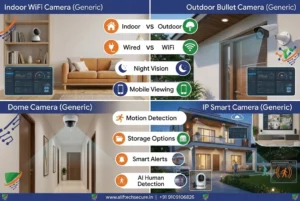
Decide the type before you compare prices. Where you’re mounting it decides almost everything else.
| Camera type | Where it suits | Typical price |
|---|---|---|
| Indoor WiFi Pan-Tilt | Living room, bedroom, kids’ room | ₹1,500 to ₹3,500 |
| Outdoor WiFi bullet | Main gate, balcony, parking | ₹2,500 to ₹5,500 |
| Outdoor Pan-Tilt-Zoom | Terrace, garden, large open area | ₹3,000 to ₹7,000 |
| Battery wireless | Rented homes, temporary spots | ₹3,000 to ₹8,000 |
| Video doorbell | Flat door, main entrance | ₹5,000 to ₹12,000 |
| Wired IP set, 4 cameras plus NVR | Whole-home permanent coverage | ₹8,000 to ₹18,000 equipment only |
That last row is equipment only. Add cable, installation and a hard disk and a professionally fitted four-camera system lands between ₹12,000 and ₹25,000. Independent houses with long cable runs sit at the upper end.
Browse current options in WiFi cameras, wired IP cameras or ready-made CCTV packages.
Best CCTV Cameras for Home in India 2026 — Brand Wise
These are the most trusted and widely available options for Indian homes in 2026. All are STQC compliant or from certified Indian brands.
CP Plus — Best Overall for Indian Homes
CP Plus is India’s largest CCTV brand and the most widely recommended for homes in 2026. Their WiFi Pan-Tilt camera (CP-E31Q) at Rs. 2,200 to Rs. 2,800 offers 3MP 2K resolution, 360-degree pan and tilt, human detection, two-way audio, and works with the gCMOB app on Android and iPhone. For outdoor use, the CP Plus 4MP outdoor WiFi camera gives full-colour night vision — meaning colour footage at night, not just black and white. Furthermore, CP Plus has the widest service network in India, so finding support is never a problem.
Qubo — Best for Privacy-Conscious Buyers
Qubo is backed by the Hero Group and stores all data on Indian servers — an important advantage for anyone placing cameras inside bedrooms or living rooms. Their Smart Cam 360 at Rs. 2,500 to Rs. 3,000 offers 2K resolution, 360-degree coverage, AI person detection, and works with Alexa and Google Home. As a result, Qubo is the preferred choice for buyers who are concerned about where their footage is stored and processed.
TP-Link Tapo — Best Night Vision Value
TP-Link Tapo cameras consistently top reviews for night vision quality in India. The Tapo C500 outdoor camera at Rs. 2,500 to Rs. 3,200 has colour night vision up to 30 metres, IP67 weatherproofing (suitable for Indian monsoons), human detection, and dual WiFi plus Ethernet connectivity — a rare feature at this price that provides a wired backup option when WiFi signal is weak. The Tapo app is well-reviewed for reliability and ease of use.
Imou — Strong Outdoor Option at Budget Price
Imou’s 3MP outdoor bullet camera at Rs. 2,000 to Rs. 2,500 offers colour night vision up to 30 metres, human detection with spotlight, and IP67 weatherproofing — impressive specifications for the price. It suits Indian homes where the outdoor area needs good night coverage but the budget is limited.
Where to Place CCTV Cameras in Your Home
Buying the right camera is only half the decision. Placing it correctly determines whether the footage is actually useful when you need it.
Brands Worth Considering for Indian Homes
These are the options we fit most often in Indore homes. Prices move with sales and stock, so treat them as a guide and confirm before buying.
CP Plus
India’s largest CCTV brand, and the safest default for most homes. Their WiFi Pan-Tilt units sit around ₹2,200 to ₹2,800 with 3MP resolution, 360 degree pan and tilt, human detection and two-way audio. The outdoor 4MP models offer full-colour night vision rather than black-and-white infrared.
The real advantage is service reach. When a camera fails in year three, CP Plus support exists in almost every Indian city.
Qubo
Backed by the Hero Group, and it stores data on Indian servers. That matters if cameras are going inside bedrooms or living rooms. The Smart Cam 360 runs about ₹2,500 to ₹3,000 with 2K resolution, AI person detection, and Alexa and Google Home support.
TP-Link Tapo
Consistently strong on night vision. The C500 outdoor model sits near ₹2,500 to ₹3,200 with colour night vision, IP67 weatherproofing and both WiFi and Ethernet. That wired fallback is rare at this price and genuinely useful where the router signal is weak.
Imou
Good outdoor value. The 3MP bullet at roughly ₹2,000 to ₹2,500 gives colour night vision, human detection with spotlight and IP67 sealing. It suits homes where the gate needs decent night coverage on a tight budget.
Whichever brand you pick, ask for the BIS registration number of that exact model. A trusted brand name is not the same as a compliant model.
Where to Put the Cameras
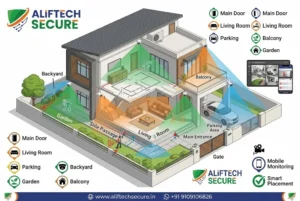
Buying the right camera is half the job. Placement decides whether the footage helps you when something happens.
Main entrance, the highest-value position
One camera facing outward at the main door captures everyone who comes and goes. If you only ever buy one camera, buy this one.
Mount it at 2 to 2.5 metres and angle it toward faces. Too high and you record the tops of heads. For flats, a video door phone covers the same position and adds two-way audio.
Living room, for indoor activity
A Pan-Tilt indoor camera covers the main common area. It’s the right choice for keeping an eye on domestic help, checking the house is locked up, or confirming children reached home. Set motion alerts for hours when the house should be empty.
Gate, parking and balcony
For independent houses and ground-floor flats, outdoor coverage is the third priority. Look for IP66 weatherproofing at minimum, plus colour night vision. Indian outdoor conditions mean dust, monsoon water and long dark nights, and cheap indoor-grade housings fail within a season.
How many cameras does a home actually need?
- 1BHK or studio: 1 camera, indoor Pan-Tilt covering entrance and main room
- 2BHK flat: 2 cameras, one indoor plus a door camera or video doorbell
- 3BHK flat: 2 to 3 cameras, living room, main door and balcony
- Independent house: 4 to 6 cameras, main gate, front door, back door, living room and perimeter
Five Mistakes That Waste Money
1. Ignoring night vision. Most break-ins happen after dark. A camera that records black silhouettes is decoration. Look for colour night vision, or clear infrared to at least 20 metres.
2. Buying no-brand cameras online. Unbranded units fail early, have weak apps, and often carry security holes that let strangers reach your feed. Since April 2026 they’re also likely to be unregistered, which means no warranty support and no legal recourse.
3. Skipping weatherproofing. Indoor cameras die outdoors. Any exterior position needs IP65 as a floor, IP66 or IP67 for exposed walls.
4. Forgetting the memory card. Most WiFi cameras record to a microSD card. Without one you get live view and a few short cloud clips. Buy a 64GB or 128GB Class 10 card with the camera.
5. Mounting too high. A camera at 4 metres records rooftops. Keep it at 2 to 2.5 metres, angled at the entry point. Our step-by-step home installation guide covers heights, angles and cable routing.
Choosing by Home Type
Rented flat
Go wireless. A WiFi Pan-Tilt camera needs no drilling. Plug it in, connect the app, and take it with you when you move. Budget ₹1,800 to ₹3,500, plus one outdoor unit for the balcony if you need it.
Owned flat
One indoor camera plus a video doorbell covers most 2BHK and 3BHK layouts. Two indoor Pan-Tilt units also work if outdoor installation isn’t permitted by your society. Budget ₹4,000 to ₹8,000.
Independent house
You need outdoor cameras at the gate, front door and rear entry, plus one or two indoors. A wired system with an NVR gives better long-term reliability than six WiFi cameras competing for one router. Budget ₹12,000 to ₹25,000 installed, configured for 30 or more days of storage.
Frequently Asked Questions
How do I check if a CCTV camera is BIS certified?
Ask the seller for the BIS registration number, the R-number, for that specific model, then search it on the BIS portal. The packaging should also carry the Standard Mark. Registration is granted model by model, so a well-known brand can still have uncertified models on sale.
How many days of footage can a home CCTV system store?
It depends on resolution, camera count and disk size, not on the camera brand. A 1TB disk with four 2MP cameras on motion recording typically holds 30 days or more. Most installers leave the default at around 7 days, so ask for it to be configured properly at handover.
Is a WiFi camera or a wired camera better for an Indian home?
WiFi suits rented flats and setups under three cameras. Wired suits independent houses, thick RCC walls and anything beyond four cameras, because WiFi cameras compete for router slots and drop out. Wired systems also keep recording when the internet fails.
Do I need permission from my housing society for a CCTV camera?
Inside your own flat and at your own door, the choice is yours. Cameras covering shared corridors, lifts or the lobby usually need written approval from the RWA. Many societies in Indore and Bhopal ask for a request in writing first, so check the bye-laws before drilling.
What happens if I buy a camera that is not BIS compliant?
You lose warranty support, firmware updates and any legal recourse if the device is compromised. Since 1 April 2026 such cameras cannot legally be sold in India, so unregistered stock is being cleared quietly. The cheap price today usually costs more within two years.
The Short Version
The camera model matters less than most buyers think. Placement, storage duration and compliance matter more.
Get the main door covered first. Mount at 2 to 2.5 metres so faces are readable. Buy a memory card with the camera. Confirm the BIS registration number before paying. Then set storage to 30 days rather than accepting the factory default.
Do those five things and a modest system will outperform an expensive one that was fitted carelessly.
| Book a Free Home CCTV Site Visit in Indore We visit your home, recommend the right cameras for each location, and install professionally. Call / WhatsApp: +91 9109106826 | www.aliftechsecure.in| Same-Day Response in Indore |
AlifTech Secure | CCTV & Security Solutions, Indore MP | +91 9109106826 | www.aliftechsecure.in

