

By AlifTech Secure | Networking & IT Solutions, Indore | July 2026 | www.aliftechsecure.in
Introduction
The server room UPS beeps at 11 PM. A CNC machine trips on a voltage spike. Then the electricity bill jumps by ₹18,000 because a large motor started at the same moment as three air conditioners.
Three different problems, three different fixes, and most businesses treat all of them as “we need a bigger UPS.”
This guide covers what a smart power management system actually includes, how Madhya Pradesh bills commercial power, and what the whole thing costs in 2026.
Quick Answer
- A UPS is backup. Power management is control. They solve different problems.
- In MP, demand-based tariff is mandatory above 10 kW connected load. Below that you can still opt in.
- Demand charges are billed per kVA of contract demand, so you pay for booked capacity whether you draw it or not.
- Keep power factor at 0.80 or above. Fall below and MP levies a surcharge on your entire billed energy amount.
- Small office: ₹30,000 to ₹80,000. Factory: ₹3 lakh to ₹15 lakh, depending on connected load.
What a Smart Power Management System Actually Includes
A UPS keeps equipment alive for 5 to 30 minutes. That is all it does. A power management system watches, decides and acts.
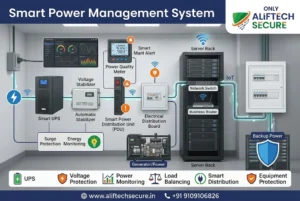
A full setup usually has six parts:
- Smart UPS or inverter with remote battery monitoring and runtime prediction
- Voltage stabiliser or conditioner to absorb the fluctuations and spikes common on Indian supply
- Power quality monitoring measuring voltage, current, frequency and power factor per circuit
- Automatic load balancing that sheds or delays non-critical loads before a peak forms
- Demand controller that staggers heavy equipment so it never starts simultaneously
- Remote dashboard giving you alerts and consumption reports from a phone
Scale it to the site. A 20-person office needs monitored UPS and voltage protection. A factory running CNC machines, compressors and multiple AC units needs the whole stack. The principle stays the same either way: stop treating power as something that either arrives or doesn’t.
How Madhya Pradesh Actually Bills Commercial Power
Most articles on this topic describe demand charges generically. The details differ by state, and getting them wrong costs real money, so here is how MP works.
Demand-based tariff and the 10 kW line
Under MPERC’s tariff schedule, consumers in the LV-2 categories with connected load above 10 kW must be on demand-based tariff. Below 10 kW, you may opt in voluntarily.
For LT consumers on demand-based tariff and for all HT consumers, contract demand is what you apply for. So the number on your application becomes the number you pay against every month, used or not.
That changes the strategy. Right-sizing your contract demand matters as much as shaving peaks, and an oversized booking quietly bleeds money in every billing cycle.
Power factor: the 0.80 threshold
This is where MP is stricter than most guides suggest.
It is the consumer’s responsibility to keep power factor at or above 0.80 in any month. Fall below and a low power factor surcharge applies to the entire billed energy amount for that month, not just to the reactive portion.
Demand charges are levied per kVA, not per kW. Since poor power factor raises kVA for the same useful kW, a weak power factor inflates your demand charge and triggers the surcharge at the same time. A capacitor bank fixes both.
For conversion between kW and kVA, MPERC applies 0.8 for LT connections and 0.9 for HT.
Voltage quality damages equipment slowly
Indian commercial supply swings widely during peak hours and through the monsoon. Servers, medical equipment, CNC controllers and precision instruments degrade under that stress, and they usually fail without warning rather than gradually.
A stabiliser upstream of critical equipment costs a fraction of replacing a controller board. Our UPS and power protection range covers the backup side of this.
The Three Components That Do the Real Work
Smart UPS with a network management card
An NMC puts the UPS on your network. You get battery health, load percentage, input voltage and runtime estimates in a browser or app. When power fails, the system logs it, sends alerts, and can trigger clean shutdown scripts on connected servers with nobody on site.
Standard UPS units give you none of this. You find out the battery is dead during the outage it was bought for.
Power quality metering
Meters record voltage, current, frequency, power factor and harmonic distortion per circuit, in real time. The value is diagnostic. Instead of guessing which machine is causing trouble, you see it.
On motor-heavy factory floors this often shows that a capacitor bank would cut both waste and equipment stress, which is a cheaper answer than upsizing protection. Pairing metering with your automation and control systems turns the data into scheduling decisions rather than a report nobody reads.
Demand controller
The controller watches cumulative load and acts before the threshold is crossed. If demand is climbing, it holds back a secondary compressor for ten minutes rather than letting the peak form.
Savings depend entirely on your load profile, tariff category and how many large motors you run. Anyone quoting a fixed percentage before seeing your bills is guessing.
Five Mistakes That Cost Indian Businesses Money
1. Running a UPS with no monitoring. Battery degradation is invisible until the outage. Monitored systems flag it weeks ahead.
2. Waiting for equipment to fail before adding voltage protection. Stabilisers run ₹5,000 to ₹50,000 by capacity. A CNC controller or server board costs far more.
3. Never reading the demand component of the bill. Most finance teams see only the total. Split out demand charges and power factor surcharge and you learn whether the problem is peaks, contract demand or power factor.
4. Booking more contract demand than you need. In MP you pay per kVA of contract demand. An oversized booking is a fixed monthly leak.
5. Ignoring power factor. Below 0.80 in MP, the surcharge hits your whole energy bill. Capacitor banks usually pay for themselves quickly on motor-heavy loads.
What to Install, by Business Size
Small office, 10 to 30 people
A smart online UPS of 1 to 3 kVA with a network management card, a stabiliser for the server rack, and basic monitoring. Budget ₹30,000 to ₹80,000.
Prioritise remote monitoring above capacity. Knowing the battery is failing is worth more than an extra five minutes of runtime.
Medium office or commercial building
A modular UPS of 10 to 40 kVA, power quality monitoring at the main panel, and a demand controller for HVAC and other large loads. Add power factor correction if you are on a demand-based tariff, which most three-phase commercial consumers in MP are. Budget ₹1.5 lakh to ₹5 lakh.
Factory or industrial unit
Centralised UPS for office and control systems, a power quality analyser on production circuits, a demand controller tied to the production schedule, and power factor correction for motor loads.
Pithampur units tend to have the strongest case, because motor-heavy loads combine high contract demand with power factor risk. The same sites usually benefit from tightening attendance and shift systems alongside, since both projects touch the same panel rooms. Budget ₹3 lakh to ₹15 lakh depending on connected load and circuits monitored.
Frequently Asked Questions
What is the difference between a UPS and a power management system?
A UPS supplies backup power for a few minutes during an outage. A power management system adds voltage protection, per-circuit monitoring, load balancing and demand control, so it reduces your bill and protects equipment during normal operation, not only during failures.
When does demand-based tariff apply in Madhya Pradesh?
For LV-2 consumers, MPERC makes demand-based tariff mandatory above 10 kW connected load, and optional at or below it. All HT consumers are on demand-based tariff. Contract demand is what the consumer applies for, so it should be reviewed against actual usage.
What power factor do I need to maintain in MP?
At least 0.80 in any given month. Below that, a low power factor surcharge applies to your entire billed energy amount for the month. Since demand charges are billed per kVA, weak power factor raises the demand charge too, which is why capacitor banks often pay back fast.
Will a smart power management system reduce my electricity bill?
Usually yes, though how much depends on your tariff category, load profile and current power factor. The honest answer needs your last six bills. Any vendor promising a fixed percentage before reading your bills is selling, not advising.
Do I need this if I already have an inverter and a stabiliser?
Possibly not, if you are a small office with no demand-based tariff. Once you cross 10 kW connected load, or run motors that swing your power factor, monitoring and demand control start paying for themselves. That crossover point is worth checking against your bill.
The Short Version
Read the bill before buying anything. Find your demand charge, your contract demand in kVA, and any power factor surcharge.
If contract demand is oversized, fix that first, because it costs nothing to correct and saves every month. If power factor sits near 0.80, a capacitor bank is the next cheapest win. Monitoring and demand control come after, once you know which circuits are actually causing the problem.
A power audit costs a fraction of the equipment, and it stops you buying the wrong thing confidently.

| Book a Free Power Audit for Your Business We review your electricity bills, measure power quality, and recommend the right protection system. Call / WhatsApp: +91 9109106826 | www.aliftechsecure.in | Free Audit in Indore |
AlifTech Secure | Networking & IT Solutions, Indore MP |+91 9109106826 | www.aliftechsecure.in

