
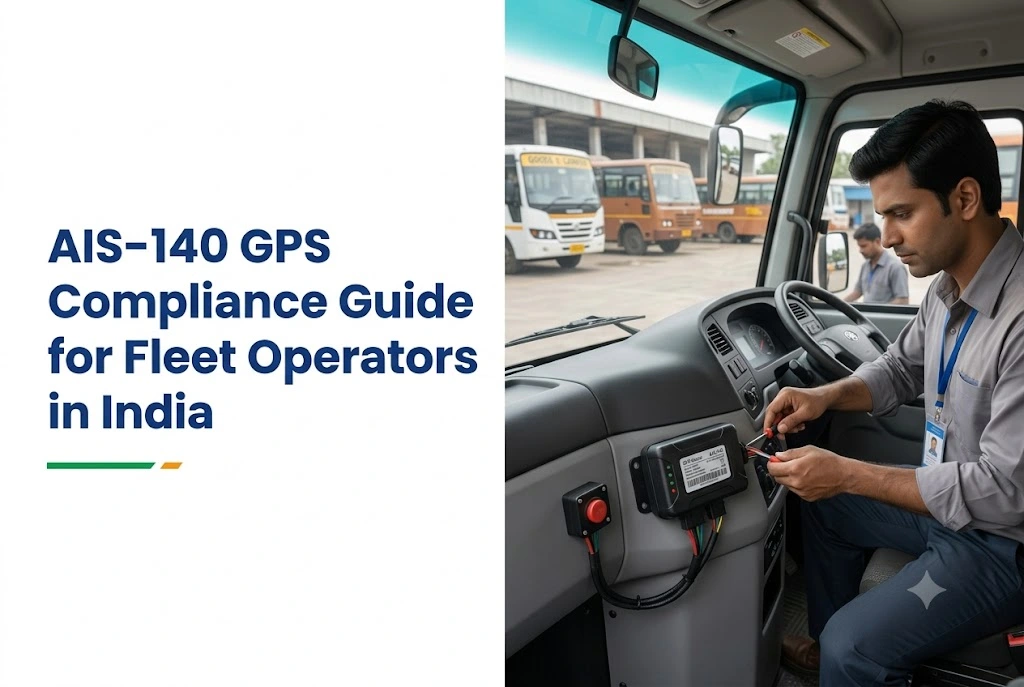
By AlifTech Secure | FleetNow GPS — Vehicle Tracking Solutions, Indore | May 2026 | www.aliftechsecure.in
AIS-140 has moved from something operators could quietly delay to an actively enforced standard. Fitness certificate rejection, challans at checkposts, permit problems in several states.
But the operators who run into trouble are rarely the ones who ignored it. They are usually the ones who bought a device, had it fitted, and assumed that was the end of it.
This guide covers what the standard actually requires, which vehicles need it, what separates a certified device from a tracker that looks similar, what it costs, and the step most people skip.
Quick Answer
- AIS-140 is a technical standard for tracking devices on commercial vehicles, defined by ARAI under MoRTH.
- It applies to yellow number plate vehicles: buses, trucks, taxis, school vehicles, goods carriers.
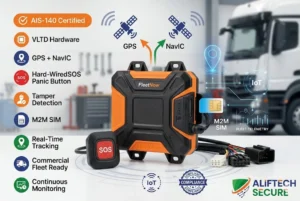
- A compliant VLTD needs dual GPS and NavIC positioning, a hard-wired panic button, tamper detection and a dedicated M2M SIM.
- Fitment is not compliance. The device has to reach your Vahan record, through an authorised installer.
- Cost per vehicle, year one: roughly ₹8,000 to ₹15,000 all in.
What AIS-140 Actually Is
AIS stands for Automotive Industry Standard. Standard 140 comes from the Automotive Research Association of India, working under the Ministry of Road Transport and Highways, and it exists to give transport authorities real-time visibility of commercial vehicle movement nationally.
The first phase began in April 2018 with public transport buses, and the mandate has expanded since.
The chain of authority runs like this: MoRTH issues the mandate under the Motor Vehicles Act, ARAI defines the technical standard and certifies devices and backend systems, RTOs enforce through the Vahan portal, and officers verify at checkposts.
So a device is compliant only if it carries genuine ARAI certification. A manufacturer’s claim is not certification.
The standard has also been amended. AIS-140A brought updated GNSS requirements with stronger NavIC support, revised data packet specifications and additional emergency response integration. If you are buying now, ask your supplier which version their device is certified against, because an older certification may not satisfy current requirements.
What Separates a Certified VLTD From a Tracker
This is where most confusion sits. A GPS tracker sold online is not the same thing as a Vehicle Location Tracking Device certified under AIS-140.
Dual constellation positioning
A certified VLTD uses a GNSS module combining standard GPS with NavIC, India’s regional navigation system developed by ISRO, with a minimum position accuracy of 5 metres CEP.
So authorities get considerably better location data than a single-constellation tracker provides, particularly in dense urban areas or where satellite visibility is weaker.
Hard-wired panic button
A physical SOS button wired into the vehicle’s electrical system, not a phone app and not a battery-powered accessory.
When triggered it sends an emergency alert to the state transport authority and emergency response systems. This requirement matters most for passenger transport and school vehicles, which is why those categories carry the strictest attention.
Tamper detection
The casing has to resist physical tampering, and the unit includes a detection circuit that alerts if someone tries to disconnect or interfere with it.
So a driver cannot simply unplug the device mid-route. The attempt itself generates an alert rather than silently stopping tracking.
Dedicated M2M SIM and battery backup
Each device carries an embedded M2M SIM provisioned specifically for vehicle tracking data, separate from any consumer connection. The device also includes internal battery backup, so tracking continues if main vehicle power is cut.
None of these appear in a standard consumer tracker, which is precisely why one cannot substitute for a certified device.
The Four Steps, and the One People Skip
Buying the device is the first step, not the whole process.
Step 1: Buy from a certified manufacturer
Only devices from approved VLTD manufacturers carry valid certification, and status changes over time, particularly after standard amendments like AIS-140A.
Ask your supplier for the specific certificate number by device model and get it in writing. A genuine supplier provides this without hesitation. A vendor who offers general assurances instead of a certificate number is telling you something.
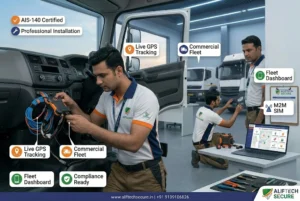
Step 2: Professional installation by an authorised technician
Installation has to happen through an approved service centre or an authorised technician. A private mechanic’s work carries no legal standing however good the wiring is.
Incorrect installation can lead to penalties even with a properly certified device, since the wiring, panic button placement and power connection all have to meet specification. Our installation service covers this.
Step 3: Link the device to Vahan
This is the step people skip, and it is the one that decides compliance.
After installation, the device has to connect to the state transport department’s control room or the national tracking platform, registering the device IMEI against your vehicle in the Vahan database. That record is what enforcement officers actually check.
A physically installed device that was never registered still shows as non-compliant. Our guide to Parivahan GPS IMEI registration walks through the portal side.
Step 4: Verify it keeps transmitting
Installing and registering does not guarantee ongoing compliance. Confirm data transmits consistently, the panic button works, and the SIM stays active.
We have seen devices pass initial inspection and stop transmitting weeks later because a SIM data plan lapsed, leaving the operator non-compliant without knowing it.

Which Vehicles Need It
The yellow number plate is the simplest test, though some categories deserve specific mention.
| Vehicle category | Requirement |
|---|---|
| Public transport buses | Mandatory |
| Goods trucks and carriers | Mandatory |
| Commercial taxis | Mandatory |
| School buses and vans | Mandatory, with additional emphasis on student safety |
| Mining and hazmat transport | Mandatory, often with further certified requirements |
| Private cars, white plate | Exempt under the core mandate |
| Personal two-wheelers | Exempt |
School and college transport carries particular attention, since these vehicles carry minors and the regulation specifically mandates tracking, panic buttons and live data transmission.
State-level notifications occasionally vary, so if a specific vehicle category is unclear, confirm with your regional RTO rather than assuming exemption.
Enforcement and What Non-Compliance Costs
Enforcement in 2026 is meaningfully stricter than in earlier years. RTO checkposts actively verify, and several states link compliance directly to fitness certificate renewal and permit issuance. Madhya Pradesh follows the same national framework, with RTOs checking VLTD status at fitness renewal and at routine checkposts.
What non-compliance actually risks:
- Fines at RTO checkposts
- Fitness certificate rejection or delayed renewal
- Permit suspension or cancellation
- Complications with insurance claims after an incident
One observation from the ground. The operators under most enforcement pressure right now are individual owners running one to five vehicles. Larger fleets with 50 or more vehicles generally deployed devices early as part of broader fleet systems, so smaller operators have the lowest compliance rates and remain the focus of enforcement drives.
What Compliance Costs
Pricing varies by hardware tier, bundled services and vendor margin, so treat figures as bands.
| Cost component | Approximate |
|---|---|
| VLTD device hardware | ₹3,500 to ₹6,000 per unit |
| Professional installation | ₹500 to ₹1,500 per vehicle |
| M2M SIM and data plan | ₹100 to ₹300 per month |
| Backend platform access | ₹50 to ₹200 per month |
| Year one, single vehicle | ₹8,000 to ₹15,000 |
| Annual ongoing, per vehicle | ₹3,000 to ₹6,000 |
For fleets of 50 or more, volume pricing reduces per-unit cost meaningfully, and bundled pricing usually beats buying devices and services separately. Our GPS device price guide covers the components in more detail, and choosing a fleet tracking system covers what else to compare.
Four Mistakes We See Repeatedly
Buying uncertified to save money. Plenty of cheap devices claim AIS-140 compliance. An uncertified unit may pass a casual look and fail when the registration is checked against the approved list. Ask for the certificate number by model before paying.
Installing but never registering with Vahan. A device that was never linked shows as non-compliant in the system officers check. This happens most often when a device is bought online without installation and registration support.
Never checking whether data still transmits. SIM connectivity lapses, batteries degrade, devices fail. Operators who never verify discover non-compliance at a checkpost, when it is too late to fix quietly.
Treating compliance as separate from fleet management. Route history, overspeed alerts, geofencing, fuel monitoring and driver behaviour all run on the same data feed the compliance system already generates. Operators who treat the VLTD as a checkbox leave that value sitting unused.
Frequently Asked Questions
Is AIS-140 compliance mandatory for my private car?
No. It applies to commercial transport vehicles with a yellow number plate, so private vehicles registered for personal use with a white plate fall outside the core mandate. If your vehicle category is unclear, check with your regional RTO, since state-level notifications occasionally vary.
Can I use a regular GPS tracker instead of a certified device?
No. A regular tracker provides location data but carries no certification, so it will not satisfy RTO requirements however accurate it is. A compliant device must meet specific certified requirements including dual GPS and NavIC positioning, a hard-wired panic button, tamper detection, embedded M2M SIM and internal battery backup.
How do I verify a device is genuinely certified?
Ask your supplier for the specific certificate number for that exact device model and get it in writing. Certification is granted per model, so a manufacturer having certified products does not mean every model in their range is one. A genuine supplier provides documentation without hesitation.
After I install the device, am I automatically compliant?
Not quite. Installation is one step of four: certified device, authorised installation, Vahan registration, and verifying data actually transmits. Skipping Vahan registration is the most common mistake, since a physically installed device that was never registered still shows as non-compliant in the system officers check.
Does compliance help with anything beyond avoiding fines?
Yes, considerably. The same data supports route optimisation, overspeed alerts, geofencing, fuel monitoring and driver behaviour analysis. Panic buttons and live tracking also improve emergency response, and many operators who installed purely for compliance end up using the data daily for fleet management.
Getting Compliant Without the Confusion
The operators who run into trouble almost always did one of three things: bought uncertified hardware to save money, skipped the Vahan registration step, or installed a device and never checked it kept transmitting.
Each is entirely avoidable with the right supplier and a little ongoing attention.
If you are unsure where your fleet stands, get an assessment. Checking your existing devices against current requirements tells you what needs attention before an RTO checkpost tells you instead.
| FleetNow GPS by AlifTech Secure — Indore Call / WhatsApp: +91 9109106826 www.aliftechsecure.in | aliftechsecure@gmail.com 112 Basement, Akbar Ali Complex, MG Road, Palasia Square, Indore — 452001 |
| Get a Free Fleet Compliance Assessment We check your current fleet’s AIS-140 status and quote certified devices with full Vahan registration. No obligations. Call / WhatsApp: +91 9109106826 | www.aliftechsecure.in |
AlifTech Secure | FleetNow GPS — Vehicle Tracking Solutions, Indore MP | www.aliftechsecure.in | +91 9109106826


2 Comments. Leave new
[…] guide to Parivahan IMEI registration walks through the portal side, and the full AIS-140 compliance guide covers the wider requirement including which vehicles fall under […]
[…] AIS-140 compliance guide covers the full requirement, and the Parivahan IMEI registration guide walks through the portal […]