
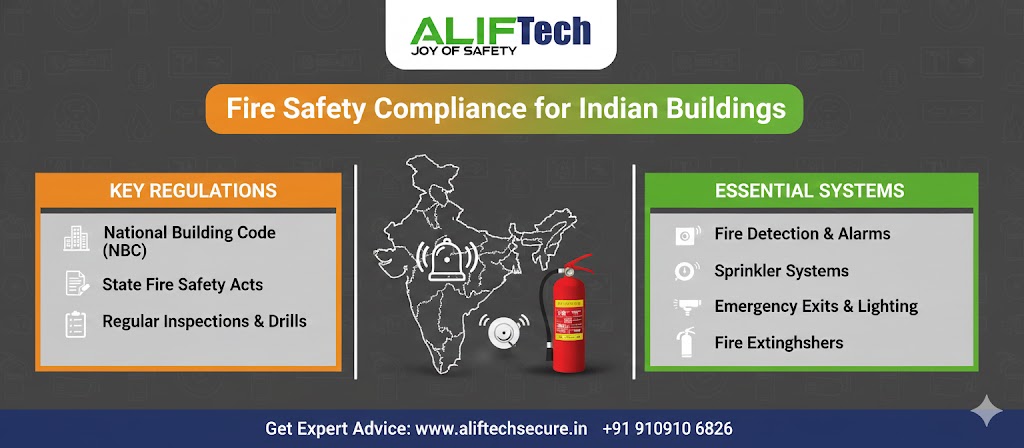
Fire Safety Compliance for Indian Buildings: Complete Guide
Fire safety compliance for Indian buildings is a critical legal and moral obligation for property owners, builders, and building managers. India’s fire safety regulations have become increasingly stringent following tragic incidents, requiring comprehensive systems and certifications. This complete guide covers fire safety compliance for Indian buildings including regulations, required equipment, NOC processes, and ongoing maintenance obligations.
Understanding India’s fire safety framework is essential for every building stakeholder. First, non-compliance risks lives, attracts heavy penalties, and invalidates insurance. Moreover, fire safety compliance for Indian buildings involves multiple authorities including state fire departments, municipal corporations, and national building codes. Therefore, staying informed and compliant protects both property and occupants.
For comprehensive fire safety systems, explore compliant equipment options. Additionally, review our fire alarm installation guide for technical setup details.
Understanding India’s Fire Safety Regulatory Framework
National Building Code (NBC) 2016
The National Building Code is the primary reference for fire safety compliance. First, NBC 2016 Part 4 covers fire and life safety. Then, it specifies requirements for fire detection, suppression, escape routes, and construction materials. Additionally, states adopt NBC as mandatory standard with local modifications.
Key NBC Requirements:
- Fire-resistant construction materials
- Minimum exit widths and travel distances
- Emergency lighting specifications
- Sprinkler system requirements
- Fire alarm system standards
- Emergency signage requirements
Moreover, NBC classifies buildings by occupancy (residential, commercial, industrial, assembly) with different requirements. Furthermore, building height determines fire safety equipment complexity.
State Fire Prevention Acts
Each state has specific fire prevention legislation. First, state fire departments enforce these acts. Then, they issue Fire NOCs (No Objection Certificates). Additionally, they conduct regular inspections verifying compliance.
Key States and Acts:
- Maharashtra: Maharashtra Fire Prevention and Life Safety Measures Act 2006
- Delhi: Delhi Fire Prevention and Fire Safety Act 1986
- Karnataka: Karnataka Fire Force Act 1964
- Tamil Nadu: Tamil Nadu Fire Service Act 1985
Moreover, state regulations often exceed NBC minimums. Furthermore, penalties for non-compliance vary by state (fines ₹10,000-₹10,00,000+).
Municipal Corporation Requirements
Local bodies add another compliance layer. First, building plan approval requires fire safety drawings. Then, occupancy certificates need fire NOC. Additionally, periodic renewal requirements exist.
Moreover, municipal corporations coordinate with fire departments for inspections. Furthermore, they can seal buildings for persistent non-compliance.
Learn about fire alarm system types for appropriate equipment selection.
Building Categories and Requirements
Residential Buildings
Residential fire safety compliance varies by height and type. First, individual homes have minimal requirements (smoke detectors, fire extinguishers). Then, apartments above 15 meters need comprehensive systems.
High-Rise Residential Requirements (above 15 meters):
- Automatic fire alarm system (addressable preferred)
- Sprinkler systems in common areas
- Fire hydrant system
- Refuge areas every 15 floors
- Emergency lighting
- Fire escape staircase (pressurized)
- Firefighting lift (above 24 meters)
- Fire NOC mandatory
Moreover, societies must conduct quarterly fire drills. Furthermore, building residents must receive fire safety training.
Commercial Buildings
Commercial properties face stricter requirements. First, offices, malls, and hotels have comprehensive obligations. Then, larger footprints require more equipment. Additionally, higher occupancy increases evacuation complexity.
Commercial Requirements:
- Automatic addressable fire alarm system
- Complete sprinkler coverage
- Fire compartmentation
- Multiple emergency exits
- Assembly points marked
- Fire safety officer designation
- Monthly equipment checks
- Annual third-party audit
Moreover, malls and multiplexes require specialized fire safety plans. Furthermore, restaurants and food courts need kitchen fire suppression systems.
Industrial and Warehouse Facilities
Industrial fire safety compliance addresses specific hazards. First, manufacturing facilities with flammable materials need explosion-proof equipment. Then, warehouses require rack sprinklers. Additionally, chemical storage areas need specialized suppression.
Industrial Requirements:
- Hazard-specific fire detection
- Specialized suppression (CO₂, FM-200, water mist)
- Explosion-proof fittings in hazardous zones
- External firefighting connections
- Emergency response plans
- Trained fire brigade team
- Regular hazard assessments
Moreover, factories must comply with Factories Act fire provisions. Furthermore, industrial fire safety audits are typically annual.
Healthcare Facilities
Hospitals require specialized fire safety compliance. First, critical patients cannot evacuate quickly. Then, life support equipment must continue during fire emergencies. Additionally, specific zones need different protection strategies.
Hospital Requirements:
- Horizontal evacuation capability
- Smoke compartmentation
- Staff fire safety training (all personnel)
- Patient evacuation procedures
- 24/7 fire safety monitoring
- Automatic fire doors
- Medical gas system protection
Moreover, healthcare fire safety compliance is extremely rigorous. Furthermore, NABH accreditation requires strict fire safety standards.
Reference our fire alarm installation guide for life safety systems.
Fire NOC Process
What is Fire NOC?
Fire NOC (No Objection Certificate) certifies buildings meet fire safety requirements. First, required before construction begins (building plan approval). Then, needed before occupancy (completion NOC). Additionally, periodic renewal required for operational buildings.
NOC Types:
- Preliminary NOC: Building plan approval stage
- Provisional NOC: During construction inspection
- Final NOC: Before occupancy permission
- Renewal NOC: Periodic revalidation (typically annual)
Moreover, NOC is mandatory for obtaining occupancy certificates. Furthermore, banks often require valid Fire NOC for property loans.
Documents Required for Fire NOC
Preparing documentation correctly speeds approval. First, gather building plans showing fire safety features. Then, compile equipment specifications and supplier certificates. Additionally, prepare maintenance records for existing buildings.
Required Documents:
- Building plan (fire safety layout)
- Structural drawings
- Fire fighting system layout
- Equipment list with specifications
- UL/FM certification of equipment
- Site location map
- Ownership/occupancy proof
- Previous NOC copy (for renewal)
- Inspection report (renewal)
Moreover, all documents need architect certification. Furthermore, digital submission now available in many states.
Fire NOC Application Process
Follow systematic approach for smooth approval. First, prepare complete documentation. Then, submit application to state fire department (online or in person). Additionally, pay required fees (₹500-₹50,000 depending on building size).
Application Steps:
- Prepare fire safety drawings (certified architect)
- Install required fire safety equipment
- Obtain equipment test certificates
- Submit application with documents
- Fire department inspection scheduling
- Site inspection by fire officer
- Compliance report submission
- NOC issuance (typically 15-60 days)
Moreover, prepare for inspection by testing all equipment. Furthermore, ensure all deficiencies corrected before inspector visits.
Explore fire safety equipment meeting compliance requirements.
Required Fire Safety Equipment
Fire Detection Systems
Detection is the first line of defense. First, smoke detectors identify fires early through ionization or photoelectric technology. Then, heat detectors suit high-temperature environments (kitchens, machinery rooms). Additionally, manual call points allow occupants to trigger alarms manually.
Equipment Standards:
- Bureau of Indian Standards (BIS) certified
- IS 2189 (automatic fire alarm systems)
- IS 11360 (smoke detectors)
- IS 2175 (heat detectors)
Moreover, addressable systems mandatory for buildings above 15 meters. Furthermore, conventional systems adequate for smaller buildings.
Fire Suppression Systems
Suppression stops fires before spreading. First, sprinkler systems activate automatically suppressing fires. Then, fire hydrant systems provide water for manual firefighting. Additionally, kitchen suppression (wet chemical) protects cooking areas.
Sprinkler Requirements:
- Mandatory for buildings above 24 meters (commercial)
- Coverage: One head per 9-12 square meters
- Water pressure: Minimum 3.5 bar
- Response time: Temperature-activated (57°C-93°C)
Moreover, clean agent systems (FM-200, CO₂) protect server rooms and valuable assets. Furthermore, foam systems suit oil and chemical hazards.
Emergency Lighting and Signage
Evacuation requires visible guidance. First, emergency lights activate automatically during power failure. Then, exit signs illuminate escape routes. Additionally, assembly point markers guide evacuees.
Compliance Requirements:
- 90-minute minimum battery backup
- Minimum 1 lux at floor level
- Exit signs every 30 meters
- Photoluminescent signage in designated areas
- Testing certificates maintained
Moreover, emergency lighting connected to dedicated circuit. Furthermore, regular testing mandatory (monthly recommended).
Fire Extinguishers
First-response equipment requires proper placement. First, locate every 15 meters or per floor. Then, select appropriate type for fire class:
Extinguisher Types:
- ABC Dry Powder: General use (Class A, B, C)
- CO₂: Electrical fires, server rooms
- Wet Chemical: Kitchen cooking fires
- Foam: Liquid fires (B class)
- Water: Solid material fires (A class)
Moreover, capacity requirements depend on building occupancy. Furthermore, annual refilling and servicing mandatory.
Check our burglar alarm guide for comprehensive building security.
Fire Safety Equipment Standards
Bureau of Indian Standards (BIS) Certification
BIS certification ensures equipment quality. First, all fire safety equipment must carry ISI mark. Then, verify certification when purchasing. Additionally, maintain purchase records for inspections.
Key IS Standards:
- IS 2189: Automatic Fire Alarm Systems
- IS 3844: Code of Practice for Installation of Internal Hydrant
- IS 15105: CO₂ Fire Extinguishing Systems
- IS 15683: Portable Fire Extinguishers
- IS 12349: Sprinkler Systems
Moreover, imported equipment must meet equivalent international standards (UL, FM, EN). Furthermore, third-party testing reports required for some equipment.
Equipment Maintenance Standards
Maintained equipment is compliant equipment. First, establish maintenance contracts with certified companies. Then, document all inspections, tests, and repairs. Additionally, keep maintenance logs accessible for inspections.
Maintenance Frequency:
- Fire Extinguishers: Annual refilling, 5-year hydrostatic test
- Sprinkler Systems: Quarterly inspection, annual full test
- Fire Alarm System: Monthly test, annual calibration
- Emergency Lighting: Monthly function test, annual discharge test
- Fire Hydrants: Semi-annual flow test
Moreover, records must be available during fire department inspections. Furthermore, digital maintenance logs increasingly accepted.
Building Design Requirements
Fire Compartmentation
Compartmentation limits fire spread. First, fire-rated walls divide buildings into compartments. Then, fire doors maintain compartment integrity. Additionally, penetration sealing prevents spread through openings.
Requirements:
- 1-2 hour fire-rated walls (depending on occupancy)
- Self-closing fire doors at compartment boundaries
- Fire stopping for cable penetrations
- Smoke seals on all fire doors
- Regular inspection and maintenance
Moreover, improper compartmentation is common compliance failure. Furthermore, renovation work often compromises existing compartmentation.
Emergency Escape Routes
Safe evacuation depends on properly designed exits. First, travel distance to nearest exit must not exceed 30 meters (general) or 18 meters (high-risk). Then, exit widths accommodate occupant load. Additionally, staircase pressurization prevents smoke ingress.
Exit Requirements:
- Minimum two exits in most cases
- Exit width: Minimum 1 meter (small buildings), 1.5+ meters (large)
- Staircase dimensions: Minimum 1.2 meters
- Clear signage and emergency lighting
- Non-combustible construction
Moreover, exit corridors must remain unobstructed always. Furthermore, fire safety officer must ensure routes clear regularly.
Refuge Areas
High-rise buildings need safe holding areas. First, refuge areas every 15 floors provide temporary shelter. Then, disabled persons can wait safely for evacuation assistance. Additionally, refuge areas must be fire-protected.
Refuge Area Requirements:
- Minimum 15% of floor area
- Fire-rated construction (2 hours minimum)
- Direct access from staircase
- Communication system
- Fire suppression
Moreover, refuge areas critical for disability compliance. Furthermore, staff training includes refuge area procedures.
Compliance Inspections
Fire Department Inspections
Regular inspections verify ongoing compliance. First, fire officers conduct unannounced or scheduled inspections. Then, they check all equipment and documentation. Additionally, they verify evacuation routes clear.
Inspection Focus Areas:
- Equipment functionality and maintenance records
- Exit routes clear and properly marked
- Fire extinguisher placement and servicing
- Staff awareness and training records
- Fire NOC validity
- Recent drill records
Moreover, inspection reports detail deficiencies. Furthermore, compliance timeline given for corrections.
Self-Inspection Requirements
Buildings must conduct internal assessments. First, monthly self-inspections by designated fire safety officer. Then, document findings and corrective actions. Additionally, report to building management.
Self-Inspection Checklist:
- ✓ All exits clear and accessible
- ✓ Emergency lighting functional
- ✓ Fire extinguishers in place, charged
- ✓ Alarm panel showing normal
- ✓ Sprinkler heads undamaged
- ✓ Fire doors operational (self-closing)
- ✓ Emergency signage visible
- ✓ No combustible materials in corridors
Moreover, self-inspection records demonstrate due diligence. Furthermore, they help identify issues before official inspections.
Third-Party Audits
Independent audits provide objective assessment. First, certified fire safety auditors assess complete compliance. Then, provide detailed reports with recommendations. Additionally, help prepare for official inspections.
Moreover, some states mandate annual third-party audits. Furthermore, insurance companies increasingly require them.
Check our IP camera systems for monitoring fire safety compliance.
Penalties for Non-Compliance
Legal Consequences
Non-compliance carries serious consequences. First, fire department can seal buildings immediately for critical violations. Then, courts can prosecute building owners/managers. Additionally, building occupancy permission can be revoked.
Penalty Structure:
- Minor violations: ₹10,000-₹50,000
- Major violations: ₹50,000-₹5,00,000
- Criminal negligence: Imprisonment possible
- Fatal incidents: IPC Section 304A applies
- Insurance: Claims rejected without compliance
Moreover, recent high-profile fire incidents resulted in criminal charges. Furthermore, courts increasingly hold building managers accountable.
Insurance Implications
Fire insurance validity depends on compliance. First, insurers require valid Fire NOC. Then, non-compliant buildings face claim rejection. Additionally, premiums increase for high-risk non-compliant properties.
Moreover, proper compliance documentation protects insurance claims. Furthermore, some insurers offer premium discounts for exceeding minimum requirements.
Cost of Compliance
Initial Investment
Fire safety compliance requires upfront investment:
Small Commercial Building (under 1,000 sq m):
- Fire alarm system: ₹1,50,000-₹3,00,000
- Extinguishers: ₹20,000-₹50,000
- Emergency lighting: ₹30,000-₹80,000
- NOC fees and documentation: ₹15,000-₹40,000
- Total: ₹2,15,000-₹4,70,000
Medium Building (1,000-5,000 sq m):
- Complete fire safety system: ₹8,00,000-₹20,00,000
- Sprinkler installation: ₹5,00,000-₹15,00,000
- Emergency systems: ₹1,50,000-₹4,00,000
- Compliance documentation: ₹50,000-₹1,50,000
- Total: ₹15,00,000-₹40,50,000
Ongoing Compliance Costs
Annual Maintenance:
- Fire alarm service: ₹20,000-₹80,000/year
- Extinguisher refilling: ₹500-₹1,000 per unit/year
- Sprinkler inspection: ₹30,000-₹1,00,000/year
- NOC renewal fees: ₹5,000-₹20,000/year
- Third-party audit: ₹25,000-₹75,000/year
Therefore, factor ongoing costs into building operating budgets. Moreover, compliance costs are small compared to penalties or fire damage.
Visit fire safety equipment for pricing.
Recent Regulatory Updates
Post-Incident Changes
Major fire incidents have triggered stricter enforcement. First, Kamala Mills fire (Mumbai, 2017) led to restaurant regulation overhaul. Then, subsequent incidents prompted stricter enforcement nationwide. Additionally, states introduced surprise inspections and higher penalties.
Moreover, fire NOC renewal frequency increased in many states. Furthermore, online complaint portals enable public reporting of violations.
Digital Compliance Management
Technology is transforming compliance. First, online NOC applications reduce processing time. Then, digital maintenance records accepted. Additionally, smart fire safety systems provide real-time compliance monitoring.
Moreover, some states developing integrated compliance portals. Furthermore, IoT-based fire safety systems can automatically generate compliance reports.
Conclusion: Compliance Protects Lives and Property
Fire safety compliance for Indian buildings is not merely legal obligation—it is a fundamental responsibility protecting human lives. First, understand applicable regulations for your building type and state. Then, install required equipment meeting BIS standards. Additionally, maintain systems properly and keep documentation current.
Moreover, regular staff training and fire drills transform compliance from paper exercise to practical preparedness. Furthermore, engaging certified fire safety consultants ensures comprehensive compliance while avoiding costly mistakes.
Therefore, invest appropriately in fire safety compliance for Indian buildings. The cost of compliance is always lower than the cost of fire damage, legal penalties, or most importantly, human casualties. Ultimately, fire safety compliance represents your commitment to protecting every person who enters your building.
For integrated building security, explore our fire alarm types guide and access control systems for comprehensive protection.
Frequently Asked Questions: Fire Safety Compliance India
Q: Which buildings require Fire NOC in India?
A: Fire NOC is mandatory for all commercial buildings, residential buildings above 15 meters (approximately 4 floors), industrial facilities, assembly occupancies (hotels, hospitals, schools), and multiplexes. Moreover, individual states may have additional requirements. Therefore, verify local state regulations for your building type.
Q: How often must Fire NOC be renewed?
A: Renewal frequency varies by state: annually in most states, every 2-3 years in some. Moreover, major renovations or change of use require fresh NOC. Therefore, check with your state fire department for specific renewal requirements.
Q: What is the penalty for operating without Fire NOC?
A: Penalties vary from ₹10,000 to ₹5,00,000+ depending on state and violation severity. Moreover, buildings can be sealed by fire department. Additionally, in case of fire-related fatalities, criminal charges under IPC Section 304A apply. Therefore, compliance is non-negotiable.
Q: Are sprinklers mandatory for all buildings?
A: Sprinklers are mandatory for commercial buildings above 24 meters and high-occupancy buildings. However, some states require them at lower heights. Moreover, NBC 2016 recommends sprinklers for buildings above 15 meters. Therefore, verify state-specific requirements.
Q: How long does Fire NOC application take?
A: Processing typically takes 15-60 days after complete document submission and successful inspection. However, incomplete applications cause delays. Moreover, online systems in some states have reduced processing time to 7-15 days.
Q: Who is responsible for fire safety compliance in apartment buildings?
A: The Resident Welfare Association (RWA) or housing society management is responsible. Additionally, individual flat owners share responsibility. Moreover, builders are responsible during construction and until occupancy certificate issuance. Therefore, societies must appoint dedicated fire safety officers.
Q: Can buildings be occupied without Fire NOC?
A: Technically no—occupancy certificates require valid Fire NOC. However, many buildings operate non-compliantly. Moreover, enforcement has increased significantly following high-profile fire incidents. Therefore, obtaining proper compliance before occupancy is strongly advised.
Q: What equipment is mandatory for fire safety compliance?
A: Mandatory equipment includes automatic fire alarm system (addressable for large buildings), fire extinguishers, emergency lighting, exit signage, and fire hydrant system. Moreover, buildings above 24 meters need sprinklers and pressurized staircases. Therefore, specific requirements depend on building height, occupancy, and state regulations.
