
Multi-Apartment Video Intercom Systems: Complete Guide
Most society committees start this conversation after an incident. Someone walked in behind a resident. A delivery went to the wrong flat. Nobody could identify the person the guard let through.
The intercom is the system that closes that gap, and choosing one is a committee decision rather than an individual purchase. So the questions are different: what does it cost per flat, who maintains it, and what happens when the power goes.
This guide covers analog against IP, real per-unit costs, and what a committee should check before approving a quote.
Quick Answer
- Analog suits buildings under 20 flats. IP suits larger complexes and anyone wanting phone access.
- Budget ₹12,000 to ₹25,000 per flat, depending on system type and building size.
- A UPS is not optional. Without it the intercom dies with the power.
- Smartphone access only works on IP systems. Analog cannot do it at any price.
- Get the AMC quoted upfront, since the system needs servicing and societies forget to budget for it.
What the System Is Made Of
Three parts, and understanding them makes every quote easier to compare.
The entrance panel
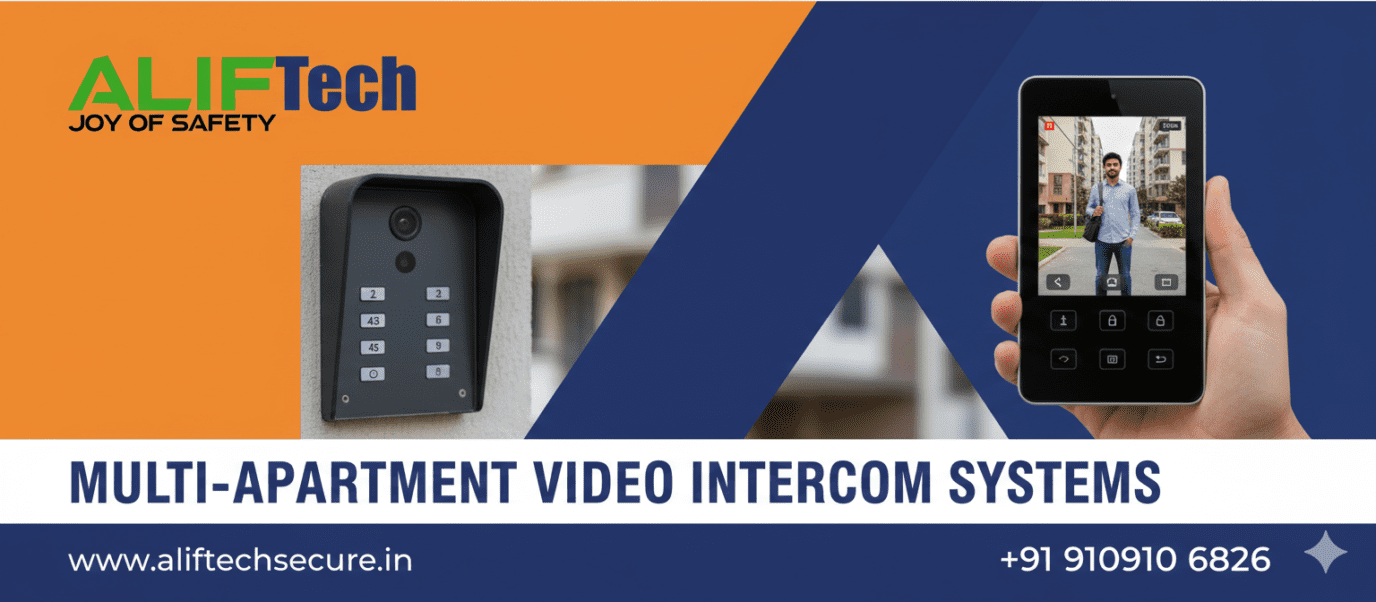
This sits at the main gate or lobby door and does the work. A camera, a speaker and microphone, a directory so visitors can find a flat, and buttons or a touchscreen to call.
What to check on a quote: camera resolution of at least 1080p, a wide-angle lens so the panel sees a whole person rather than a face, infrared for night, and an IP65 or better weather rating. Stainless steel construction matters at an Indian building entrance, where the panel sits outdoors through a monsoon and a summer.
Panels are sized by unit count, and most ranges cover anything from 8 flats to 200 or more.
Indoor stations
Each flat gets one. A screen showing who is at the gate, audio both ways, and a button to open the door.
Four tiers, and the price gap between them is real:
- Audio only, no screen, roughly ₹2,000 to ₹5,000
- Basic video, 4 to 7 inch screen, ₹5,000 to ₹12,000
- Advanced, 7 to 10 inch touchscreen with recording, ₹12,000 to ₹30,000
- Smartphone app, no hardware at all, no additional cost
That last row is why IP systems appeal to committees. A resident who takes the app instead of a wall unit costs the society nothing for that flat.
Our video door phone range covers both analog and IP options.
The controller
The box that routes calls to the right flat, manages the door lock and keeps the logs. On IP systems it also handles the network side and connects to management software.
Most committees never see it. It matters because a failed controller takes the whole building offline, so ask where it sits and whether it has backup power.
Analog or IP
The decision most committees get stuck on.
Analog
Dedicated wiring carries video, audio and control separately. Proven, simple, and any local technician can work on it.
Where it wins: lower upfront cost, straightforward troubleshooting, no dependence on a network, and it keeps working when the internet does not.
Where it does not: heavy cabling, no smartphone access at any price, a fixed unit capacity, and awkward expansion.
Best for buildings under 20 flats, tight budgets, and locations where internet reliability is poor.
IP
A single Cat6 cable per point instead of multiple analog wires, running over the building’s network.
Where it wins: far less cabling, smartphone access, remote management, easy expansion, and integration with CCTV and access control.
Where it does not: higher upfront cost, it needs a working network, and configuration is more involved.
Best for new construction, complexes above 50 flats, and any society where residents expect phone access.
Hybrid
Traditional wiring for the core functions with a network connection for the advanced ones. This is usually the practical answer for retrofitting an older building in Palasia or South Tukoganj where pulling new cable through finished walls is the expensive part.
What Committees Actually Ask
Six questions come up in every society meeting.
“Can we answer from our phones when we are out?”
Only on IP systems. Residents get a push notification, see the visitor, talk, and open the door from anywhere with internet. Analog cannot do this regardless of what a vendor claims.
Most systems allow several family members per flat, each with their own app login, which matters in households where both parents work.
“What happens in a power cut?”
Without backup, the system stops. This is the question that decides many purchases in Indian buildings and it deserves a straight answer.
Specify a UPS sized for four to eight hours covering the panel, controller and lock. Also settle whether the door lock should fail secure, staying locked, or fail safe, releasing, which depends on your fire escape arrangement.
“How many flats can one system handle?”
Basic analog systems cover 8 to 50 units. Larger analog systems reach beyond 100. IP systems scale much further, into the thousands.
Ask about the ceiling before buying, and size for the flats you will have in five years rather than today.
“Will it work with our existing locks?”
Usually yes. Most systems drive standard electric strikes, magnetic locks or motorised locks. Check the voltage matches, typically 12V or 24V, and set the unlock duration to suit how quickly the lock responds.
“Can we control who gets in besides residents?”
Yes, and this is where the system earns its cost beyond the intercom function.
Add RFID cards or fobs for residents, PIN codes as an alternative, and temporary codes for maids, drivers and service staff with a set validity. Deliveries can get a short access window rather than the guard opening the gate on trust.
Every entry gets logged, which is the part committees find most useful when something goes missing.
“Who maintains it?”
The question societies ask last and should ask first.
Camera lenses need cleaning quarterly. Speakers and microphones need testing. Locks need checking. Firmware needs updating. Without an AMC, none of this happens and the system degrades quietly until half the flats have a unit that does not work.
Get the AMC quoted with the installation rather than a year later.
Planning the Installation
Sizing
Count the flats, add stations for common areas the committee wants covered, such as the gate cabin, clubhouse or basement, and allow for future units if the society has expansion plans.
Check the concurrent call capacity too. A system that handles only one call at a time is a problem at 7 PM in a large building.
Cabling
Analog systems need multi-conductor cable to each flat. IP systems need one Cat6 run per point, with a maximum of 100 metres from the switch.
Vertical runs through a building need fire-rated conduit. Label everything at both ends, because the society will change vendors at some point and an unlabelled riser costs the next contractor a day.
For IP systems the network side needs a PoE switch with enough power budget for every station.
Power
The entrance panel typically needs 12V at 3A. Indoor stations run on PoE or 12V at around 1A each. The controller needs stable power and backup.
Add these up before installation rather than discovering the supply is undersized afterwards.
Mounting
The entrance panel goes at 1.4 to 1.5 metres so the camera sits at face height, angled slightly downward so rain runs off rather than pooling on the lens.
Fix into concrete rather than plaster, and seal every cable entry. An entrance panel is outdoors, and water getting in behind it is the most common early failure.
Indoor stations go at the same height, near the flat’s main door.
What It Costs
Equipment plus installation, for an Indore building.
| Building size | Analog | IP with smartphone access |
|---|---|---|
| Small, 8 to 16 flats | ₹80,000 to ₹1.5 lakh | ₹1.5 lakh to ₹3 lakh |
| Medium, 20 to 50 flats | ₹2 lakh to ₹4 lakh | ₹4 lakh to ₹8 lakh |
| Large, 50 to 200 flats | Not typically suitable | ₹8 lakh to ₹25 lakh |
| Installation | ₹20,000 to ₹50,000 small, up to ₹5 lakh for large complexes | Same |
| Annual AMC | Quote with the installation | Quote with the installation |
Per flat, expect ₹12,000 to ₹25,000 depending on system type, building size and indoor station tier.
Larger buildings get better per-unit pricing, so a 60-flat society pays less per flat than a 12-flat one. Committees comparing quotes across societies should keep that in mind.
One thing worth putting to the committee: IP costs more upfront and less to expand. If the society expects to add a wing or a second tower, that changes the arithmetic considerably.
Common Problems and What Causes Them
No video, or poor quality. Check the camera has power, then clean the lens and its cover. Dust on an entrance panel in Indore builds up faster than people expect. For IP systems, confirm the network has bandwidth. Backlighting from the afternoon sun also ruins video, and the fix is repositioning rather than a better camera.
Audio problems. Verify microphone and speaker connections, then check volume settings. Echo cancellation helps where the lobby is tiled and reverberant.
The lock does not open. Confirm the lock has power, check the wiring, then test it manually. If it opens but not for long enough, increase the unlock duration in settings. Magnetic locks in particular need adequate supply.
The whole system is offline. Check power to every component, then network connectivity on IP systems, then restart the controller. If nothing returns, the controller itself may have failed, which is why backup power and an AMC matter.
Frequently Asked Questions
Can residents answer the intercom from their phones?
Only on IP-based systems. Residents get a push notification, see live video of the visitor, talk to them and open the door from anywhere with internet. Analog systems cannot do this at any price, so if phone access matters to your committee, that decides the system type.
What happens to the intercom during a power cut?
Without backup power it stops working entirely. Specify a UPS sized for four to eight hours covering the entrance panel, controller and lock. Also decide with your installer whether the door should stay locked or release during a failure, since that depends on your fire escape arrangement.
How many flats can one system support?
Basic analog systems handle 8 to 50 units, larger analog systems go beyond 100, and IP systems scale into the thousands. Ask for the specific ceiling before buying and size for the flats you expect in five years rather than the ones you have now.
Can more than one family member use the app?
Yes. Most systems allow several users per flat, each with their own login, which suits households where more than one person needs to answer the gate. The society administrator controls who has access and can remove a login when someone moves out.
Will the system work with our existing electric locks?
Usually. Most systems drive standard electric strikes, magnetic locks and motorised locks. Confirm the voltage matches, typically 12V or 24V, and set the unlock duration to suit how quickly your lock responds. Your installer should test this at handover.
How much does installation cost separately from the equipment?
Roughly ₹20,000 to ₹50,000 for buildings under 20 flats, ₹50,000 to ₹1.5 lakh for 20 to 50 flats, and considerably more for large complexes. Cabling complexity drives it, so a retrofit into a finished building costs more than an installation during construction.
For the Committee Meeting
Three things to settle before approving any quote.
System type. Analog if the building is small and the budget is tight. IP if residents want phone access or the society plans to expand.
Backup power. Get the UPS specified in the quote, not added afterwards.
AMC. Get it priced at the same time. A society that budgets for the system and not its maintenance ends up with a system nobody maintains.
Then ask each vendor for a site visit before quoting. A quote produced without someone walking the building is a guess about your cable runs, and cable runs are where the cost variation sits.
Book a free society intercom assessment. We visit the building, count the points, look at the riser and the entrance, and prepare a proper BOQ before quoting.
We install analog, IP and hybrid systems for societies across Indore, including Super Corridor, Nipania, Vijay Nagar and the older buildings in Palasia and South Tukoganj where cabling is the harder part of the job.
Every installation includes labelled cabling, a documented configuration handed to the committee, and training for whoever manages the system. Our AMC covers lens cleaning, station testing and firmware updates, so the system works in year three as it did in year one.
See our video door phone solutions, our VDP installation service, or get in touch.
Call or WhatsApp +91 91091 06826.

