
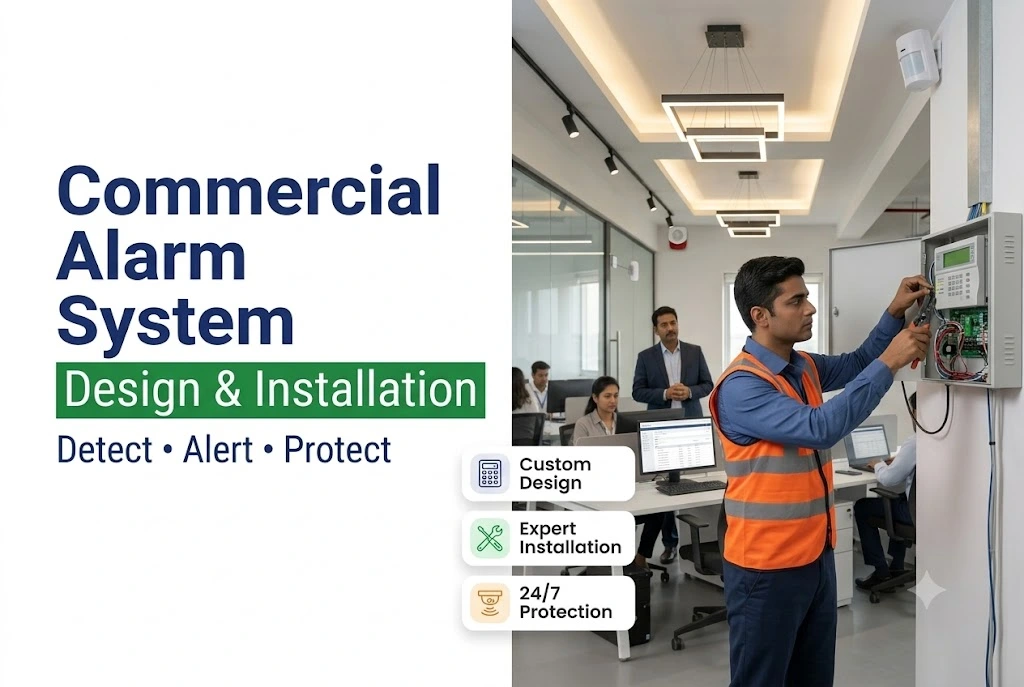
A camera records a break-in. An alarm interrupts one.
That single difference decides which system a business actually needs, and most owners in Indore buy the camera first and think about the alarm after something happens.
This guide covers how a commercial alarm system is designed, what each component does, how monitoring works in India rather than in the brochures, and what it costs.
Quick Answer
- Door and window contacts trigger at entry, before a motion sensor sees anything.
- Zone the premises so an alert tells you where, not just that something happened.
- Wired suits new construction. Wireless suits existing buildings.
- Monitoring in India usually means a call to you or a private response team, not police dispatch.
- Battery and cellular backup matter here, because power cuts and cut phone lines are both routine.
Why an Alarm Does Something Cameras Cannot
Cameras document. Alarms interrupt.
A siren going off at 2 AM sends most opportunistic intruders back out the way they came, before anything is taken. Footage of the same person, however clear, arrives after the loss.
So the two work together rather than competing. Cameras give you evidence and daily oversight. The alarm gives you the interruption and the alert. Our retail security checklist covers how the two combine for shops and showrooms.
For premises holding real value overnight, jewellery, electronics, pharmaceuticals or stock, the alarm is the part that changes outcomes.
The Components, and What Each One Does
Control panel
The panel manages every connected device, holds the zone configuration and user codes, and communicates outward when something triggers. Everything else on this list connects back to it.
Ours sit in our alarm control panel range.
Door and window contacts
Magnetic contact sensors on every external opening detect the moment a door or window is forced or opened while the system is armed.
These are the cheapest and most effective part of the system. They trigger at entry, before an intruder is inside, which is earlier than any interior sensor can manage. At a few hundred rupees each, this is the best security per rupee available.
Motion detectors
Passive infrared sensors detect body heat moving through a space. Dual-technology units combine PIR with microwave detection, which cuts false alarms from pets, air movement or sunlight through a window.
For a warehouse or a large floor, dual-technology is worth the extra cost, since false alarms are what make staff stop taking the system seriously.
Glass break detectors
Acoustic sensors tuned to the frequency of breaking glass. They cover showroom windows and display cases where an intruder may reach through rather than walk in.
Keypads and arming
Staff arm and disarm through a keypad at the entrance, or through a card reader where you want a record of who did it.
If you also run access control, the two can share credentials so one card handles both.
Sirens
A loud siren deters, alerts anyone nearby, and tells the intruder they have been detected. Fit both an internal and an external unit, since the internal one is unpleasant enough to shorten the visit.
Panic buttons
For jewellery counters, cash handling areas and reception desks, a panic button raises an alert without anyone visibly doing anything.
How Monitoring Actually Works in India
Worth being straight about this, because most alarm content on this subject is written for other markets.
A local alarm sounds a siren and notifies you by app or SMS. Nobody else is involved. For most small businesses this is adequate, since the siren does the deterrent work and you decide what happens next.
A monitored alarm connects to a monitoring centre that sees the activation. What happens next depends on the service. Typically the centre calls you, then your listed emergency contacts. Where a private response service operates in your area, they can dispatch a guard.
Police dispatch is not the standard outcome here. Some international guides present it as automatic. But in most Indian cities the police response follows your call rather than the monitoring centre’s, so treat monitoring as faster notification and verification rather than a guaranteed response.
On insurance, coverage conditions for high-value commercial premises increasingly reference alarm and monitoring arrangements. Check your own policy rather than assuming a discount exists, since terms vary considerably between insurers here.
For jewellery, gold and high-value electronics, monitoring is worth having regardless. For an ordinary office holding no cash overnight, a good local alarm usually does the job.
Designing the System
Start with a walk, not a product list
Walk the premises and mark every external door, every ground floor window, the routes between them, and wherever value sits overnight.
Then note the awkward parts: a rear door that opens onto a shared corridor, a skylight, a compound wall someone could climb, a shutter that lifts from outside.
That walk produces the sensor list. A product catalogue does not.
Choose wired, wireless or hybrid
Wired systems run cable to each sensor. More reliable, no batteries to change, and they suit new construction or a building being renovated where cable can go in before finishes.
Wireless systems use battery-powered sensors talking to the panel by radio. Far easier to fit in an occupied building, no cable routing, and quick to expand. Batteries need periodic replacement, and range through thick RCC walls needs checking during the survey.
Hybrid systems combine both, wired where cable already exists and wireless where it does not. For most retrofits in older Indore commercial buildings, this is the practical answer.
Our wired and wireless ranges cover both.
Divide the premises into zones
Zoning is the difference between an alert saying “something happened” and one saying “the rear stockroom door opened at 2:14 AM.”
A workable zone plan for most commercial premises:
- Perimeter, meaning all external doors and ground floor windows
- Interior, meaning motion detection across the main floor
- High-value, meaning the safe, server room or stock area, armed separately
- After-hours, meaning areas that should see no movement outside working hours
Zones also let you arm part of the building while people work in another part, which is what makes the system usable rather than something staff bypass.
Plan for power cuts and cut lines
Two failures matter in Indian conditions.
Power. The panel needs battery backup that holds through a typical outage. Twenty-four hours is a reasonable target, and it should report the failure rather than fail silently.
Communication. A landline can be cut from outside the building, which is the oldest defeat there is. A cellular backup path means the alarm still reaches you when the line is down.
Ask about both before buying. Neither is expensive, and a system without them protects you only on days when nothing else has gone wrong.
Installation, Step by Step
1. Site survey. A technician walks the premises, marks sensor positions, checks wireless range through your actual walls, and plans cable routes where wired sensors are going in.
2. Fitment. Panel, sensors, keypads and sirens go in. Contacts need aligning properly, since a misaligned magnet either fails to trigger or triggers constantly.
3. Programming. Zones, user codes, entry and exit delays, notification rules and monitoring settings. Entry delay matters more than it sounds, since too short and staff set the alarm off daily, too long and an intruder has time to reach the panel.
4. Testing. Every sensor triggered individually, every zone verified, the communication path tested, and the backup battery checked.
5. Staff training. Whoever opens and closes the premises needs to arm and disarm confidently, know what to do on a false alarm, and know who to call. Skip this and the system gets left disarmed within a month.
What It Costs
Cost depends on the number of openings, whether you go wired or wireless, and whether monitoring is included.
| Component | Cost |
|---|---|
| Control panel | [FILL IN] |
| Door or window contact, each | [FILL IN] |
| Motion detector, each | [FILL IN] |
| Glass break detector, each | [FILL IN] |
| Siren, internal and external | [FILL IN] |
| Panic button, each | [FILL IN] |
| Installation, small premises | [FILL IN] |
| Monitoring, per month | [FILL IN] |
| Annual AMC | [FILL IN] |
Two things drive the total. The number of external openings sets the contact count, and that is usually the largest line. And monitoring is a recurring cost rather than a one-time one, so compare it across three years rather than at purchase.
The cheapest quote usually skips the contacts. A system with motion detectors and no door contacts triggers only after someone is already inside, which loses you the most useful minutes.
Five Mistakes Worth Avoiding
Skipping door and window contacts. They are the cheapest component and the earliest warning. A motion-only system detects the intruder after entry rather than at it.
No zoning. A single-zone system tells you something happened somewhere. That is far less useful at 2 AM than knowing which door opened.
Ignoring false alarms. A system that triggers on a stray cat trains staff to ignore it. Dual-technology sensors and correct placement cost less than the alarm nobody responds to.
No backup power or communication. Both failures are routine here and both are cheap to cover.
No maintenance. Batteries in wireless sensors die, contacts drift out of alignment, and sirens seize. An annual service keeps the system real rather than decorative. Our alarm repair and service covers this.
Frequently Asked Questions
Do I need a monitored alarm, or is a local alarm enough?
For most offices and small businesses, a local alarm with app alerts covers it, since the siren does the deterrent work. For jewellery, gold, electronics or anywhere holding real value overnight, monitoring is worth having because it adds verification and a response pathway when you cannot get there yourself.
How long does installation take?
One to two days for a small commercial premises, longer for a large warehouse or a multi-building site. Wireless systems fit faster since there is no cable routing. Most of the time goes into sensor placement and testing rather than mounting the panel.
What happens during a power cut?
A properly specified panel runs on battery backup, typically holding through a day. It should also report the power failure rather than going quiet. Cellular backup keeps the communication path alive if the phone line is down or cut, which is worth specifying rather than assuming.
Can the alarm work with my existing CCTV?
Yes. Integration lets an alarm activation trigger recording or bookmark the footage at that moment, so you find the relevant clip in seconds rather than scrolling. Ask whether your panel and recorder support it before buying, since compatibility varies by brand.
How often should the system be serviced?
Annually at minimum. A service tests every sensor, replaces batteries in wireless devices, checks contact alignment, verifies the siren and confirms the communication path. High-value premises are worth doing twice a year, and regular servicing is also what prevents the false alarms that make staff stop trusting the system.
The Short Version
Contacts on every external opening. Motion detection inside. Zones so an alert tells you where. Backup power and a cellular path. And an annual service so it still works when it matters.
Cameras tell you what happened. The alarm is what stops it happening.
Book a free alarm system site survey. We walk the premises, mark every opening that needs covering, check wireless range through your actual walls, and design the zone plan before quoting anything.
We supply and install wired, wireless and hybrid systems for offices, showrooms, warehouses and factories across Indore and Pithampur, and we integrate alarms with existing CCTV and access control where you already have them.
Every installation includes zone documentation, staff training and a tested backup path. Our AMC covers sensor testing, battery replacement and contact alignment, because an alarm nobody services is an alarm nobody can rely on.
See our burglar alarm range, our burglar alarm installation service, or get in touch.
Call or WhatsApp +91 91091 06826.

