
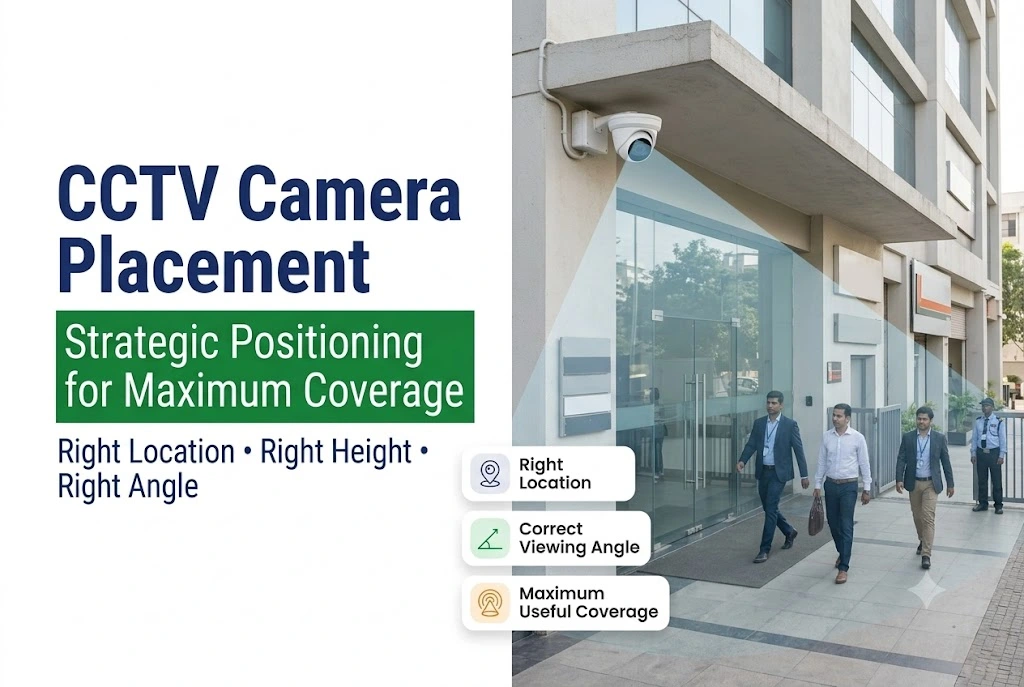
CCTV Camera Placement: Strategic Positioning for Maximum Coverage
The best camera in the catalogue records useless footage if it points at the wrong thing.
That is the whole subject in one line. Placement decides whether you get a face you can identify or a shape you cannot, and it costs nothing to get right at installation while costing a great deal to fix afterwards.
This guide covers where cameras belong, at what height and angle, and the mistakes that leave gaps in otherwise well-specified systems.
Quick Answer
- Mount at 2.4 to 3 metres for most positions. Above 4.5 metres you record the tops of heads.
- Tilt down 10 to 15 degrees for a nearby doorway, more for a longer approach.
- Overlap coverage by 10 to 20 percent so no gap sits between two cameras.
- Cover the approach, not just the door. Footage of someone who turned back is often the useful footage.
- Test at night and in rain before signing off the installation.
Why Placement Decides Everything
A camera position determines three things at once: whether a face is identifiable, whether the footage covers the moment that matters, and whether the system has gaps somebody can walk through.
Get those right and a modest four-camera system does real work. Get them wrong and an expensive installation produces recordings that show an incident happened without showing who caused it.
This matters more in Indian conditions than most guides acknowledge. Harsh afternoon sun through a west-facing entrance, monsoon rain reducing visibility, and dust settling on outdoor lenses all affect what a camera actually captures across a year.
Height and Angle
Mount between 2.4 and 3 metres
That range works for almost every position. It puts the camera above easy reach while keeping faces in the usable part of the frame.
Above roughly 4.5 metres, facial detail drops sharply. You record the tops of heads and the tops of vehicles, which tells you something happened but not who did it.
For general overview coverage of a large open area, higher mounting at 3.5 to 4.5 metres works, provided you accept that those cameras are for context rather than identification. So pair them with a lower camera at the entry point.
Angle depends on height and distance
Most guides quote a fixed downward tilt, which is why you see different numbers in different places. The angle actually follows the geometry.
A camera at 2.5 metres covering a doorway three metres away needs roughly 10 to 15 degrees of downward tilt. The same camera covering an approach path eight metres out needs less tilt, closer to flat. A camera mounted higher, or looking at something closer, needs more.
The practical test beats any number. Stand where a person would stand, look at the live feed, and check that the face fills a useful part of the frame rather than sitting at the very top or bottom. Adjust until it does.
Gate cameras are a special case
For number plate capture at a vehicle gate, height changes entirely. Mount at 1.2 to 1.8 metres, looking along a narrow entry lane rather than down across a wide view.
A camera at four metres angled down over a gate captures the roof of every vehicle and no readable plate. This is the most common placement error we correct in Indore, and it is the one that costs the most when footage is actually needed.
Our factory and warehouse CCTV guide covers gate and yard placement in more depth.
Where Cameras Belong
Entrances and exits
One camera above the door facing downward captures everyone entering and leaving. Then add a second at face height inside the entryway where the position allows, since the two angles together give you a much better chance of identification.
Cover the approach path, not just the doorway. Footage of someone who walked up, looked around and left without entering is often the footage that matters, and a camera pointed only at the door never sees it.
Vehicle gates and parking
Position cameras at corners and elevated points for general parking coverage, and at plate height on the entry lane for identification.
For parking specifically, cover at vehicle level rather than bird’s eye. In any vehicle incident the useful detail sits at door and windscreen height, so a roof-level view gives you very little.
Retail and commercial floors
Cover the billing counter from more than one angle, so you see both the transaction and the customer side. For jewellery, electronics and pharmacy, that second angle catches what the counter-side camera cannot.
Then cover merchandise displays, aisles and the emergency exit. Our retail security checklist works through this zone by zone.
Perimeters
Along a boundary wall or fence, space cameras according to their actual range rather than a fixed distance. For standard cameras that usually works out to one every 15 to 30 metres depending on lens and lighting.
Use thermal cameras for long perimeters and poor light, since they detect heat rather than visible light and ignore headlight glare and shadow entirely. They cost considerably more, so they suit specific high-risk stretches rather than general coverage.
Homes
Front door, gate, driveway and any rear or side access. Ground floor windows where the layout allows.
Position a video door phone or doorbell camera at 1.2 to 1.5 metres, which puts it at face height for an adult standing at the door. Our home installation guide covers the full sequence, and the video door phone range covers the hardware.
Lighting, and Why It Breaks More Installations Than Anything Else
Lighting conditions defeat more cameras than any other single factor, and the problem is rarely visible on the day of installation.
Never point a camera at a light source. That includes the afternoon sun through a west-facing entrance, which turns everyone walking in into a silhouette for two hours a day.
Use wide dynamic range cameras where light is mixed. A doorway with bright daylight outside and dim interior lighting inside is exactly the situation WDR exists for.
Add infrared or low-light cameras for dark areas, and consider whether external lighting would help more than a better camera. Sometimes a light costs less than the camera upgrade it replaces.
Test at different times of day. A position that works at 11 AM may be unusable at 4 PM, and neither shows up during a morning installation.
Eliminating Blind Spots
Overlap the fields of view of adjacent cameras by roughly 10 to 20 percent. That leaves no strip of ground covered by nothing.
Use wide-angle cameras for broad areas and narrow-angle cameras where you need detail at distance. Mixing the two deliberately covers more ground with fewer units than using the same lens everywhere.
Then walk the property while somebody watches the live feed. That single exercise finds gaps no plan predicts, and it takes twenty minutes.
Camera Types and Where Each Fits
| Type | Best for | Note |
|---|---|---|
| Dome | Indoor areas, retail floors | Discreet, harder to tell where it points |
| Bullet | Outdoor, long-range, perimeter | Visible deterrent, easy to aim |
| PTZ | Large open areas with active monitoring | Needs someone watching, or tour presets |
| Fisheye | Open indoor spaces | 180 to 360 degree coverage, fewer units |
| Turret | Indoor or outdoor, general use | Easier to adjust than a dome |
| Thermal | Long perimeters, complete darkness | Detects heat, ignores glare, costs more |
Our IP camera range and PTZ cameras cover most of these.
One point on buying. Since 1 April 2026, cameras sold in India must meet MeitY’s Essential Requirements, so ask for the BIS registration number for the exact model before paying. Our guide to the 2026 CCTV import and BIS rules covers what changed.
Six Mistakes That Waste a Good System
Mounting too high. Above 4.5 metres you lose facial detail entirely. This is the most common error and the most expensive to discover late.
Ignoring the light. Backlighting and direct sun produce unusable footage, and neither is obvious at installation time.
No overlap between cameras. Single coverage leaves gaps, and gaps are exactly where somebody walks.
Making cameras too obvious. Visible cameras deter, which is good. A camera mounted where anyone can reach and twist it invites tampering instead. Balance the two.
Skipping weatherproofing. Indoor-rated cameras fail outdoors, usually within one monsoon. Any exterior position needs IP66 at minimum, and IP67 where rain hits directly.
No maintenance access. A camera you cannot reach is a camera nobody cleans. Dust on an outdoor lens in Indore degrades the picture within months, and a position that needs scaffolding to service will not get serviced.
Testing Before You Sign Off
Do all six of these before accepting an installation as complete.
- Review footage at different times of day, including late afternoon
- Walk every coverage area while somebody watches the live feed
- Check whether faces are actually identifiable at each entry point
- Verify night vision, looking specifically for infrared glare off nearby walls
- Test remote viewing on mobile data rather than home Wi-Fi
- Get the camera positions and coverage documented in writing
That last one matters more than it sounds. A documented layout tells whoever services the system in three years what was intended, and it tells you what changed if coverage degrades.
Frequently Asked Questions
What is the ideal height for a CCTV camera?
Between 2.4 and 3 metres for most positions, which keeps the camera above easy reach while holding faces in the usable part of the frame. Overview cameras can sit at 3.5 to 4.5 metres. Above roughly 4.5 metres facial detail drops sharply, so those cameras give context rather than identification.
How many cameras does a property actually need?
It depends on layout and risk zones rather than area alone. A typical home needs four to six covering the gate, front door, rear access and one indoor position. Commercial properties usually need eight to twenty, depending on entry points and floor size. Only a site survey gives the real number, since a camera in the wrong position adds cost without adding coverage.
Should cameras be visible or hidden?
Visible cameras deter, so most positions should be obvious. But mount them where nobody can reach and twist them, because a camera at head height invites tampering. Most effective systems combine clearly visible cameras at entry points with less prominent ones covering the areas that matter most.
What downward angle should a camera have?
It depends on mounting height and how far away the subject is. A camera at 2.5 metres covering a doorway three metres out needs roughly 10 to 15 degrees. A longer approach needs less tilt. Rather than following a fixed number, check the live feed with somebody standing where a person would stand.
How do I find blind spots in my coverage?
Overlap adjacent camera views by 10 to 20 percent, then walk the whole property while somebody watches the live feed and calls out where you disappear. That twenty-minute exercise finds gaps no floor plan predicts, and it is worth repeating whenever the layout changes.
Can I install outdoor cameras myself?
Yes for straightforward positions using an existing power point. Call a licensed electrician for any new mains point or concealed wiring. The parts most people get wrong are not the mounting but the height, the angle and the weatherproofing at the cable entry, which is where water gets in.
The Short Version
Mount at 2.4 to 3 metres. Angle so faces sit in the middle of the frame rather than the edges. Overlap adjacent cameras. Cover the approach as well as the door. And test at night before calling the job finished.
Placement costs nothing at installation and a great deal to correct afterwards, once cable is inside walls and brackets are drilled into place.
Book a free CCTV site survey in Indore. We walk the property, work out where cameras actually need to point for your layout, and design coverage around that rather than around a package.
Certified cameras with documentation, correct heights and angles, weatherproofing at every exterior position, remote access configured before we leave, and a written coverage map you can hand to whoever services the system later.
See our CCTV installation service across Indore and MP, our AMC plans for ongoing camera and lens health, or get in touch.
Call or WhatsApp +91 91091 06826.


1 Comment. Leave new
[…] at the actual position before signing off an installation. Our placement guide covers what else to […]