

By AlifTech Secure | CCTV & Security Solutions, Indore | June 2026 | www.aliftechsecure.in
Most factory owners budget their first security system by remembering what cameras cost for a shop. That comparison is where the trouble starts.
A shop system and a factory system share a name and some hardware. Beyond that, though, they are different projects with different failure modes, so a factory buying shop-grade equipment finds out during the first monsoon or the first forklift collision.
This guide covers camera types that survive industrial conditions, zone-by-zone placement, access control integration, what compliance actually requires in 2026, and real costs for Indore and Pithampur units.
Quick Answer
- Industrial ratings are not optional. IP66 or IP67 for dust and washdown, IK10 for impact.
- Gate cameras belong at 1.2 to 1.8 metres, not 4 metres. Height decides whether you get number plates.
- The dispatch bay is where goods actually go missing, not the production floor.
- 30 days storage minimum, 45 to 60 for stores and dispatch.
- The register requirements changed. The Factories Act was subsumed into the OSH Code in November 2025.
- Cost: ₹75,000 to ₹1.8 lakh small, ₹2 to ₹5 lakh medium, ₹5 to ₹15 lakh large.
Why Factory Requirements Differ
Two reasons: the environment, and the geometry.
The environment breaks standard equipment. Production dust clogs ordinary camera housings within weeks, before anyone notices the picture softening. Chemical areas produce fumes and humidity that degrade optics. Welding bays and heavy machinery generate electrical interference that affects wireless links and cheap IP cameras. Forklift vibration near loading bays loosens mounts and connectors. And in an Indore summer, an outdoor camera on a west-facing wall sees temperatures a commercial-grade unit is not rated for.
The geometry defeats simple coverage. One camera at the entrance covers a shop reasonably. A plant with 5,000 to 20,000 square metres of floor, a yard, a boundary wall, several gates and different risk levels per zone needs a design, not a package of identical cameras in convenient spots.
So when office thinking gets applied to a factory, the result is a system recording footage nobody can use, because the camera type, position or resolution was wrong, or because it pointed at the wrong thing.
Camera Types That Survive Industrial Conditions
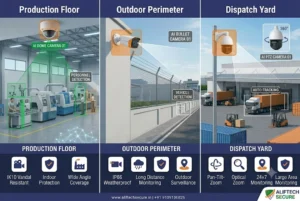
Dome cameras with IK10, for production floors
For production areas, assembly and indoor stores, use dome cameras rated IK10, which means the housing withstands a 20-joule impact. That is the level of contact a forklift arm, a swinging length of material or a stacked box actually delivers, and standard housings do not survive it.
Domes also make it harder for anyone on the floor to see exactly where the camera points, which matters for deterrence. Then choose IP66 for dusty areas, or IP67 where there is water spray or washdown.
Bullet cameras with IP66 or better, for outdoors
Bullet cameras at IP66 or higher suit gates, boundary walls, loading docks and any exterior position.
Gate coverage deserves its own note, because this is the most common installation error we see in Pithampur. Number plate capture needs the camera at 1.2 to 1.8 metres, looking along a narrow entry lane, because that is the only angle that reads a plate cleanly. Mounting it at 4 or 5 metres angled down across a wide view captures the roof of every vehicle and nothing readable. Height is the whole decision.
PTZ, for large open areas
A PTZ camera earns its place in open yards and large covered warehouses where no fixed position covers the area.
It works best with someone actively monitoring, or on automated tour presets. But for pure recording, several well-placed static cameras usually beat one PTZ trying to cover too much, and they cost less too.
ANPR at vehicle gates
Plants with heavy vehicle movement benefit from number plate recognition at entry, which logs every plate automatically instead of relying on a gate register somebody fills in by hand.
These need specific placement, so a narrow lane at the correct angle and height, plus higher resolution than standard cameras. The value then shows up during an investigation, when you have a complete entry and exit record to work from.
Thermal, for high-value perimeters
Pharmaceutical plants, chemical storage and valuable finished goods warehouses are the cases for thermal on the boundary. Since thermal units detect heat rather than visible light, they work in complete darkness and ignore headlight glare and shadow.
Cost is considerably higher, so thermal suits specific high-risk stretches rather than general coverage.
| Camera type | Rating to specify | Zone |
|---|---|---|
| IP dome | IK10, IP66 or IP67 | Production floor, indoor stores |
| IP bullet | IP66 or higher | Gates, perimeter, loading bays |
| PTZ | IP66 outdoor | Large yard, open warehouse |
| ANPR | High resolution, narrow lane | Vehicle entry and exit |
| Thermal | IP66 or higher | Perimeter, high-value storage |
| Wide-angle or fisheye | IK10 indoor | Open areas needing 180 degree coverage |
Compliance in 2026: Two Things Changed
Factory owners have two separate compliance questions this year, though most articles cover one and miss the other.
Camera certification
From 1 April 2026, cameras that do not meet MeitY’s Essential Requirements cannot be manufactured, imported or sold in India.
For a private purchase, ask for the BIS registration number, the R-number, for the exact model, and check the packaging carries the Standard Mark. Under the Compulsory Registration Scheme, nobody may manufacture, store for sale, import, sell or distribute goods lacking that mark and number.
STQC certification is the deeper route required for government, PSU and GeM procurement. If your plant bids on government contracts, you need it. Otherwise BIS is your check, and a dealer offering an STQC reference in place of a BIS number is not answering the question.
Certification is granted model by model, never brand by brand. Still, it helps to know the field: certified Indian options currently include CP Plus, Prama, Sparsh, Matrix and HiFocus. Hikvision-branded and Dahua-branded models do not appear on the certified list, though Prama, Hikvision’s Indian joint venture, does under its own brand. Our made in India camera brands guide covers the detail.
The register requirements moved to the OSH Code
This is the part most factory content has not caught up with.
The four Labour Codes came into force on 21 November 2025, consolidating 29 central laws. The Factories Act, 1948 is among the legislation subsumed into the Occupational Safety, Health and Working Conditions Code, 2020.
So a 2026 article citing Section 62 of the Factories Act for worker register requirements is citing repealed legislation. The obligation to maintain records of attendance, hours worked and rest periods continues under the OSH Code, and registers may be maintained electronically.
Madhya Pradesh has notified final rules under all four Codes, which puts Pithampur and Indore units ahead of most of the country in having actual state formats to comply with rather than draft ones. Worth checking your registers against the notified MP formats rather than the old central ones, and worth asking your CA or labour consultant rather than relying on a blog for the specifics.
Zone-by-Zone Placement
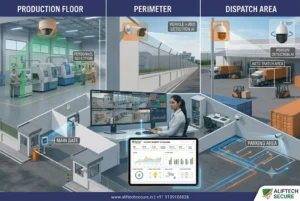
Placement decides whether the system works, because good cameras in bad positions still produce footage nobody can act on.
Vehicle gates
One camera per lane, at number plate height, positioned before the gate rather than after. Footage of a vehicle that turned around and left without entering is often the useful footage, and a camera inside the gate never sees it.
Pedestrian entries
One camera at face height on each door. Simple, though frequently skipped in favour of covering the main gate twice.
Reception and weighbridge
Cover the desk, any documents being signed, and visitor faces. So this footage settles disputes about what a visitor was briefed on or signed at entry, which comes up more often than theft does.
Production floor
Full identification coverage of a whole floor needs more cameras than most owners plan for, so prioritise instead: every entry and exit door, the routes high-value material and finished goods take, and the sections with the worst historical loss record.
Ceiling height is the trade-off. While a camera at 4 metres covers more floor than one at 2.5 metres, it also identifies people less well at distance. For a 5,000 square metre floor, then, plan 12 to 20 cameras depending on layout.
Raw material and finished goods stores
The two highest-risk zones for pilferage, and usually the least covered.
Every access point needs a camera. Internal coverage should also let you identify who reached a specific racking aisle. For high-value finished goods, add a camera on the dispatch area showing goods loading and the vehicle at the dock together.
Dispatch bays
This is where finished goods loss actually happens, not on the production floor.
Two cameras work better than one wide shot: one showing the vehicle at the dock, one covering the dock interior. Make sure both give you readable faces of driver and loaders, since one camera trying to do both jobs does neither well.
Perimeter and parking
One camera per 30 to 50 metres of open perimeter, depending on field of view.
Parking wants coverage at vehicle level rather than bird’s eye, because in any vehicle incident the useful detail sits at door and windscreen height, while a roof-level view gives you nothing.
The NVR room
Anyone wanting footage deleted knows exactly where to go. So lock the room, put an access control device on it, and point a camera at the door whose footage backs up somewhere else.
If you have a security cabin, cover its entrance and interior too, since a system your own security team can quietly disable is not really a system.
Access Control and Attendance
Zone-based access
Accounts has no operational reason to enter the production floor. Contract workers have none to enter raw material stores.
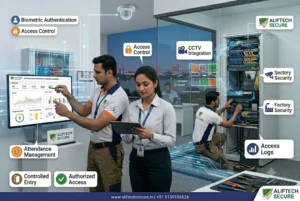
So access control lets you define who enters each zone, whether by fingerprint, face, RFID card or a combination, and it logs every entry with a timestamp and identity. When something goes missing from a specific zone, that log narrows the investigation to the people who were actually there.
Integration with CCTV
The setups that work best link the two, so an access event triggers the system to save a camera clip of that entry.
So if somebody authorised opens a raw material store at 11 PM, you have both the log entry and the footage, without anyone reviewing hours of recording to find it. That combination is also a far better deterrent than either alone, because staff understand it exists.
Attendance in dusty conditions
Face recognition outperforms fingerprint on a factory floor, since fingerprint readers fail on dirty, wet or worn hands, which describes most shop-floor workers by mid-shift. Failed scans build queues at shift change, and queues are what push supervisors into marking attendance manually.
Our Pithampur biometric attendance write-up covers a live example, and the attendance and salary software guide covers the payroll side, including the data protection duties that come with holding employee biometrics.
Storage and Retention
A factory where pilferage surfaces two weeks later needs 30 days minimum. High-value goods, where transporter and contractor disputes arise weeks after a delivery, want 45 to 60. The 7 to 15 days that ships as default in most packages is not enough.
Rough sizing: 16 cameras at mixed 2MP and 4MP recording continuously for 30 days needs about 8TB, while thirty-two cameras need 12 to 16TB. Motion-triggered recording extends that considerably, though sensitivity needs proper configuration, since a camera triggering on plastic film fluttering near a duct vent burns storage as fast as continuous recording.
Our guide on how long to keep CCTV footage works through the calculation and the evidence-handling requirements, which matter if a case reaches court.
Redundancy for critical zones
For dispatch, stores and the NVR room itself, arrange backup. That can be a second recorder elsewhere in the facility, cloud backup on selected cameras, or a RAID configuration protecting against a single drive failure.
Because a plant that loses its recorder to fire or deliberate damage, with no backup, has no investigative material at all.
Costs in Indore and Pithampur
Equipment plus professional installation, certified cameras.
| Factory size | System scope | Cost |
|---|---|---|
| Small, up to 10,000 sqft | 8 to 16 cameras, 4TB recorder, cabling | ₹60,000 to ₹1.5 lakh |
| Small, with access control | Add biometric on 1 to 2 entries | ₹75,000 to ₹1.8 lakh total |
| Medium, 10,000 to 30,000 sqft | 16 to 32 cameras, 8 to 16TB, access control on 3 to 5 zones, ANPR at main gate | ₹2 to ₹5 lakh |
| Large, multiple buildings | 40 to 60 cameras, ANPR on two gates, zone access control, central VMS | ₹5 to ₹15 lakh |
| Annual AMC, medium system | Full system service | ₹20,000 to ₹50,000 |
The large band is wide because cabling distance, zone count, recorder capacity and analytics all move the total materially. A scoped design is the only way to narrow it, which is why we survey before quoting.
Frequently Asked Questions
How many cameras does my factory need?
No standard number applies. Floor area, ceiling height, entry point count, perimeter length and zone risk all decide it. As a rough guide, a 5,000 square metre single-shed unit needs 12 to 20 cameras for meaningful coverage, while a multi-building complex with a yard needs 30 to 60. A survey gives the real number.
Can I use existing Hikvision or Dahua cameras with a new recorder?
Yes. Installed cameras keep working and can be added to a compatible recorder, since the April 2026 restriction covers new sales rather than existing systems. Any camera you add or replace from now on has to be a certified model with a BIS registration number.
How long should factory footage be kept?
Thirty days minimum for production and general areas, 45 to 60 days for finished goods stores and dispatch. Pilferage and cargo discrepancies surface weeks after the event, so a recorder holding 7 to 15 days has usually overwritten the relevant footage before anyone looks.
Does CCTV need to integrate with access control?
Not technically, though it is worth doing. Integration saves a camera clip automatically at each access event, narrows investigations to whoever was actually in a zone, and gives you a combined record neither system produces alone. The integration cost is small against the investigative value.
What storage does a 16-camera system need?
About 8TB minimum for 30 days at mixed 2MP and 4MP with continuous recording. With motion-triggered recording properly configured, the same 8TB can stretch to 45 or 60 days. Recorder capacity is the most commonly under-specified item in factory installations, and running out overwrites the oldest footage silently.
Start With a Survey
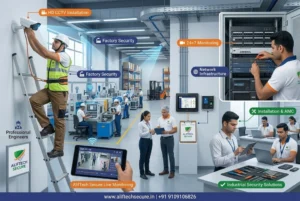
The Pithampur plants with systems that actually work all started the same way, since somebody walked the facility before anyone quoted a package.
Walking it with someone who knows why gate camera height decides number plate capture, why the dispatch bay needs two cameras rather than one, and why the recorder room needs its own camera produces a design that fits the plant. A price list does not.
| AlifTech Secure — Indore Call / WhatsApp: +91 9109106826 www.aliftechsecure.in | aliftechsecure@gmail.com 112 Basement, Akbar Ali Complex, MG Road, Palasia Square, Indore — 452001 |
| Book a Free Factory Security Site Survey We walk your facility, identify risk zones, and design the right CCTV and access control system. Call / WhatsApp: +91 9109106826 | www.aliftechsecure.in |
AlifTech Secure | CCTV & Security Solutions, Indore MP |+91 9109106826 | www.aliftechsecure.in


1 Comment. Leave new
[…] factory and warehouse CCTV guide covers gate and yard placement in more […]