
By AlifTech Secure | Fire & Safety Solutions, Indore | May 2026 |
www.aliftechsecure.in
Most building owners in Indore ask this question with a budget in mind, then discover the answer was never really theirs to make.
What your building legally requires is set by height and occupancy type, and the fire officer signs off on it. So the real question is not which system you prefer, it is which one your building falls under, and what happens if you guess wrong.
This guide covers what each system does, what the code requires, what both cost here, and the mistake that makes owners pay for a fire alarm twice.
Quick Answer
- Conventional shows which zone triggered, not which device. Simpler and cheaper.
- Addressable identifies the exact device and location. Faster response, easier fault finding.
- NBC 2016 Part 4 requires addressable detection above 15 m, and for assembly, mercantile and institutional occupancies regardless of height.
- Conventional costs 20 to 40 percent less upfront, though the gap narrows over the system’s life.
- Confirm with your fire officer before buying. Installing the wrong system means paying for two.
How a Conventional System Works
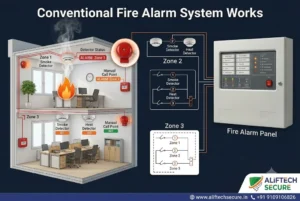
A conventional fire alarm system divides the building into zones, typically one per floor or per section of a large floor. The control panel connects to all detectors and call points in a zone through a single wired loop.
When anything in that zone triggers, the panel shows the zone.
That is both the strength and the limit. You know a zone has a problem, but not which device, so somebody has to walk the zone to find it. In a zone covering fifteen or twenty rooms, that search takes real time.
Where conventional genuinely works
A single-floor shop, a small office unit, a factory shed below 15 metres. The zone approach works when zones are small enough that finding the triggered device takes under a minute.
Conventional systems are also simpler to maintain, with fewer components and wiring most local electricians understand. If your building is small, the budget is tight, and the fire officer accepts conventional for your occupancy type, it is a sound choice.
Where it starts failing
Consider a production floor split into three zones. An alarm shows in Zone 2, which covers 40 metres. The guard walks the zone checking fifteen detectors one at a time, while a fire that started as a small electrical fault has several minutes to grow.
Fault finding has the same problem. A wiring fault shows the zone as in trouble, so the maintenance team checks every device in it. Hours go into troubleshooting that an addressable panel resolves in seconds.
How an Addressable System Works
An addressable fire alarm system gives every detector and manual call point its own identity. The panel communicates with each device individually and displays the exact location: “Smoke Detector, Server Room, Second Floor” rather than “Zone 3 Alarm.”
Why that matters operationally
Response goes straight to the device rather than to a general area, which in a large building saves minutes that matter.
The panel also monitors every device continuously for faults, showing a dirty sensor or a wiring problem with its exact location before it becomes a failure.
Because each device reports individually, the system supports more sophisticated responses too. Different actions for smoke on floor three versus a call point on floor one, allowing phased evacuation rather than emptying the whole building for every alert. It can also drive the PA system, lifts, air handling units and access control automatically.
The wiring point most quotes miss
Conventional systems run separate loops to each zone, which in a multi-storey building means a lot of cable.
Addressable systems connect all devices on a single loop, one cable passing through every device on a floor then continuing to the next. So total cable length in a large addressable installation is often considerably shorter than the conventional equivalent, which reduces both installation time and material cost.
That does not make addressable cheaper overall, though it does close part of the gap on larger buildings.
What the Code Requires
This is where owners need clarity, because what a building legally requires is not always what a vendor recommends.
NBC 2016 Part 4 covers fire and life safety. Automatic fire detection with addressable smoke detectors and manual call points is required for all buildings above 15 metres, and for assembly, mercantile and institutional occupancies irrespective of height.
Mercantile covers shops and retail. Institutional covers hospitals, nursing homes and educational buildings. So the rule reaches a much wider set of properties than most owners expect, including single-storey retail and small clinics.
IS 2189 governs the detail: detector placement in habitable areas, corridors, lift lobbies, staircase landings and electrical rooms, and manual call points within 30 metres travel distance of any occupied point. Above 24 metres, the alarm system has to interface with voice evacuation.
One important caveat. State fire rules and the local fire officer’s determination govern your specific building. Height thresholds and occupancy interpretation vary in application, and older buildings undergoing partial upgrades are often treated differently. Confirm with your fire officer before purchasing anything.
Where the code is heading
A revision to the National Building Code is currently in draft. Reporting indicates it proposes to make addressable detection, IoT-enabled alert connectivity and automatic coordination with emergency services baseline requirements rather than premium options, including for residential buildings above 15 metres.
This is a draft, not enacted law, so it changes nothing about your obligation today. But it is worth knowing when deciding between systems for a building near the threshold, because a conventional system installed now may face replacement earlier than its service life suggests.
The False Economy That Costs Twice
We see this regularly in Indore.
An owner installs conventional to save money. The Fire NOC inspection then requires addressable for that building type. Out comes the conventional system, in goes addressable, and the owner has paid for both.
Total spend ends up well above what installing addressable from the start would have cost, plus the delay on the NOC.
So confirm the requirement with the fire authority before installation, not after. A phone call costs nothing. A second installation costs a lakh or more.
Addressable vs Conventional, Side by Side
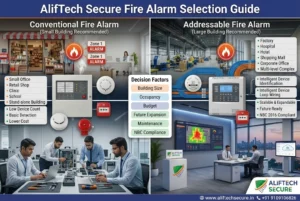
| Factor | Conventional | Addressable |
|---|---|---|
| How it identifies alarms | Shows the zone only | Exact device and location |
| Response time | Slower, staff search the zone | Direct to the device |
| Fault finding | Check each device in the zone | Panel names the faulty device |
| Fault monitoring | Limited | Continuous, per device |
| Wiring | Multiple loops, more cable in large buildings | Single loop, often less total cable |
| Upfront cost | 20 to 40 percent lower | Higher panel and device cost |
| Long-term maintenance | Higher, longer fault finding | Lower, faster diagnosis |
| Code position | Small low-risk buildings only | Required above 15 m and for assembly, mercantile, institutional |
| Scalability | New zones need new loops | Add a device to the existing loop |
| Integration with PA, lifts, access control | Limited or not possible | Standard |
| Phased evacuation | Not supported | Supported |
| Best suited for | Small shops, small single-floor offices | Most commercial and industrial buildings |
Four Questions That Decide It
What is your building’s height?
Above 15 metres, roughly four full floors, addressable detection is required. That is the starting point, though the questions below may point the same way even below the threshold.
What type of building is it?
Assembly, mercantile and institutional occupancies fall under the requirement regardless of height. If your building serves the public, or houses people who cannot evacuate quickly on their own, addressable is both required and genuinely the right answer.
How large is the floor area?
A building below 15 metres with one very large floor, say a 2,000 square metre warehouse shed, may pass with a well-designed conventional system if the zones stay small.
But large open floors are exactly where zone-based detection creates the search-time problem described earlier, so addressable usually earns its cost even where conventional would technically pass.
Do you need integration?
If the fire alarm should drive the PA system, alert security phones, close HVAC fire dampers, or interact with lifts and access control, addressable is the only option.
The same applies if you expect to expand. Adding a device to an addressable loop is straightforward, while adding to a conventional system may mean running a new zone loop.

Quick decision guide
- Below 15 m, small floor area, low-risk occupancy: conventional may work, confirm with the fire officer first
- Above 15 m: addressable required
- Assembly, mercantile or institutional occupancy: addressable required regardless of height
- Multiple buildings or large floor areas: addressable strongly indicated
- Integration with PA, lifts or access control needed: addressable only
- Unsure: book a site assessment before buying anything
What Each System Costs in Indore
Supply plus installation. Documentation, testing, commissioning and the written report for your Fire NOC application add to these.
| Scope | Conventional | Addressable |
|---|---|---|
| Small building, up to 500 sqm | ₹25,000 to ₹45,000 | ₹60,000 to ₹1.2 lakh |
| Medium building, 500 to 2,000 sqm | ₹45,000 to ₹1 lakh | ₹80,000 to ₹2 lakh |
| Large building, 2,000 to 5,000 sqm | ₹80,000 to ₹1.5 lakh | ₹1.5 lakh to ₹3 lakh |
| Control panel | ₹5,000 to ₹15,000 | ₹20,000 to ₹60,000 |
| Detector, per unit | ₹500 to ₹1,200 | ₹1,200 to ₹2,500 |
| Annual AMC | ₹8,000 to ₹20,000 | ₹10,000 to ₹25,000 |
The panel is where most of the price difference sits, since addressable panels carry loop electronics and each device carries its own addressing.
Both types need regular servicing to keep AMC records clean for NOC renewal, so budget for it either way. Addressable costs slightly less to maintain because fault finding is faster.
Frequently Asked Questions
Can I install a conventional system now and upgrade to addressable later?
Technically yes, but rarely cost-effective. The two use different wiring approaches and different device types, so upgrading means replacing the panel, all detectors, all call points and often the wiring. The upgrade typically costs as much as a fresh addressable installation.
Does my small factory in Pithampur need an addressable system?
It depends on height and occupancy. Above 15 metres, addressable is required. A lower single-shed unit may satisfy the fire officer with conventional. Factories handling chemicals, pharmaceuticals or flammable materials face higher scrutiny regardless of height, so confirm with the fire department before purchasing.
How many fire detectors do I need?
Coverage per detector depends on ceiling height and room layout under IS 2189, and manual call points must sit within 30 metres travel distance of any occupied point. A 1,000 square metre building typically needs 15 to 20 smoke detectors plus heat detectors in kitchens and electrical rooms. A site assessment gives the exact layout.
Will a wireless addressable fire alarm work in my building?
Wireless addressable systems work well where cabling is difficult, such as heritage structures or occupied buildings being retrofitted. They cost more because each device runs on batteries, though they remove the cost and disruption of cable installation. For new construction, wired addressable is usually more practical.
How long does a fire alarm installation take?
A conventional system in a small building takes one to two days. An addressable system across two or three floors takes two to three days plus a day for testing, commissioning and documentation. Fifty or more devices may take five to seven days. Allow additional time for the Fire NOC documentation.
The Short Answer
For a small ground-floor office or a single-shed unit below 15 metres, conventional may be adequate. Confirm it with the fire officer before installing, because that conversation costs nothing and a second installation costs a lakh or more.
For most commercial and industrial buildings in Indore, addressable is what the code requires and what the building actually needs.
If you are not certain which applies, a site assessment takes an hour and gives a definitive answer. From there the installation and the Fire NOC documentation follow a clear path.
|
AlifTech Secure | Fire Safety & ELV Solutions, Indore MP | www.aliftechsecure.in | +91 9109106826


2 Comments. Leave new
[…] in stairwells, toilets and plant rooms, where someone might be when it matters. Our guide on addressable and conventional fire alarms covers what each type is capable […]
[…] guide on addressable versus conventional systems covers which type your building actually […]