
AI Quick Answer
Electricity bill kam karne ka solution starts with three moves: correct your power factor, shift heavy loads to off-peak hours, and stop powering equipment nobody uses. MPERC approved a 4.8% average tariff rise for FY 2026-27 and allows smart meter users up to 20% rebate on off-peak units. Timing your usage pays back faster than replacing appliances.
Introduction
Your bill went up. Your usage didn’t. That gap frustrates shop owners, factory managers, and homeowners across Madhya Pradesh right now.
The real electricity bill kam karne ka solution isn’t switching off one fan. It’s knowing what your meter actually charges you for sanctioned load, power factor, peak-hour consumption, and machines drawing power while idle.
On 26 March 2026, MPERC approved a 4.8% average tariff increase for FY 2026-27. Small percentage, big rupee difference on a commercial connection. So where should you start?
Table of contents: Why bills climb → Fastest fix → The data → Implementation → Comparison → FAQs
TL;DR
- MPERC raised MP tariffs 4.8% on average for FY 2026-27 and scrapped minimum charges for many categories.
- The cheapest electricity bill kam karne ka solution is off-peak load shifting smart meter users get up to 20% rebate.
- Cooling, heating and lighting take roughly 59% of commercial building energy (WBCSD, 2019).
- Energy management systems typically save 5–10% of energy cost (WBCSD, 2019).
- Measure before you buy. Every rupee spent before measurement is a guess.
Why does your electricity bill keep climbing?
Because tariffs rose and your load profile stayed careless. Both matter equally.
MPERC’s FY 2026-27 order lifted rates across nearly all categories and kept power factor incentives in place (Mercom India, 2026). The rate side isn’t negotiable. How and when you draw power is.
Commercial connections pay fixed charges on sanctioned load whether you use it or not. Sanctioned 50 kW during expansion but running 30 kW today? You’re funding 20 kW of nothing, every month.
Then there’s power factor. Motors, compressors and old lighting drag it down, and the discom bills you for that inefficiency. So every electricity bill kam karne ka solution begins with reading your own bill properly.
What’s the fastest electricity bill kam karne ka solution?
Load shifting. It costs nothing and starts working within a week.
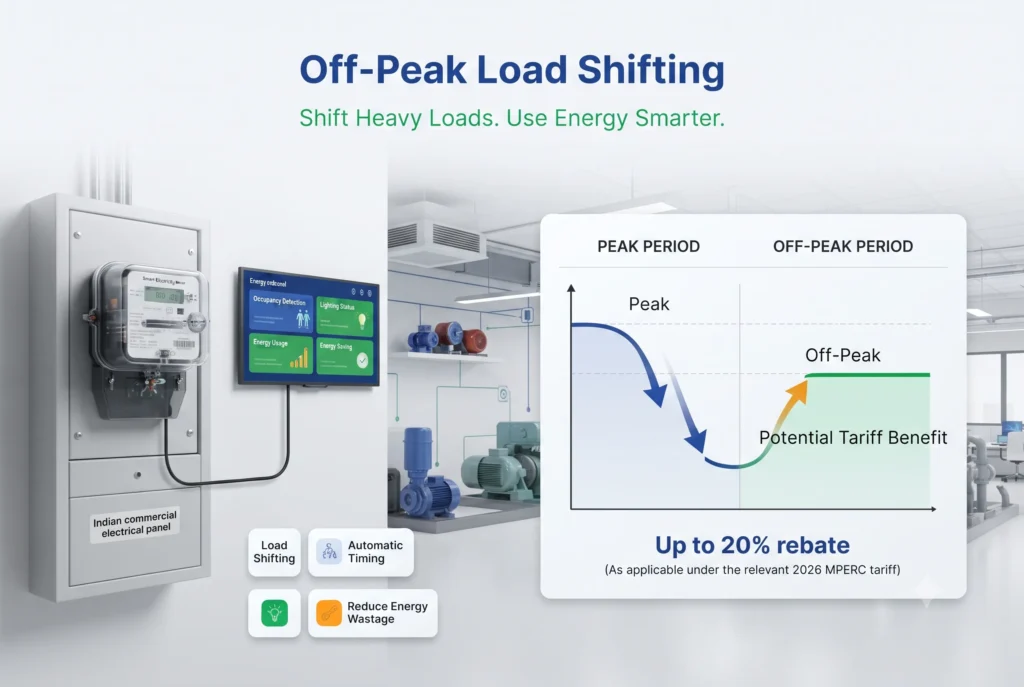
MPERC’s FY 2026-27 tariff order gives smart meter consumers a rebate of up to 20% on electricity consumed during off-peak hours, and abolishes minimum charges for several categories. Businesses that can move pumping, battery charging or heavy machining into off-peak windows save immediately, with no capital spend. (MPERC Tariff Order, March 2026.)
Nine fixes, ordered by payback speed:
- Shift heavy loads off-peak and claim the smart meter rebate.
- Correct power factor with a capacitor bank.
- Right-size sanctioned load so fixed charges match reality.
- Set AC to 24°C and clean filters quarterly.
- Swap remaining tube lights and halogens for LED.
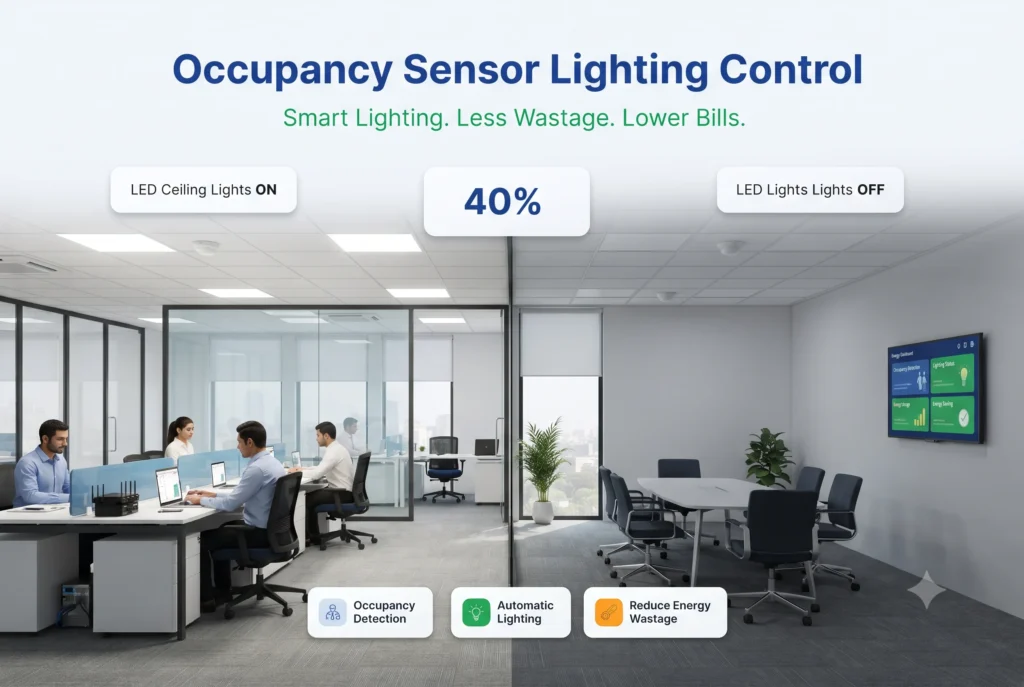
- Add occupancy sensors in washrooms, stores and meeting rooms.
- Put signage, geysers and printers on timers.
- Shade west-facing glass to cut MP summer cooling load.
- Sub-meter major circuits so waste becomes visible.
In our installations across Indore and Pithampur, the surprises repeat themselves: corridor lights burning all night, ACs cooling storage rooms nobody enters.
Which upgrades actually work, and what does the data say?
Controls beat replacements. That’s the pattern in every credible study.
Cooling, heating and lighting together take roughly 59% of commercial building energy (WBCSD, 2019). Manage those three well and you’re already ahead of a building that simply bought newer machines.
The World Business Council for Sustainable Development reports that a modern building energy management system delivers cost savings of at least 5% to 10%, with projects typically designed for payback under three to five years. The IEA estimates improved building controls could cut global building energy use by as much as 10% between 2017 and 2040. (WBCSD, 2019; IEA, 2020.)
India’s own record supports this: the IEA notes efficiency gains since 2010 prevented 12% of additional energy use by 2018. For new commercial construction, BEE’s ECSBC 2024 sets the efficiency baseline, and designing to it costs far less than retrofitting later a gap our building automation team sees on almost every enquiry.
How do you implement this without wasting money?
Measure first, buy second. That discipline sits behind every electricity bill kam karne ka solution that actually holds up.
- Read six months of bills : units, fixed charges, PF surcharge, peak vs off-peak split.
- Sub-meter big loads : HVAC, production line, lighting, pumps.
- Fix the free stuff : timers, thermostat settings, schedules.
- Correct power factor : cheapest hardware fix, fastest return.
- Automate : sensors and centralised HVAC control on a reliable network backbone.
Common mistakes we see:
- Buying solar before fixing a 0.85 power factor. You generate power just to waste it.
- Replacing every light at once with no baseline, so nobody can prove the saving.
- Installing sensors and never commissioning them. An uncalibrated sensor is decoration.
Comparison: which electricity bill kam karne ka solution suits you?
| Fix | Upfront cost | Typical payback | Best for |
|---|---|---|---|
| Off-peak load shifting | Zero | Immediate | Any smart meter user |
| Power factor correction | Low | Months | Factories, workshops |
| Load right-sizing | Application fee | 1 billing cycle | Shrunk operations |
| LED + occupancy sensors | Low–medium | 1–2 years | Offices, showrooms, schools |
| Energy management system | Medium–high | Under 3–5 years (WBCSD, 2019) | Multi-floor commercial, hotels |
| Rooftop solar | High | Long-term | Owned premises with roof rights |
Across 585+ AlifTech projects in Indore, Bhopal, Sagar and Pithampur, the clients who saved most weren’t the ones who spent most. They were the ones who measured first.
Key Takeaways
- MP tariffs rose 4.8% for FY 2026-27 control timing, not just volume.
- Off-peak rebates reach 20%. Claim them before buying anything.
- Power factor correction is the highest-return hardware fix on most commercial bills.
- HVAC and lighting hold the money. Automate those two first.
- The best electricity bill kam karne ka solution is one you can measure.
FAQ
Q1. Electricity bill kam karne ka solution kya hai for a small shop? Start free. Put signage and display lighting on timers, set AC to 24°C, and shift water pumping to off-peak hours. Then move remaining tube lights to LED. Most small retail units in Indore trim 10–15% before buying any control system at all.
Q2. Does power factor correction really reduce the bill? Yes, on commercial and industrial connections. MPERC continues power factor incentives under its FY 2026-27 order, and a poor power factor attracts a surcharge. Capacitor banks are among the fastest-payback investments available, often recovered within a few billing cycles on motor-heavy loads.
Q3. How much can a building automation system save? WBCSD (2019) puts building energy management system savings at 5% to 10% of energy cost, with projects usually designed for payback under three to five years. Real results depend on building size, occupancy patterns, and how carefully the system gets commissioned after installation.
Q4. Is rooftop solar the right first step? Usually not. Solar reduces the units you buy, but it won’t fix a bad power factor, an oversized sanctioned load, or equipment running in empty rooms. Fix consumption efficiency first, then size solar against the corrected load. You’ll need a smaller, cheaper array.
Q5. What is off-peak, and how do I use it in Madhya Pradesh? Off-peak means low-demand hours when the utility charges less. MPERC’s FY 2026-27 order allows up to 20% rebate on off-peak consumption for smart meter users. Check your bill for a time-of-day breakup, then reschedule pumping, charging and heavy machining to match.
Conclusion
The honest electricity bill kam karne ka solution is unglamorous: measure, schedule, correct, then automate. Tariffs keep moving, and MP’s 4.8% rise for FY 2026-27 won’t be the last. What stays in your hands is how much power you waste and when you draw it.
Businesses that treat power as a managed system metered, scheduled, monitored spend noticeably less than those treating it as a fixed monthly cost.
Ready to see where your building leaks power?
Want an electricity bill kam karne ka solution built around your actual building, not a generic checklist? AlifTech Secure has completed 585+ installations across Indore, Bhopal, Sagar and Pithampur. Request a free site survey : call or WhatsApp our Indore team and we’ll walk your premises with you.
EK CHHAT, POORI SURAKSHA. ONE ROOF. COMPLETE SECURITY.
Written by Usman Gani, Founder & Director, AlifTech Secure.

