
By AlifTech Secure | Home & Office Automation, Indore | June 2026 | www.aliftechsecure.in
Walk through most Indore offices at 8 PM. Half the lights are on in empty rooms. The AC is cooling a floor holding four people. Nobody is doing anything wrong, because nobody’s job is to walk round switching things off.
Building automation exists to close that gap. It works, and it pays back, though not at the numbers most vendors quote.
This guide covers what to automate in an office, in what order, what it costs in Indore, and how to work out your own payback rather than accepting someone else’s percentage.
Quick Answer
- Start with meeting rooms. Intermittent use, high-wattage fixtures, lights left on. Fastest payback in the building.
- AC scheduling by zone delivers the largest absolute saving in an Indian office.
- Lighting controls cut lighting energy 24% to 38% depending on strategy (LBNL meta-analysis).
- Whole-building energy management saves 5% to 10% of energy cost, payback aimed at three to five years (WBCSD).
- Cost: ₹60,000 to ₹1.2 lakh small office, ₹1.5 to ₹2.5 lakh mid-size, ₹2.5 to ₹5 lakh large.
- Rented office? Wireless retrofit avoids structural work entirely.
How It Actually Works
Take one meeting room. A motion sensor and a smart switch. Nobody enters for 15 minutes, so lights go off and the thermostat steps back a few degrees. Someone walks in, and both come back within about 30 seconds.
Nobody has to remember anything. The room runs at full comfort when occupied and near-idle when empty.
Now scale that across corridors, washrooms, cabins and AC zones, and add smart plugs cutting idle equipment overnight. The savings compound, though they compound from a base, and knowing that base is the difference between a sensible investment and a disappointed one.
Occupancy beats schedule
A fixed schedule switches the AC off at 7 PM whether or not a project team is still working. Then somebody overrides it, and the override stays on all night.
Occupancy-based control keeps cooling running in the zone people are actually in and shuts the rest down. Comfort improves while consumption falls, which is why occupancy control tends to survive contact with staff while rigid schedules get bypassed within a month.## What the Research Actually Supports
Worth being straight about this, because the numbers quoted in this market vary wildly and most of them describe a subsystem while sounding like they describe your bill.
Lighting controls. The Lawrence Berkeley National Laboratory meta-analysis pooled 240 savings estimates from 88 papers. Best estimates of average savings: 24% for occupancy control, 28% for daylighting, 31% for personal tuning, 36% for institutional tuning, 38% for combined approaches. Individual studies ranged from 6% to 80%, so building type matters enormously.
LED retrofit. LBNL’s FLEXLAB work found a plain fluorescent-to-LED swap gave 63% lighting energy savings, while integrated systems combining automated shading, daylight dimming and occupancy control reached 81% to 93%.
The catch. Every figure above is a percentage of lighting energy, not of your total bill. If lighting is a quarter of your office bill and you cut lighting energy by 38%, the total falls about 9.5%. Real money, and not 38%.
Whole building. WBCSD puts building energy management at 5% to 10% of energy cost, with payback aimed at three to five years. That is the honest benchmark for a combined system, and it is the number to hold in mind when someone quotes you 30%.
For a deeper look at the arithmetic, see our guide on what energy saving automation actually saves.
Lighting: Start Here
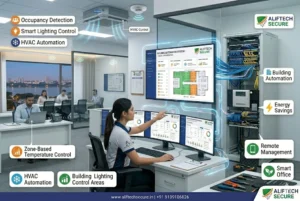
Lighting is roughly a fifth to a third of a typical office bill. It is also the cheapest thing to automate and the fastest to pay back, which is why it goes first regardless of what else you do later.
Occupancy sensors, room by room
A PIR or microwave sensor in each room, corridor and meeting area keeps lights on while people are present, then switches off after 10 to 15 minutes of nothing.
No manual action, no reliance on anyone remembering. In offices where meeting room lights routinely burn overnight, this single measure often carries the whole project.
Daylight harvesting on perimeter zones
Indore offices on south and west elevations get substantial natural light for much of the day. Light sensors measure ambient level and dim artificial lighting proportionally, so a zone stays at the right brightness while drawing less.
LBNL’s figure for daylighting is 28% of lighting energy on average, and perimeter zones with good glazing sit at the higher end of that.
LED first if you are still on tubes
If the office runs fluorescent tubes, do the lamp swap before the sensors. LBNL measured 63% lighting energy saving from the retrofit alone, which is a bigger single step than any control layer.
Then add controls on top. Our automation systems work covers both, and it is usually one project rather than two.
HVAC: The Largest Absolute Saving
Cooling is the biggest line in an Indian office bill through summer, and in Indore the AC runs from March to October. WBCSD puts cooling and lighting together at about 59% of building energy, and in this climate cooling carries the larger share of that.
Zone scheduling against real occupancy
Most offices run the whole AC system 9 AM to 8 PM on an assumption about when people are around.
But the accounts section empties by 6, the server room runs continuously, and client meeting rooms fill mid-morning and empty by afternoon. So zone scheduling cools each area during the hours that area is used, rather than cooling everything for the full window.
Temperature setback, not shutdown
Even with cleaning staff or occasional late work, the building does not need its full daytime setpoint. Raising the setpoint by three or four degrees during unoccupied hours keeps the space within an acceptable range at much lower draw.
Setback beats switching off entirely, because a fully warmed building costs more to pull back down than it saved overnight.
Pre-cooling
An underused measure. Starting the system gently from around 7:30 AM uses less total energy than running at maximum from 9 AM to drag an already-warm building down to temperature.
Automation handles it from outdoor temperature and historical patterns. It also flattens the morning startup spike, which matters if you are on a demand-based tariff.
Energy Monitoring: Prove It Worked
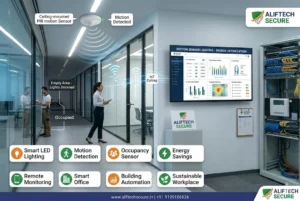
The point of monitoring is not the dashboard. It is that you can show the saving actually happened, and find the waste that survived.
Sub-metering by circuit
Sub-meters on lighting, AC, server room, equipment and common areas show what each draws in real time.
That makes visible what was invisible: the AC at full output at 8 PM with two people in the building, or a server room drawing more than expected because of poor airflow.
Anomaly alerts
An alert at 2 AM saying consumption is three times the expected off-peak level tells facilities something was left on, or something has failed.
Catching that the same night rather than at the month’s bill is most of the value. These alerts also surface equipment problems early, such as a compressor running continuously without cooling effectively.
Demand charges: check your own tariff first
This is where generic advice goes wrong in Madhya Pradesh.
Many articles describe demand charges as based on your highest 15-minute peak. MPERC does not work that way. For LT consumers on demand-based tariff and for all HT consumers, contract demand is what you applied for, billed per kVA, whether you draw it or not. Demand-based tariff is mandatory above 10 kW connected load for LV-2 consumers.
So if your demand charge is high, the first question is whether your contract demand is oversized, not whether you need peak-shaving hardware. That correction costs nothing and saves every month. Our smart power management guide covers the MP tariff structure properly, including the 0.80 power factor threshold.
What It Costs in Indore
| Office size | Scope | Cost |
|---|---|---|
| Small, 1,000 to 2,000 sqft, 10 to 20 staff | Lighting controls, basic AC scheduling | ₹60,000 to ₹1.2 lakh |
| Mid-size, 3,000 to 5,000 sqft, 30 to 50 staff | Full lighting, HVAC zoning, monitoring | ₹1.5 to ₹2.5 lakh |
| Large, 5,000 to 10,000 sqft, 50 to 100 staff | Full system, multiple zones, dashboard | ₹2.5 to ₹5 lakh |
| Factory or warehouse, lighting only | High-bay occupancy control | ₹80,000 to ₹2 lakh |
Broken down for a mid-size office: lighting controls ₹60,000 to ₹1.5 lakh depending on zone count and whether LED upgrade is included, HVAC controls ₹40,000 to ₹1.2 lakh depending on AC unit count and system type, and sub-metering with dashboard ₹25,000 to ₹60,000 including first-year platform.
Working out your own payback
Do not accept a percentage. Do this instead.
Take your monthly bill. Estimate what share is lighting and what share is cooling, from your sub-meter readings if you have them or from your installer’s assessment if you do not. Apply the researched figures to each: roughly 24% to 38% off lighting energy from controls, more if you are also swapping to LED, and a smaller percentage off cooling from scheduling and setback.
Add those two together and you have your realistic saving, usually in the range WBCSD describes for whole-building management rather than the 30% figure that circulates in this market. Then divide the installation cost by the monthly saving.
That calculation is what an energy audit produces, and it takes about an hour. Any vendor quoting you a payback period before reading your bills is guessing.
Where to Start
Meeting rooms first. Intermittent occupancy, high-wattage fixtures, frequently left lit. Sensors run ₹1,500 to ₹3,000 per room and this is the fastest payback in the building.
Corridors and washrooms second. Always lit regardless of occupancy, and simple to automate.
AC zoning third. Bigger saving in absolute terms, higher cost, and the work depends on your system. Central ducted needs zone dampers and controllers; split units need a smart thermostat module each.
Monitoring last. It verifies the first three worked and finds what is left. Without it you are trusting a claim rather than checking one.
Common mistakes: buying before auditing, automating lighting and stopping there, cheap sensors that miss seated people and get taped over within a month, and treating it as one-time work when occupancy patterns change every time teams move floors.
Frequently Asked Questions
Can building automation work in a rented office?
Yes, and most office retrofits are designed for it. Smart switches replace existing switches, sensors clip to ceilings or walls, and AC thermostat modules fit over existing controls. The system comes out and reinstalls elsewhere when the lease ends. Get written landlord approval for anything involving cabling or central HVAC zoning.
How disruptive is installation?
Wireless lighting and AC controls usually complete over a weekend or outside business hours for a mid-size office. Switch replacement runs 15 to 30 minutes per point, and most work happens at switch locations rather than the panel. Sub-metering needs a short power shutdown at the electrical panel, typically one to two hours.
How much will this actually cut my bill?
Expect single digits to mid-teens as a share of the total bill for a combined system. WBCSD puts whole-building energy management at 5% to 10% of energy cost with three to five year payback. Larger percentages usually describe lighting energy alone. Your own bills give the real answer.
What is the ECBC angle for commercial buildings?
The Energy Conservation Building Code sets energy performance standards for larger commercial buildings, and certain lighting and HVAC controls form part of compliance where it applies. If your office sits in a newer Indore commercial building, ask building management whether ECBC applies to the property before assuming it does.
Do I need an IT team to run it?
No. Modern dashboards are built for facilities managers and office administrators. Reviewing reports, adjusting schedules and responding to alerts need no technical background. Deeper configuration happens at commissioning and occasionally afterwards, which an AMC with your installer normally covers.
The Honest Case
Building automation is a sound investment for most offices. It is a better one when you go in with the right expectation.
Audit first. Do meeting rooms, then corridors, then AC zoning. Add monitoring to prove it worked. Expect a saving in the range the research supports rather than the one in the brochure, and the payback will still make sense.
Any vendor promising 30% off your total bill before reading a single bill is selling, not advising. That includes anyone who has told you that in the past.
| AlifTech Secure — Indore Call / WhatsApp: +91 9109106826 www.aliftechsecure.in | aliftechsecure@gmail.com 112 Basement, Akbar Ali Complex, MG Road, Palasia Square, Indore — 452001 |
| Book a Free Office Energy Audit We review your electricity bills and office layout to identify your highest-return automation measures. Call / WhatsApp: +91 9109106826 | www.aliftechsecure.in |
AlifTech Secure | Home & Office Automation, Indore MP | +91 9109106826 | www.aliftechsecure.in

