
By AlifTech Secure | Home & Office Automation, Indore | June 2026 | www.aliftechsecure.in
Introduction
Your office has 20 lights. At 6 PM half the team has gone home, so 20 lights are burning for eight people. The AC cools an entire floor holding three of them. Server room sits at 18 degrees when 24 would do.
Nobody notices, because nobody’s job is to notice. Then the bill arrives.
Automation fixes exactly this problem, and only this problem. So it helps to know what it can realistically save before you spend anything, because the numbers thrown around by most vendors describe subsystems while sounding like they describe your whole bill.
Quick Answer
- Lighting controls cut lighting energy by roughly 24% to 38%, depending on strategy (LBNL meta-analysis of 240 estimates).
- An LED retrofit alone cuts lighting energy about 63%. Add integrated controls and studies show 81% to 93%.
- Cooling and lighting together are around 59% of building energy (WBCSD, 2019), so those are the two worth automating first.
- Whole-building energy management typically saves 5% to 10% of energy cost, with payback aimed at three to five years (WBCSD, 2019).
- Start with an audit, not equipment. You cannot verify a saving without a baseline.
What an Energy Saving Automation System Does
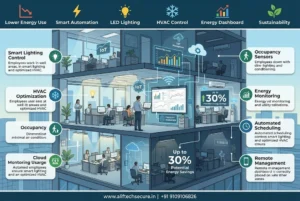
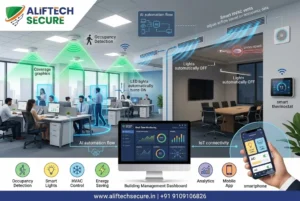
It connects lights, air conditioners, fans, plug points and motors to a control layer, then uses sensors to decide what runs and when.
The logic is simple. When motion sensors show a meeting room is empty, lights switch off and the thermostat steps back several degrees. In the morning, only occupied zones come up. After hours, everything except essential equipment shuts down without anyone touching a switch.
What it controls, in practice:
- Lighting, off in unoccupied rooms, dimmed when daylight is sufficient
- Air conditioning, reduced in unused zones, setpoints adjusted by occupancy
- Fans, off or slowed when a room is empty
- Plug points, cut to idle monitors, chargers and printers after hours
- Motors, speed-reduced during low-demand periods on factory floors
- Monitoring, consumption tracked zone by zone with alerts on unusual spikes
You can see the hardware side of this in our home automation range and our automation systems work.
What the Research Actually Shows
This is where most articles on this topic go wrong, so here are the sourced numbers and what they apply to.
Lighting controls
The Lawrence Berkeley National Laboratory meta-analysis by Williams and colleagues pooled 240 savings estimates from 88 papers and case studies. Its best estimates of average savings potential are 24% for occupancy-based control, 28% for daylighting, 31% for personal tuning, 36% for institutional tuning, and 38% for combined approaches.
The individual studies ranged from 6% to 80%, which tells you how much building type and occupancy pattern matter. A corridor with low occupancy behaves nothing like an open-plan floor that is full all day.
LED plus controls
LBNL’s FLEXLAB analysis found a straightforward fluorescent-to-LED retrofit delivered 63% lighting energy savings, while integrated systems combining automated shading, daylight dimming and occupancy control reached 81% to 93%.
So if your building still runs old tube lighting, the lamp swap is the bigger single win and the controls layer on top of it.
The critical caveat
Every figure above is a percentage of lighting energy, not of your total electricity bill. Those are very different numbers.
WBCSD (2019) puts cooling and lighting together at roughly 59% of building energy. So if lighting is a fifth of your bill and you cut lighting energy by 38%, you have reduced the total bill by about 7.6%. Real, worth having, and not 38%.
For whole-building energy management, WBCSD’s figure is 5% to 10% of energy cost, with payback aimed at three to five years. That is the honest benchmark for a combined system, and any vendor quoting you 30% or 40% of your total bill is either describing a subsystem or guessing.
Where to Start, in Order
1. Get a baseline
Read six months of bills. Note units consumed, demand charges and any power factor surcharge. Without this you cannot prove a saving later, and you cannot tell whether automation or a tariff change caused a drop.
2. Fix lighting first
Fastest return, least disruption. Corridors, meeting rooms, washrooms and store areas waste the most because they are intermittently occupied and rarely switched off.
If you are still on tube lighting, do the LED swap before the sensors.
3. Then tackle cooling
Cooling is usually the larger share of the bill, but it is harder to automate well. Zone scheduling and temperature setback during unoccupied hours give most of the benefit. Setting back a few degrees rather than switching off entirely avoids the pull-down load when the space reoccupies.
4. Add monitoring to verify
Sub-metering per circuit or zone is what turns a claim into evidence. It also catches new waste as building use changes, which is why a system installed and forgotten drifts back over two or three years.
5. Motors, if you run them
On a factory floor, variable frequency drives on high-load motors often outperform everything above. Worth assessing alongside your power management and protection setup, since both touch the same panels.
Five Mistakes That Waste the Investment
1. Installing before auditing. You cannot measure savings against a baseline you never recorded. So the audit is not optional overhead, it is the thing that makes the rest provable.
2. Automating lighting and stopping there. Lighting is the easier job, but cooling is usually the bigger share of the bill. Doing only lighting leaves most of the opportunity untouched.
3. Buying cheap sensors. A motion sensor that misses a seated person switches lights off on staff. Then someone tapes over it or bypasses the circuit, and the system is dead within a month.
4. Skipping monitoring. Without a dashboard you cannot tell whether the system still works or whether new waste has appeared. Most drift goes unnoticed for years.
5. Treating it as one-time work. Occupancy patterns change, teams move floors, shifts change. A system tuned once for a layout that no longer exists slowly stops saving.
Frequently Asked Questions
How much can automation really cut my electricity bill?
Expect single digits to mid-teens as a share of the total bill for a combined system. WBCSD puts whole-building energy management at 5% to 10% of energy cost with a three to five year payback. Larger percentages usually describe one subsystem, such as lighting energy alone, rather than your whole bill.
Which saves more, lighting automation or AC control?
Lighting controls are cheaper and faster to fit, so they return sooner. Cooling is normally the larger share of the bill, though, so AC scheduling has the higher ceiling. Do lighting first for quick wins, then cooling for total impact.
Do I need to rewire my building for this?
Usually not. Retrofit smart switches and modules fit behind existing boards, and wireless sensors need no cabling. Rewiring only becomes necessary where switchboards have no neutral wire at the switch point, which is common in older buildings.
How long before the system pays for itself?
WBCSD targets three to five years for building energy management. Sites with long operating hours, heavy cooling loads or old lighting recover faster, while a small office running eight hours a day takes longer. Your own bills decide it, so ask for the calculation before you buy.
Is this worth it for a factory?
Often more than for an office, because operating hours are longer and motor loads are larger. Variable frequency drives on high-load motors frequently beat lighting and HVAC controls on return. Start by metering which circuits actually consume the most.
The Short Version
Automation saves real money, though less dramatically than most marketing suggests. The percentages you see quoted almost always apply to a subsystem rather than to your total bill, and that distinction is worth holding onto when you compare quotes.
Audit first. Then lighting, then cooling, then monitoring to prove it worked. Skip the audit and you will never know whether the system earned its cost.
| Book a Free Energy Assessment for Your Property We identify your highest-saving automation measures and design a system within your budget. Call / WhatsApp:+91 9109106826 | www.aliftechsecure.in| Free Site Visit in Indore |
AlifTech Secure | Home & Office Automation, Indore MP |+91 9109106826 | www.aliftechsecure.in

