By AlifTech Secure | Access Control & Biometric Solutions, Indore | June 2026 | www.aliftechsecure.in
Introduction
Last week of the month. Your HR manager is hunched over Excel, pulling data off the biometric machine, cross-checking leave registers, working out overtime, then typing it all into payroll by hand. Two hours in, there are still errors to chase.
That gap between the machine and the payslip is where the money and the mistakes live. Closing it is the whole point of buying an attendance machine with salary software rather than just a machine.
There is also something most 2026 guides skip entirely. Since the DPDP Rules were notified, employee fingerprints and face templates are regulated data, and your payroll vendor is legally a Data Processor. That changes what you should ask before you buy.
Quick Answer
- The machine records, the software calculates. Buying only the machine leaves the manual work untouched.
- Basic fingerprint: ₹3,000 to ₹5,500. Face recognition: ₹8,000 to ₹18,000.
- Cloud payroll: roughly ₹50 to ₹200 per employee per month.
- Face recognition beats fingerprint in dusty or wet factory conditions.
- You are the Data Fiduciary for employee biometric data, and your payroll vendor is the Data Processor. Get the agreement in writing.
What the Integration Actually Does
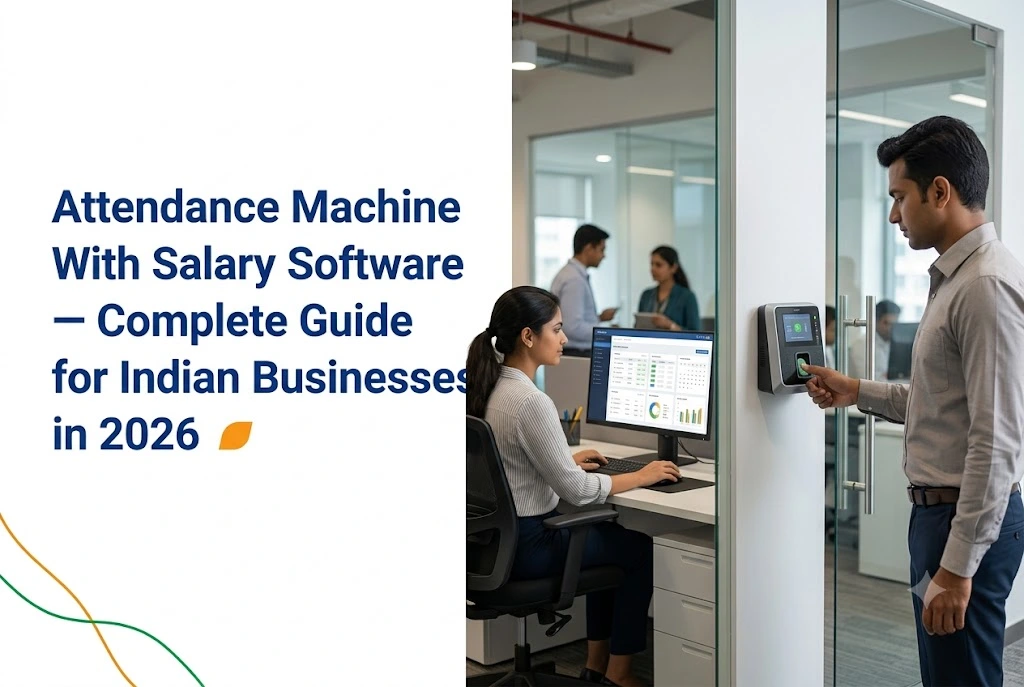
A biometric machine records clock-in and clock-out using a fingerprint, face template or RFID card. That data sits on the device until somebody moves it.
Connect it to salary software and the workflow changes shape. Punches sync automatically, the software works out present days, absences, late marks, overtime and leave balances, and the payslip generates without anyone entering a number.
What an integrated setup handles on its own:
- Daily marking, including present, absent, half day and late arrival
- Leave balances across earned, casual and sick leave
- Overtime, calculated from actual punch times rather than estimates
- Salary with deductions for PF, ESI, TDS and advances
- Payslips, shareable by email or WhatsApp
- Statutory registers for PF and ESI
One correction worth making, because vendors oversell this. Payroll software prepares the data behind Form 16, but the certificate itself is generated and issued by the employer through the TRACES portal after TDS returns are filed. No attendance machine produces it.
For the compliance side of the same workflow, our guide on PF and ESI filing checks covers how attendance data reaches the ECR and where mismatches trigger notices.
Machine Prices in India, 2026
| Machine type | Price band | Suits |
|---|---|---|
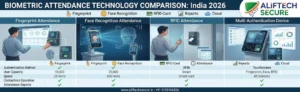
| Basic fingerprint | ₹3,000 to ₹5,500 | Shops, 10 to 20 staff |
| Fingerprint plus RFID | ₹5,000 to ₹9,000 | Offices wanting card backup |
| Face recognition, touchless | ₹8,000 to ₹18,000 | Offices, factories, dusty sites |
| Face plus fingerprint | ₹10,000 to ₹22,000 | High-security offices, banks |
| Enterprise, 1000+ users | ₹20,000 to ₹40,000 | Large factories, hospitals, campuses |
Prices move with model and quantity, so treat these as bands. You can see current options in our time attendance systems range.
Which Salary Software Connects
Most branded machines integrate through direct API, scheduled sync or file export. The four routes below cover almost every Indian business.
Cloud HR platforms
Greythr, Keka and Zoho Payroll connect with most ZKTeco, eSSL and Matrix devices. Attendance syncs, then the platform handles salary, deductions and compliance reports. Budget roughly ₹50 to ₹200 per employee per month depending on plan.
Bundled device software
eSSL machines usually ship with eTimeTrackLite or ETAMS at no extra cost, which handles attendance reports and leave. For salary you either use the bundled module or export into a separate payroll tool.
Tally
Plenty of Indore businesses and Pithampur factories already run accounts in Tally. Tally Prime accepts attendance imports through add-ons, though a Tally partner normally has to configure it once. After that, payroll runs inside Tally with no second subscription. We covered the setup in detail in our biometric attendance and Tally integration guide.
Custom payroll
Multiple shifts, contract labour, piece-rate wages. Standard payroll packages handle these badly, which is why factories with production-linked pay often end up with something built around their actual wage structure. Our factory floor attendance setup guide goes through the shift side of this.
The Part Most Guides Leave Out: Your Data Obligations
Employee fingerprints and face templates are digital personal data. So once you collect them, you are a Data Fiduciary under the Digital Personal Data Protection Act, and your employees are Data Principals. The Act draws no distinction between customer data and employee data, and the same penalties apply.
The DPDP Rules were notified on 13 November 2025. Data Protection Board provisions took effect immediately, consent manager provisions activate on 13 November 2026, and the full compliance obligations including security safeguards become enforceable on 13 May 2027. So there is time, though not much.
Good news first: you generally do not need consent
Section 7 of the Act provides a legitimate use covering employment purposes. Core HR processing such as payroll, benefits, attendance and workplace safety therefore sits under that provision rather than requiring individual consent.
Consent still applies to anything outside employment purposes, and it applies to visitors and contractors enrolled on the same device.
What you do need
A notice. Before or at the time of collection, employees must get a clear notice, in English or any language listed in the Eighth Schedule. Say what you collect, why, and how long you keep it.
An agreement with your payroll vendor. Greythr, Keka, Zoho, your Tally partner, any cloud HR platform. Each is a Data Processor acting on your behalf, and the agreement should cover security obligations, breach notification timelines, retention and deletion, and whether they can sub-process. Sign it before data starts flowing, not after.
A deletion rule. Access logs, meaning who entered and when, can be retained for audit purposes. The biometric template itself should be deleted when someone leaves or their access is revoked. Most businesses never delete anything, which is the single most common gap.
Contractor handling. Every enrolment is a fresh processing event. Temporary and contract staff need consent before enrolment, and their templates deleted when the contract ends.
If you are a large factory, read this twice
Organisations processing biometric data at scale are explicitly flagged in the DPDP framework as likely candidates for Significant Data Fiduciary designation. That status brings an India-based Data Protection Officer, annual independent audits, annual Data Protection Impact Assessments and algorithmic due diligence.
A plant running fingerprint attendance across several thousand workers is exactly the profile in question. Worth raising with your CA or legal advisor now rather than in 2027.
Five Mistakes That Cost Money
1. Buying before checking integration. Confirm your machine talks to your existing payroll system. Ask for it in writing, because “compatible” often means someone exports a CSV by hand.
2. Fingerprint in a factory. Dirty, wet or worn hands fail to scan, so queues build at shift change and supervisors start marking people manually. Face recognition handles industrial conditions far better.
3. Ignoring software cost. Many machines include basic attendance software, then charge separately for payroll integration. Ask for the total including software and annual renewals.
4. Going live without shift configuration. If the software does not know your shift timings, it cannot compute late marks or overtime. Configure shifts, week-offs and holiday calendars before the first payroll run.
5. Rushing enrolment. Poor quality templates cause daily recognition failures, and daily failures are what make staff bypass the system entirely. Enrol carefully once.
Frequently Asked Questions
Do I need employee consent to collect biometric attendance?
Generally no. Section 7 of the DPDP Act provides a legitimate use covering employment purposes, which includes attendance and payroll. But you still have to give employees a clear notice about what you collect and why, and consent is required for visitors, contractors and any use beyond employment purposes.
Is my payroll software provider responsible for data protection?
They share the obligation as a Data Processor, though you remain the Data Fiduciary and carry ultimate responsibility. So put a written agreement in place covering security, breach notification, retention and sub-processing before sharing employee data with any cloud payroll platform.
Fingerprint or face recognition, which should I buy?
Face recognition for factories, warehouses and anywhere hands get dirty or wet, since fingerprint readers fail in those conditions. Fingerprint remains fine for clean office environments and costs less. Combination devices suit sites needing a fallback when one method fails.
How long should I keep biometric data after an employee leaves?
Delete the biometric template when access is revoked. Access logs showing who entered and when can be retained for security and audit purposes under legitimate use. Set a written retention period rather than keeping everything indefinitely, which is the most common compliance gap.
Will the machine work during a power cut or internet outage?
Choose a device with onboard storage and it keeps recording offline, syncing when the connection returns. Cloud-only devices lose punches during outages. In areas with frequent cuts, offline storage plus battery backup is worth the small premium.
The Short Version
The machine is the cheap part. What determines whether this project saves anyone time is the software mapping, the shift configuration and the enrolment quality.
So ask three questions before you pay. Does it integrate with the payroll system you already use? What is the total annual cost including software? And who signs the data processing agreement?
Get those answered and the monthly two-hour Excel session disappears. Skip them and you will own a very accurate clock that nobody uses.
| Book a Free Attendance System Consultation We visit your office or factory, recommend the right machine, and configure salary software integration. Call / WhatsApp: +91 9109106826 | www.aliftechsecure.in| Quick Installation in Indore |
AlifTech Secure | Access Control & Biometric Solutions, Indore MP |+91 9109106826 | www.aliftechsecure.in

