
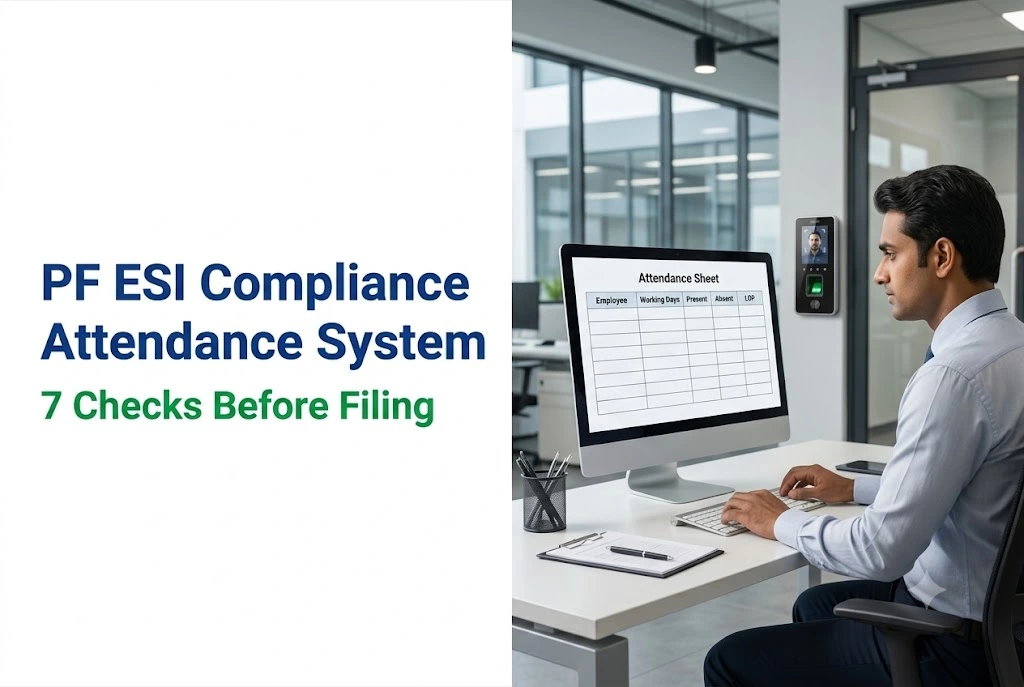
PF ESI Compliance Attendance System: 7 Checks Before Filing

Most PF and ESI notices don’t start in the accounts department. They start on the attendance sheet, weeks earlier, when somebody marks a day wrong and nobody catches it.
A PF ESI compliance attendance system exists to close that gap. Your monthly ECR carries a field for non-contributory days, and that number comes straight from whatever your attendance machine feeds into your salary software. So if the roster says three unpaid days and the return says five, EPFO sees a mismatch, not a typo.
The Labour Codes made this tighter still. Since November 2025, the wage base itself changed, which means old attendance habits now produce new errors.
TL;DR
- NCP days in the ECR come directly from attendance. So a wrong roster becomes a wrong return.
- Both PF and ESI fall due on the 15th of the following month, together with the filing.
- Late payment attracts 12% annual interest under Section 7Q, plus graded damages under Section 14B.
- ESI runs on six-month contribution periods, April to September and then October to March, not on your financial year.
- The four Labour Codes took effect on 21 November 2025, and Madhya Pradesh is among the states that have already notified final rules.
Why Attendance Is Really a Compliance Record
Attendance looks like an HR function. In practice it’s the source document for two statutory filings, one wage register and any inspection that follows.
Here’s the chain. Attendance produces loss-of-pay days. LOP reduces wages. Reduced wages change both contributions. Then the same figure has to appear in the ECR as NCP days, meaning the days no contribution is due.
The field that connects the two systems
EPFO’s ECR format is strict about this. NCP days can’t carry decimals, half-day NCP isn’t permitted, and the figure can’t exceed the number of days in that month. Where an employee has a full month of NCP, the return must show zero contribution.
So attendance rounding that seems harmless internally will simply reject the file. This is why the export step matters so much, whether you connect the attendance machine to Tally or to a separate payroll package. A return that passes upload but disagrees with your payroll register creates a discrepancy that surfaces later, during inspection, across every month it occurred.
What Changed After the Labour Codes
The four Labour Codes covering Wages, Social Security, Industrial Relations, and Occupational Safety came into force on 21 November 2025, consolidating 29 central laws.
The 50% wage rule
Under the Code on Wages, “wages” means basic pay, dearness allowance and retaining allowance. Exclusions like HRA and overtime are allowed, but only up to 50% of total remuneration. Anything above that gets treated as wages.
That single definition now applies across EPF, ESI, gratuity and bonus. So employers whose basic pay sits at 20% to 30% of CTC face the sharpest increase in statutory cost.
Where your state stands
Central rules were still in draft when the Codes commenced, and the Ministry of Labour and Employment published draft central rules on 30 December 2025. State readiness varies widely, though. Madhya Pradesh has notified final rules under all four Codes, alongside Gujarat, Haryana, Karnataka, Maharashtra and Arunachal Pradesh.
For an employer in Bhopal, Sagar or Indore, that matters practically. You’re operating in a state that has moved ahead, so registers and returns should already match the notified formats rather than the old ones. Factories in the industrial belt feel this first, which is why Pithampur units reviewed their biometric setups well before the deadline talk started.
Where Attendance Errors Turn Into Notices
The numbers themselves are simple. PF runs at 12% from each side, on a wage ceiling of ₹15,000, and applies at 20 or more employees. Per ESIC’s published contribution rules, ESI runs at 3.25% employer and 0.75% employee on wages, applying at 10 employees in most states. Both are due within 15 days of the month ending.
Miss that date and interest runs at 12% a year under Section 7Q, with damages under Section 14B graded by how long the default continues.
The validations that reject an upload
Under EPFO’s published ECR file format, an upload fails when the UAN isn’t valid or linked to the establishment, when EPS wages exceed EPF wages, or when NCP logic breaks. The same document confirms that no decimals are accepted anywhere, and that half-day NCP has to be recorded in full days instead.
A wage variance well above the previous month raises a soft warning rather than a hard failure. So it goes through, but it’s now on record.
The checks that happen afterwards
EPFO and ESIC both run analytics on filed data. Sudden wage drops, large numbers of zero-contribution UANs, and mismatches against GST turnover all draw attention.
Then there’s headcount reconciliation. If PF shows 150 members and ESI shows 120, you need to explain those 30, whether they earn above the ESI ceiling or sit outside an implemented area. Attendance and wage records are what make that explanation stand up.
One ESI trap deserves its own line. Contribution periods run April to September and October to March. So an employee whose wage crosses the ceiling in January stays covered until 31 March, not from the month of the raise.
Comparing Three Ways to Track Attendance
How you record attendance decides how much manual work the 15th creates. Multi-shift sites have the hardest time here, so it’s worth reading how to set up attendance on a factory floor before you pick a setup.
| Factor | Paper muster roll | Standalone biometric | Attendance integrated with payroll |
|---|---|---|---|
| LOP accuracy | Depends on the clerk | Good, if exceptions are logged | Highest |
| Feeds ECR directly | No | Manual export | Yes |
| Audit trail for edits | None | Limited | Full, with timestamps |
| Handles contract staff | Poorly | Partially | Yes, with separate registers |
| Effort at month end | 2 to 4 days | 1 to 2 days | Hours |
| Best suited to | Under 10 staff | 10 to 50 staff | 50+ staff, or multi-site |
Seven Checks Before You File
1. Reconcile LOP with NCP. Match payroll LOP against the NCP column, employee by employee, before generating the file.
2. Round attendance to whole days. Half-day NCP isn’t accepted, so decide your rounding rule and apply it consistently.
3. Verify UAN status for every new joiner. The UAN must be valid and linked to your establishment code, otherwise the whole file fails.
4. Check gross wages, not basic, for ESI. Using basic salary is the most common ESI error, and it creates a shortfall every single month.
5. Confirm joining and exit dates. EPFO checks that the date of joining falls before the wage month and the date of exit falls after it.
6. Reconcile PF and ESI headcount. Know why the two numbers differ before an inspector asks.
7. File by the 10th, not the 14th. Portal load peaks close to the deadline, and technical trouble isn’t accepted as a defence.
Common mistakes to avoid: treating paid leave as NCP, keeping contract workers off the register, calculating on CTC instead of statutory wages, editing attendance without an audit trail, and assuming last year’s salary structure still works under the 50% rule.
Key Takeaways
- Fix attendance first, because every downstream filing inherits its errors.
- Reconcile LOP against NCP days each month before uploading the ECR.
- Rebuild salary structures around the 50% wage rule, since PF, ESI, gratuity and bonus all move together.
- Track ESI by contribution period rather than by financial year.
- Keep an audit trail on attendance edits, because inspections look backwards across months.
Frequently Asked Questions
What is the due date for PF and ESI payment each month?
Both fall due within 15 days of the month ending, so the 15th is the working deadline. The ECR must be filed alongside PF payment, not after it. Since the portals get heavily loaded near the deadline, most compliance teams process by the 10th. Late deposit attracts 12% annual interest plus damages.
How do attendance records affect PF contributions?
Unpaid absence reduces wages, which reduces both contributions. Those days must then be reported as NCP days in the ECR. Paid leave doesn’t count, though. Casual, sick and earned leave are wages, so they stay out of NCP. Getting this wrong understates contributions and can block an employee’s claim years later.
Is a biometric attendance system mandatory for PF ESI compliance?
No specific technology is mandated. What the law requires is an accurate register of attendance, hours worked, rest days and wages paid, which may be kept electronically. So a biometric system helps but isn’t required. Accuracy and a defensible audit trail matter far more than the device itself.
What happens if my ECR shows different LOP days from payroll?
EPFO can flag the mismatch, since both figures are visible to the department. A single month may pass unnoticed, but a recurring pattern usually surfaces during inspection or analytics review. Then the correction covers every affected month, along with arrear contributions, interest and damages on the shortfall.
Do the new Labour Codes change PF and ESI calculations?
Yes, indirectly but significantly. The Code on Wages caps excluded allowances at 50% of total remuneration, so any excess counts as wages. Since PF, ESI, gratuity and bonus all calculate on that base, statutory costs rise for companies with low basic pay. The contribution rates themselves are unchanged.
Conclusion
A working PF ESI compliance attendance system isn’t really about software. It’s about one number, days worked, travelling from the roster to the ECR without changing along the way.
Reconcile LOP against NCP every month, review salary structures against the 50% wage rule, and keep an audit trail you’d be comfortable showing an inspector. Do that consistently, and the 15th stops being the most stressful day of your month.
Operating in Bhopal, Sagar or Indore? Since Madhya Pradesh has notified final rules under all four Codes, review your registers against the state formats rather than the old central ones. If your current machine can’t produce a clean monthly export, our attendance system solutions cover supply, installation across Indore and MP, and payroll integration.

