
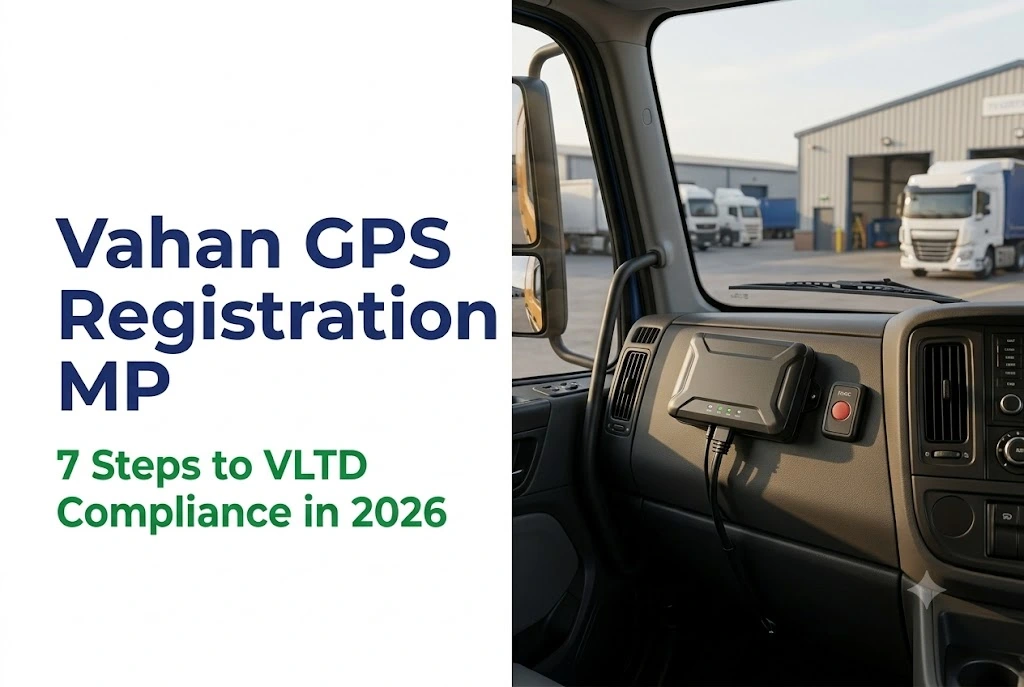
A transporter in Indore fits a GPS tracker, pays for it, and still gets turned away at the RTO counter. It happens weekly across Madhya Pradesh, and the reason is almost never the hardware quality. Vahan GPS registration MP operators need isn’t about owning a tracker. It’s about a certified device being linked to your vehicle’s record on the Vahan portal, so an RTO officer can pull it up by registration number. No linkage, no fitness certificate.
That gap got much harder to survive in 2026. So here’s what actually has to happen, in order.
TL;DR
- A regular GPS tracker will not pass. Only an ARAI or ICAT certified VLTD counts.
- Registration means Vahan linkage, connecting device IMEI, SIM and backend to your vehicle record.
- Fitness renewal now checks this automatically. An officer’s discretion no longer helps you.
- Installation must be done by an empanelled vendor. A private mechanic’s work has no legal standing, even if the wiring is identical.
- Budget 1 to 2 hours for fitment, though backend activation can take longer.
What Vahan GPS Registration Actually Means
Most people use “GPS registration” loosely. The transport department doesn’t.
The official term is VLTD, short for Vehicle Location Tracking Device. It came in through MoRTH notification GSR 979(E) dated 28 September 2018, which made AIS-140 the mandatory standard for tracking devices in commercial vehicles under the Motor Vehicles Act, 1988. AIS-140 itself was developed by ARAI, the Automotive Research Association of India.
Registration then means three things get tied to your vehicle’s Vahan record: the device IMEI, the SIM number, and the backend server your data flows to. We walk through the Parivahan IMEI registration process step by step here. Once those are linked, any RTO in the country can verify compliance by typing in your registration number.
Why a regular GPS tracker fails
A tracker you buy online tells you where your truck is. That’s a business tool. A certified VLTD is a piece of national transport infrastructure, and the difference sits in the specification.
A compliant unit needs a GNSS module reading both GPS and NavIC, a 4G modem with 3G and 2G fallback, a dedicated M2M SIM, a hard-wired panic button, and tamper detection that alerts when someone interferes with it.
There’s a trap here that catches even careful buyers. Certification isn’t permanent, because manufacturers must keep an annual Conformity of Production audit current. If a maker’s CoP lapses, their device can drop off the approved list, and your fitness renewal gets rejected for a device that was legal when you bought it.
Which Vehicles in Madhya Pradesh Need This
Applicability is set nationally but enforced state by state, so always confirm your category with your own RTO. Broadly it covers public service vehicles like buses, taxis and cabs, vehicles on national or all-India permits, and many goods carriers. Private cars are outside it.
Madhya Pradesh runs roughly 70 RTO offices across the state, from Indore and Bhopal down to district centres like Sagar. The counter you visit changes, but the Vahan check behind it doesn’t.
MP’s own rules add a layer
Two state instruments matter beyond the central mandate.
The Transport Department issued a circular dated 21 October 2022 covering registration of VLTD manufacturers, which is why the device you buy has to be one the state recognises, not merely one that exists.
Then there’s the Control and Regulation Scheme of Educational Vehicles for Safe Transport of Students, 2019. School and college transport in MP sits under this scheme, and industry reporting consistently lists MP among the states enforcing tracking on student transport. Taxi operators should also read the MP Motor Cab Policy and Aggregator Rules, 2017, since aggregator platforms apply their own onboarding checks on top of RTO rules.
What Changed in 2026
Enforcement stopped being a matter of who is on duty that day.
Device manufacturers now upload every unit’s details straight into the Vahan database, so compliance status shows up at the counter. Manufacturer and device registration happens through the VLTD Maker portal on Vahan, while each state runs its own VLTS portal for monitoring.
Then in May 2026, a Supreme Court direction tied enforcement firmly to the fitness certificate. States now have explicit judicial backing to refuse fitness renewal, and therefore continued operation, to any public service vehicle whose VLTD and panic button aren’t installed and visible on Vahan.
The practical consequences stack up quickly. Fitness certificate renewal gets refused. Permits can be suspended or cancelled. Fines under the Motor Vehicles Act vary by state but commonly run from ₹5,000 to ₹20,000, and higher for repeat violations. Check-post officers can verify through Vahan in real time, so a vehicle can be detained on the spot.
The 7 Steps to Get Registered
Before you buy
Step 1. Confirm your vehicle category. Check with your RTO whether your permit type falls under the mandate. Guessing here wastes the whole exercise.
Step 2. Buy only a certified, state-accepted device. ARAI or ICAT type approval is the minimum, so start from a range of RTO-approved AIS-140 trackers rather than a general marketplace listing. But certification alone isn’t enough, because the device must also be accepted by the backend your state uses. Ask the seller to confirm both.
Step 3. Check the SIM validity. The M2M SIM needs meaningful validity left on it. A device that stops transmitting is treated the same as no device at all.
Fitment and activation
Step 4. Use an empanelled installer. This one trips up the most operators. Installation by a private mechanic doesn’t count legally, however good the work is. An authorised GPS tracker installer hardwires the device and panic button into the power and ignition circuit, then registers the fitment in the system.
Step 5. Get the installation certificate. Keep it with your vehicle documents permanently. Tamper-evident seals should be in place before the vehicle leaves.
Step 6. Wait for backend verification. The monitoring centre checks that health data is transmitting, the panic button works, and the SIM has enough validity. All three must pass before activation.
Step 7. Confirm it shows on Vahan. This is the step people skip. Activation details flow from the state backend into Vahan, and until the fitment appears there, you are not compliant. Verify it yourself rather than assuming.
Where Operators Lose Time and Money
| Mistake | What it costs | How to avoid it |
|---|---|---|
| Buying an uncertified tracker | Full replacement, plus lost trips | Ask for the ARAI or ICAT approval number before paying |
| Fitting through a local mechanic | Work redone by an empanelled vendor | Confirm empanelment in writing |
| Ignoring SIM expiry | Silent device failure, refused renewal | Diarise the SIM renewal date |
| Assuming fitment equals registration | Rejection at the counter | Check the Vahan record yourself |
| Buying from a maker with lapsed CoP | Device drops off the approved list | Ask when their last CoP audit was |
| No health monitoring | A dead device found at renewal | Use a platform that flags dropouts |

Key Takeaways
- Certification and Vahan linkage are two separate things, so completing one doesn’t cover the other.
- Use an empanelled installer, because a private fitment has no legal standing in MP or anywhere else.
- Verify the fitment appears on your Vahan record before you go anywhere near a fitness renewal.
- Track your M2M SIM expiry, since a silent device fails the same way a missing one does.
- Ask about the manufacturer’s CoP audit status, as a lapsed audit can invalidate a device you already own.
Frequently Asked Questions
Can I use my existing GPS tracker for Vahan registration in MP?
Only if it carries ARAI or ICAT type approval as a VLTD and is accepted by the state backend. An ordinary tracker won’t qualify, however advanced it is, because it lacks certification and proper Vahan integration. Check the approval number with your supplier before assuming your current device counts.
What happens if my VLTD stops transmitting?
Treat it as urgent. A device that has dropped off is functionally the same as no device when your fitness renewal comes up, and you often won’t discover it until the RTO does. So use a fleet monitoring setup that flags device health and alerts you within days, rather than finding out at the counter.
Do school buses in Madhya Pradesh need a VLTD?
Yes. Student transport falls under MP’s Control and Regulation Scheme of Educational Vehicles for Safe Transport of Students, 2019, and industry reporting places MP among the states enforcing tracking on school vehicles. School transport typically also needs a panic button before a fitness certificate is issued.
How long does the whole registration process take?
Physical fitment usually takes one to two hours. But backend verification and the appearance of the record on Vahan can take longer, since the monitoring centre has to confirm data transmission, panic button function and SIM validity first. Start well before your fitness renewal date rather than the week of it.
Is a panic button mandatory along with the GPS device?
Yes, for public service vehicles. The panic button is a core part of the AIS-140 mandate, not an optional extra, and it must be hard-wired and tested as working before activation. Passenger safety guidelines treat it as a separate requirement from location tracking.
Conclusion
Vahan GPS registration MP fleets need comes down to one thing: does the RTO’s screen show a certified device linked to your vehicle? Everything else is preparation for that moment.
Buy certified, fit through an empanelled vendor, keep the SIM alive, and check the Vahan record yourself before renewal season. Do that once properly and it stays quiet for years. Skip a step and you’ll find out at the counter, with a loaded vehicle waiting outside.
Running commercial vehicles out of Indore, Bhopal or Sagar? We supply certified AIS-140 devices, handle fitment and Vahan linkage, and offer repair and replacement support so a dead device never becomes a refused fitness certificate

