
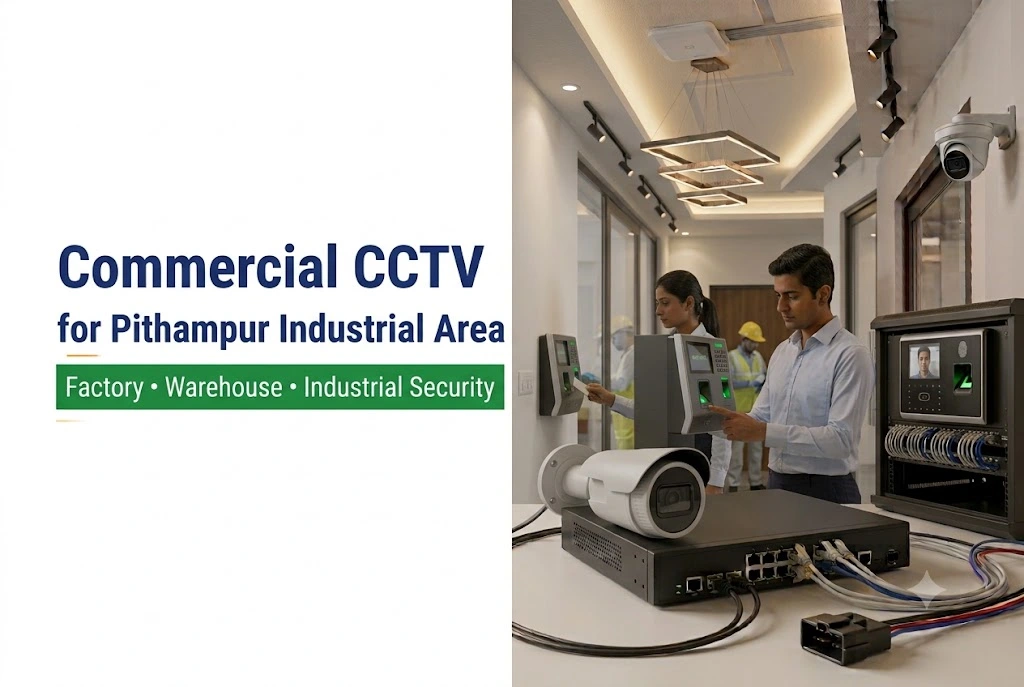
Commercial CCTV Camera Installation in Pithampur Industrial Area:
What Factory Owners Need to Know Before Buying a Single Camera
By AlifTech Secure | CCTV & Surveillance Solutions, Indore | May 2026 | www.aliftechsecure.in
We get calls from Pithampur almost every week. Sometimes it is a factory manager who installed cameras two years ago and is now realising the footage is useless — too grainy, wrong angles, blind spots in all the wrong places. Sometimes it is a plant owner whose cameras worked fine until a hard drive filled up and nobody noticed for three months. And occasionally, it is someone who just had a theft incident and is discovering, at the worst possible time, that their camera system did not actually record anything.
Pithampur is one of central India’s most significant industrial zones. Sector 1, 2, and 3 together host hundreds of manufacturing units — automotive components, pharmaceuticals, chemicals, engineering goods, plastics. Companies like Mahindra, Force Motors, Eicher Motors, Cipla, and Lupin have plants here. The area is growing fast, with Sector 7 now attracting investment from Asian Paints, JSW, and others. And with that growth comes more inventory, more equipment, more employees, and more risk.
A commercial CCTV system for a factory or warehouse is not the same as putting a few cameras in a shop. The requirements are different. The environment is different. The footage you actually need in a crisis is very different from what most basic installations provide.
This guide is written for factory owners, plant managers, and warehouse operators in Pithampur who are either setting up their first proper CCTV system or replacing one that has not been doing its job.
| What this guide covers • Why industrial CCTV requirements are different from commercial shop setups. • Which camera types actually work in factory and warehouse environments. • The BIS/STQC compliance situation and what it means for your purchase right now. • Common placement mistakes we see in Pithampur installations — and how to avoid them. • What a proper system should cost, and why the cheapest quote is usually the most expensive option. |
Why Industrial CCTV Is a Different Problem Entirely
Walk into any electronics market in Indore and you will find CCTV packages for Rs. 8,000 to Rs. 12,000 — four cameras, a DVR, some cable, done. For a small shop or a house, something like that might be adequate. For a Pithampur factory floor, it is almost certainly not.
Here is the catch. Factory environments create conditions that consumer-grade and lower-end commercial cameras genuinely struggle with. Dust from production lines. Steam or fumes in certain sections. Forklift vibration near loading bays. Direct sunlight flooding through large shed windows at certain times of day, creating massive contrast issues for cameras pointed even roughly in that direction. Temperature variations in facilities without full climate control.
Add to that the scale. A single factory shed in Pithampur might be 5,000 to 15,000 square metres. Covering that properly is not a four-camera job. Covering it with cameras that can actually read a number plate at the gate, see clearly in poor lighting conditions in a storage section, and handle the vibration near heavy machinery — that requires a proper system design, not just more of the same cheap hardware.
And then there is the footage quality question. When something goes wrong — a theft, a machinery incident, a labour dispute — what you need is footage that actually shows faces and details, not a blurry shape that could be anyone. We have reviewed footage from installed systems where the incident was captured but completely unusable because the resolution was inadequate and the camera angle was wrong.
Camera Types That Actually Make Sense in a Factory or Warehouse
Let me go through the main options and where they actually fit in an industrial setting.
IP cameras with PoE — the right base for most new installations
For any new CCTV installation in Pithampur right now, IP cameras on a PoE (Power over Ethernet) network are the right starting point. A single cable carries both power and data to each camera. No separate power points at each camera location. Easier to run across large factory floors. And the resolution options available — 4MP, 5MP, 8MP — are genuinely useful when you need to identify faces or read number plates.
DVR-based systems with analog cameras still exist, and some older Pithampur factories have them. The cabling is coaxial, the maximum resolution is lower, and expanding the system later is more complicated. If you are starting fresh, start with IP/NVR.
Bullet cameras for perimeter and gate coverage
For entry gates, compound perimeters, loading areas, and outdoor parking zones, bullet cameras with proper IP66 weatherproof ratings are the right choice. They handle rain, dust, and direct sun reasonably well when positioned correctly. For gate coverage — where you need clear number plate footage — you want at least 5MP with IR night vision, and the camera needs to be pointed at a narrow lane rather than trying to cover a wide area.
You’d be surprised how many factory gates we see where the camera is mounted high and at a wide angle, capturing the general area but not giving clear number plate footage of anything. That defeats the entire purpose of gate coverage.
Dome cameras for indoor production areas
Inside factory floors, dome cameras are generally more practical. They are harder to tamper with — a person cannot easily tell which direction a dome camera is pointing. Vandal-proof dome cameras with IK10 ratings handle the occasional impact from equipment or material movement. In areas with a lot of overhead equipment and machinery, domes mounted at ceiling height tend to give better coverage than bullet cameras mounted on walls.
PTZ cameras for large open areas and yards
For very large open yard areas — the kind of thing you find in automotive component factories or large warehouse complexes — a PTZ (pan-tilt-zoom) camera can do the work of four or five fixed cameras in covering a wide area. The trade-off is cost: PTZ cameras are expensive, and if they are being used for live monitoring they need someone actually watching. For recording purposes, fixed cameras at strategic positions usually make more sense. PTZ cameras are most useful when someone is actively monitoring a large outdoor area.
Thermal cameras for high-value and restricted areas
In pharmaceutical facilities and high-value storage areas in Pithampur, we increasingly see thermal cameras being deployed for perimeter monitoring. They detect movement based on heat rather than light — so they work in complete darkness and are not affected by headlight glare at night. They are significantly more expensive, so they make sense only for specific high-risk zones rather than general coverage.
| Camera Type | Best Use in Industrial Setting |
| IP Dome (IK10, IP66) | Production floors, indoor areas, assembly lines |
| IP Bullet (IP66) | Gates, perimeter walls, outdoor yards, parking |
| PTZ Camera | Large open yards, warehouses with active monitoring |
| Thermal Camera | Perimeter of high-value storage, dark boundary areas |
| ANPR / LPR Camera | Entry and exit gates requiring number plate logging |
| Analog / DVR (older) | Upgrades to existing coaxial installations only |
The BIS and STQC Compliance Situation — This Affects Your Purchase
If you are buying CCTV cameras in 2026, this section is important. And most people in Pithampur have not been told about it clearly.
From April 1, 2026, the Government of India through MeitY has made it mandatory that every IP camera sold in India must comply with BIS Essential Requirements (ER) and hold STQC certification or BIS ER-01 certification. Cameras without this cannot be legally sold. Fines for non-compliance go up to ten times the product value. BIS has already started raiding warehouses.
Here is where things get complicated. Some of the most popular international brands — Hikvision, Dahua, TP-Link Tapo range — have not received STQC certification as of April 2026. They cannot sell new stock in India. Brands that are currently certified and can legally be sold include CP Plus, Prama, Matrix, Sparsh, HiFocus, and a handful of others. Honeywell has certification. Some TP-Link VIGI models recently received BIS ER-01 certification.
In reality, what this means for a factory owner buying cameras today is straightforward: ask the vendor for the BIS registration number and STQC certificate before you buy. If they cannot produce documentation, walk away. Buying non-compliant cameras now means a system you may have to replace sooner than expected, potential problems with insurance claims if an incident occurs, and in the case of government-connected facilities or SEZ units, possible procurement compliance issues.
The good news is that Indian brands like CP Plus have excellent product ranges now that cover everything from basic 2MP cameras to 4K AI-enabled cameras with analytics. The compliance situation has actually pushed quality up. You are not making a significant compromise by going with a BIS-certified Indian brand.
| Quick compliance check before buying any camera • Ask for the BIS registration number — this should be on the packaging and product documentation. • Ask specifically whether the model has BIS ER-01 certification — not just the old IS 13252 electrical safety certification. • For government-connected facilities or SEZ units, ask whether the camera is STQC certified — this is the higher standard. • Verify the certificate number on the BIS public portal. It takes two minutes. |
Camera Placement — Where Most Pithampur Installations Go Wrong
This is honestly the part that matters most, and it gets the least attention. You can spend a lot of money on good cameras and get a poor result if the placement is wrong. And you can get a very good result from a modest system if the cameras are placed properl
Here are the specific mistakes we see repeatedly in factories and warehouses across Pithampur:
Gate cameras mounted too high
The entry gate is usually the first camera anyone installs. It is also one of the most frequently installed incorrectly. Cameras mounted at three to four metres height pointing down at an angle will capture the roof of a vehicle, not the number plate or the driver’s face. For number plate footage, the camera should be at roughly 1.2 to 1.8 metres height, pointed at a vehicle approaching in a narrow lane. If your gate allows vehicles from multiple lanes, you need a camera for each lane.
Too few cameras covering too large an area
A single 2MP camera cannot meaningfully cover a 50-metre loading bay. The temptation to minimise camera count to reduce cost is understandable. The result is a system where the footage shows you that something happened somewhere in a general area, but not what exactly happened or who was involved. For factory floor coverage, plan one camera per 8 to 12 metres of aisle or work zone, depending on ceiling height. For outdoor yard coverage, calculate actual field of view based on the specific camera’s specifications — not the maximum advertised range.
No coverage of the server room or NVR location
We have seen installations where considerable care went into covering production areas and entry points, but the NVR itself was in an unsecured room with no camera coverage. Someone who wants to erase footage knows exactly what to target. The recording equipment should itself be in a locked, ideally camera-covered location.
Ignoring lighting conditions for night coverage
Most factories are not fully lit at night. Security lighting covers main areas but leaves significant dark zones. Many CCTV cameras sold in the market have IR night vision that is rated for 20 to 30 metres but performs significantly worse in real conditions with any ambient light interference. For critical coverage areas at night, either plan proper security lighting as part of the system design, or use cameras with genuine low-light performance rather than relying on the IR rating alone.
Placing cameras where cable runs are convenient, not where coverage is needed
This one is surprisingly common. The cable runs get planned first, then cameras go wherever the cable ends up. The result is camera positions that cover walls and ceilings instead of the areas that actually matter. Camera positions should be decided first, based on what needs to be covered, and the cable runs designed around them.
| A practical placement checklist for Pithampur factories • All vehicle entry and exit points — with cameras at the right height for number plate and face footage. • Raw material storage areas — especially where high-value or controlled materials are kept. • Finished goods storage and dispatch areas — these are the highest-risk zones for pilferage. • Production floor entrances and exits — not necessarily the entire floor. • HR / accounts office entrances. • Perimeter boundary at regular intervals — especially on the sides away from the main gate. • Server room and NVR location. • Canteen and common areas if employee disputes are a concern. |
Storage and Recording — How Long Should Your Footage Last?
This comes up in almost every conversation we have with factory owners, and the standard answer in cheap installation packages is not useful.
Most basic CCTV packages come with enough storage for 7 to 15 days of footage at low resolution. For a factory where a theft or incident might only be discovered a week or two after it happened, that is not enough. By the time someone realises something is missing and goes to check the footage, it may already have been overwritten.
In reality, for industrial and commercial installations, 30 days of footage is a more practical minimum. For high-value areas — finished goods stores, pharmaceutical raw material areas, cash handling — 60 days. The storage requirement depends on the number of cameras, the resolution you are recording at, and whether you are recording continuously or using motion-triggered recording.
Motion-triggered recording can reduce storage needs significantly, but it needs to be configured properly. A camera set to motion-triggered recording that triggers on a swaying tree branch outside a window will fill storage just as fast as continuous recording. Setup matters.
| Factory Size / Camera Count | Recommended Storage |
| Small factory — 4 to 8 cameras | 4TB NVR minimum — 30 days at 1080p |
| Medium factory — 8 to 16 cameras | 8TB NVR — 30 days at 1080p mix |
| Large factory — 16 to 32 cameras | 16TB NVR or NAS — 30 to 60 days |
| High-value storage areas | Separate NVR with 60-day retention |
| Outdoor and gate cameras (ANPR) | High storage consumption — plan separately |
What Should a Commercial CCTV System in Pithampur Actually Cost?
This is the question everyone has and nobody wants to answer directly. I will give you a genuine range.
A basic but properly specified 8-camera IP system for a small factory unit in Pithampur — including BIS-compliant cameras, a proper NVR with adequate storage, cabling, power backup, and professional installation — should be in the range of Rs. 35,000 to Rs. 60,000 depending on the camera specifications and site complexity.
If someone quotes you Rs. 15,000 for the same scope, something is wrong. Either the cameras are not BIS compliant, the storage is inadequate, the cabling is substandard, or corners are being cut somewhere that you will not discover until something goes wrong.
For a medium-sized factory covering production floor, gates, perimeter, and key storage areas — typically 16 to 24 cameras — budget Rs. 1.2 to Rs. 2.5 lakh depending on camera types selected and site complexity. For large facilities with PTZ cameras, ANPR systems at gates, and AI-enabled analytics, the range is significantly higher and should be scoped properly.
The honest reality of industrial CCTV is that a system that costs half as much and captures footage you cannot use in a crisis has cost you more than a proper system would have.
| Installation Scope | Approximate Investment |
| Small unit — 4 to 8 cameras, basic coverage | Rs. 20,000 to Rs. 45,000 |
| Medium factory — 8 to 16 cameras | Rs. 50,000 to Rs. 1.2 lakh |
| Large factory — 16 to 32 cameras | Rs. 1.2 to Rs. 2.5 lakh |
| ANPR gate system (number plate recognition) | Rs. 25,000 to Rs. 50,000 additional |
| AI analytics integration | Quoted separately based on scope |
| Annual maintenance contract (AMC) | 10 to 15 percent of system cost per year |
Remote Monitoring — Watching Your Factory From Anywhere
Almost every factory owner in Pithampur now asks about remote monitoring. The good news is that with an IP camera system and a decent internet connection at the site, this is entirely practical.
Most NVR systems support mobile app access. You can view live feeds and playback recorded footage from your phone, wherever you are. Some factory owners we work with spend part of their time in Indore and part on-site — being able to check what is happening at the factory gate or the dispatch area from their phone is genuinely useful.
Here’s the catch with remote monitoring: it requires a stable internet connection at the factory, adequate upload speed for the number of cameras you want to monitor simultaneously, and some basic network security setup so that the camera feed is not publicly accessible. We have seen situations where a poorly configured remote access setup left camera feeds accessible to anyone who knew the IP address. That is a problem, especially post the BIS ER-01 mandate which specifically addresses cybersecurity in IP cameras.
The setup is not complicated, but it needs to be done properly. Configure port forwarding or use a VPN. Set unique strong passwords on the NVR and all cameras. Enable HTTPS for the admin interface. These are not optional steps.
Why Factory Owners in Pithampur Work With AlifTech Secure
We are based in Indore, which means when something needs attention at your Pithampur site, we are 30 to 35 minutes away. Not a two-day wait for a technician from Bhopal or Mumbai.
We have installed systems in factories across Pithampur Sector 1, 2, and 3 — automotive component units, pharmaceutical facilities, chemical plants, warehouses. We know the specific challenges: the dust in certain production zones that requires IP66 or higher ratings, the lighting conditions in large sheds, the gate configurations on Mhow-Neemuch Road that affect how camera positioning needs to work.
Every system we install starts with a site survey. We walk the facility, identify what needs to be covered, map blind spots, assess lighting, and then recommend a system. We do not quote from a standard package list and hope it fits. Factory layouts vary significantly, and the system needs to be designed for your specific site.
We supply only BIS ER-compliant cameras. Since April 2026, this is non-negotiable for us — and it should be non-negotiable for you.
We also offer AMC — Annual Maintenance Contracts — for ongoing maintenance. Hard drive health checks, camera cleaning, software updates, alignment checks. A system that runs unmonitored for two years is not a security system, it is an expensive false sense of security.
- Free site survey before any quote — we assess, then recommend
- BIS ER-compliant cameras only — CP Plus, Prama, Matrix, HiFocus and others
- Installation with proper cable management and weatherproofing
- Remote monitoring setup and network security configuration included
- AMC for ongoing maintenance and hard drive health monitoring
- Same-day site visit across Indore and Pithampur
| AlifTech Secure — Indore Call / WhatsApp: +91 9109106826 | +91 8602885412 www.aliftechsecure.in | aliftechsecure@gmail.com 112 Basement, Akbar Ali Complex, MG Road, Palasia Square, Indore — 452001 |
| Get a Free Factory CCTV Site Survey We visit your Pithampur facility, assess your coverage needs, and give you a written quote. No obligations. Call / WhatsApp: +91 9109106826 | www.aliftechsecure.in |
Questions Factory Owners Usually Ask
How many cameras does my factory actually need?
There is no universal answer. A 2,000 square metre single-shed unit might need 8 to 12 cameras placed properly. A complex with multiple buildings, an open yard, and a gate with two lanes might need 24 or more. The right number comes from a proper site survey, not from a package deal. What we can tell you is that most factories we survey are either under-covered or have cameras in the wrong positions for the coverage they think they have.
Can I use the cameras I already have and just upgrade the recording equipment?
Depends on what you have. If you have an existing analog DVR system with coaxial cable, the cameras and recording equipment are specific to that system. You can add more analog cameras, but you cannot easily mix analog and IP cameras on the same system. If you are looking to meaningfully upgrade — better resolution, remote access, analytics — a full IP system replacement is usually the right move. Trying to extend an old system tends to cost more in the long run.
What happens if the internet goes down — do cameras stop recording?
No. The cameras record locally to the NVR regardless of internet connection. Internet connectivity is only needed for remote access from your phone. Local recording continues independently. What you do lose without internet is the ability to view footage remotely or receive mobile alerts. For the recording itself, the NVR functions completely without any internet connection.
Are the cameras we install now affected by the BIS/STQC compliance rules?
The April 2026 mandate applies to new sales, not existing installed cameras. If you already have cameras installed, they are not required to be replaced simply because of the new rules. However, when you purchase any new cameras or expand your system, those new cameras must be BIS ER-compliant. This is worth bearing in mind when you receive quotes — make sure any camera being proposed carries current certification.
How long should CCTV footage be kept for a factory?
Our standard recommendation for Pithampur industrial facilities is a minimum of 30 days, and 60 days for high-value or high-risk areas. The reasoning is practical: incidents are not always discovered immediately. A theft from a finished goods store might only be noticed at the end-of-month stock check. If your system only keeps 7 days of footage, that incident has been overwritten before anyone thought to check. Storage is cheap compared to the cost of investigating an incident with no usable footage.
One Last Thing Before You Buy
is growing. The industrial belt is expanding into Sector 7. Investment from companies like Asian Paints and JSW will bring more supply chain activity, more logistics movement, more contractor personnel on-site at local units. The security challenge for factories in the area is getting more complex, not simpler.
A CCTV system installed properly today will serve your facility for 7 to 10 years with regular maintenance. One installed poorly — wrong cameras, wrong placement, inadequate storage — will give you a false sense of security until the moment you actually need it. That is the wrong time to discover the problem.
If you are ready to set up a proper system, or if you have an existing system you are not confident about, start with a site survey. Walk the facility with someone who has done this in industrial settings before. It takes an hour. The clarity it gives you on what you actually need — and what you do not — is worth far more than the time.
- IP cameras with PoE are the right starting point for any new industrial installation in 2026
- BIS ER-01 compliance is mandatory for all new camera purchases — verify before you buy
- Camera placement matters more than camera count — design the system around coverage needs, not convenience
- Plan for 30 days minimum storage — 60 days for high-value areas
- AMC keeps the system actually working, not just installed
AlifTech Secure | CCTV & Surveillance Solutions, Indore MP | www.aliftechsecure.in | +91 9109106826

