
By AlifTech Secure | EPABX & Intercom Solutions, Indore | June 2026 | www.aliftechsecure.in
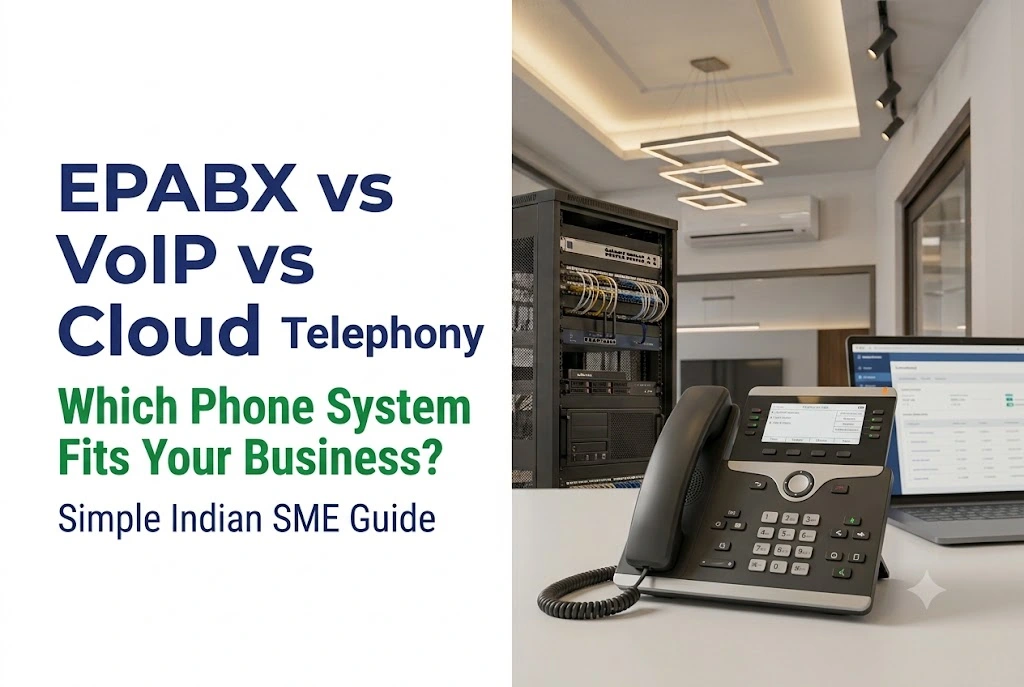
The honest position in 2026: EPABX is losing ground without being obsolete, on-premise IP-PBX sits in the middle, and cloud telephony has become the default starting point for most growing Indian businesses.
None of them is the universal right answer. What decides it is your headcount, whether people work remotely, what wiring you already have, and how reliable your internet is.
There is also a compliance question that most comparison articles get wrong, and it changed in mid-2026.
Quick Answer
- EPABX: hardware in your office, works without internet, high upfront cost. Suits 50+ users with stable headcount.
- IP-PBX: runs over your office network, more flexible, still needs on-premise hardware and local IT.
- Cloud telephony: no hardware, monthly per-user cost, adds a user in two minutes.
- Under 50 users or growing? Cloud or IP-PBX usually wins.
- Check your provider’s authorisation, not their “licence.” The framework changed in June 2026.
EPABX: Where It Still Makes Sense
Panasonic, Matrix and Avaya have supplied Indian offices for decades. The systems are reliable, local technicians understand them, and they handle high call volumes when sized correctly.
For a Pithampur manufacturing office or a large Indore commercial setup with 50 or more users, existing telephone cabling through the building and an on-site IT person, EPABX remains practical. Hardware lasts 10 to 15 years with proper AMC, and per-call costs fall below cloud once you are past break-even on the hardware.
Where it falls short
Scaling is the problem. Adding a user means buying and fitting a physical card or expansion module, which takes days and costs money each time.
Extensions are tied to desks, so remote and hybrid workers cannot connect easily. And AMC runs roughly 10% to 15% of hardware value annually, which is an ongoing cost cloud telephony avoids entirely.
IP-PBX: The Middle Ground
An IP-PBX is an EPABX that runs over your office network instead of dedicated telephone wiring. Calls travel as data over your LAN, with SIP trunks handling external calls rather than physical phone lines.
The hardware still sits in your office, either a server or an appliance, but it connects to standard network switches and IP phones rather than telephone cabling.
So you get more flexibility than EPABX. Users are easier to add, integration with CRM tools becomes possible, and extensions extend to softphones on laptops and mobiles. But you still carry on-premise hardware, local IT management and an upfront capital cost.
IP-PBX earns its place where there are specific on-premise requirements: call recording stored locally, security policies preventing data leaving the building, or existing IP phone hardware worth keeping. Otherwise most SMEs setting up new offices now skip straight to cloud.
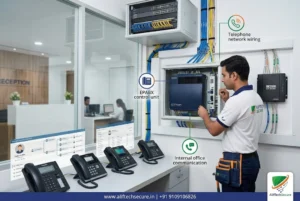
Either route needs the network underneath it to be sound, which is why we cover this alongside structured cabling and networking rather than as a separate job.
Cloud Telephony: Why Most SMEs Start Here
Cloud telephony puts the exchange in a data centre rather than your office. Staff connect through a mobile app, a browser or an IP phone, and their extension follows them.
What it gives you
A professional IVR that routes callers. A virtual or toll-free number. Call recording. And the ability to add a team member through a dashboard in two minutes rather than waiting for a hardware module.
Remote work becomes straightforward too. A sales executive at home uses the same extension as in the office, and a caller cannot tell whether the person answering is in Indore or Bhopal.
What it costs
For a 20-user office, expect roughly ₹400 to ₹900 per user per month, so ₹8,000 to ₹18,000 monthly, with no upfront hardware.
Against that, a comparable EPABX for 20 users runs ₹25,000 to ₹60,000 for a basic system or ₹80,000 to ₹2,50,000 for mid-range, plus AMC at 10% to 15% of hardware cost annually.
The crossover depends on how long you keep the system. Over three years cloud usually costs more in total but demands nothing upfront, and it adapts if headcount changes. Over ten years with stable headcount, hardware wins.
The Compliance Part, Updated for 2026
This is where most articles on this topic are now out of date, including the earlier version of this one.
The licensing framework changed in June 2026
On 24 June 2026 the Department of Telecommunications notified and operationalised the Telecommunications (Authorisation for Provision of Principal Telecommunication Services) Rules, 2026, under the Telecommunications Act, 2023.
These Rules replace the licensing architecture built around the Unified Licence and UL-VNO framework that had governed the sector since 2013. The new structure covers five categories of principal telecom service, and an eligible entity applies as either a Network Service Operator or a Virtual Network Operator.
So the practical instruction has changed. Asking a provider for their “Unified Licence number” now refers to a framework being replaced. Ask instead what authorisation they hold under the 2026 Rules, and for the number. A provider who cannot answer clearly is one to avoid.
The risk is not theoretical. Non-compliant global cloud telephony services are technically reachable from India, and businesses using them face audits that can shut the service down with little notice. Losing your phone system without warning is a bad way to discover your provider was not authorised.
Domestic VoIP to PSTN is still restricted
Worth knowing before a provider promises something they cannot deliver. The Telecom Act 2023 did not automatically lift the restriction on domestic VoIP dial-out to Indian landline and mobile numbers.
Compliant providers work around this with hybrid architectures, on-premise gateways and PSTN-first routing. That is legitimate, though it explains why some international cloud platforms cannot simply be switched on here.
The 160-series requirement
A practical point almost nobody covers, and it affects any business making outbound calls.
Commercial outbound calls are required to display a TRAI 160-series number or risk being blocked as spam. This is a requirement rather than a recommendation.
If your business does outbound sales or support calling, ask your provider directly how they handle 160-series numbering before you sign. A phone system whose calls get filtered as spam is worse than no system.

Comparison Across All Three
| Factor | EPABX | IP-PBX | Cloud telephony |
|---|---|---|---|
| Where the system sits | Your office | Your office | Provider’s data centre |
| Wiring needed | Dedicated telephone cabling | Your existing LAN | None |
| Hardware cost, 25 users | ₹80,000 to ₹2,50,000+ | ₹60,000 to ₹2,00,000 | Zero |
| Monthly cost | AMC only, 10% to 15% of hardware a year | AMC plus SIP trunk charges | ₹400 to ₹900 per user |
| Adding a user | Physical card, days | Licence plus handset, hours | Two minutes in a dashboard |
| Remote workers | Desk phone only | Softphone possible | Full mobile, laptop, browser |
| Call recording | Local, needs hardware | Local storage | Included, cloud-stored |
| IVR | Available, needs configuring | Available | Standard feature |
| Works without internet | Yes | Internal calls yes | No |
| CRM integration | Limited | Possible | Standard |
| Maintenance | On-site engineer | On-site plus IT | Provider handles it |
| Best for | 50+ users, stable, existing wiring | On-premise control with flexibility | Under 50 users, remote teams, new offices |
How AlifTech Secure Helps Indore Businesses Choose and Install the Right System
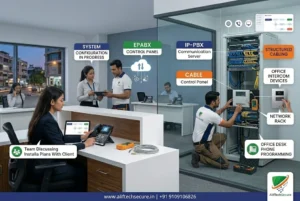
We supply Panasonic and Matrix EPABX systems for larger, stable offices where on-premise telephony makes long-term sense. For offices moving to IP-PBX or needing SIP trunk integration, we handle the full transition including cabling, network setup, and handset provisioning. For businesses that decide cloud telephony is the right choice, we advise on DoT-licensed providers and ensure the network infrastructure supports it properly — including the firewall and bandwidth allocation that a reliable cloud telephony deployment requires.
Every installation includes proper cabling, handset setup, extension numbering, IVR configuration where relevant, and staff training on the new system. We also offer AMC for EPABX and IP-PBX systems, covering preventive maintenance, fault resolution, and licence renewals.
- Panasonic and Matrix EPABX — supply and installation for larger offices
- IP-PBX systems with SIP trunk integration for flexible on-premise setups
- Intercom systems for factories, hospitals, schools, and multi-floor commercial offices
- Network and infrastructure support for cloud telephony deployments
- AMC for ongoing EPABX and IP-PBX maintenance and fault resolution
- Same-day site visits across Indore and Pithampur
Four Questions That Decide It
How many users, and will that change?
Fifty or more with stable headcount, a manufacturing office, a hospital, a large commercial setup, means the hardware economics work over a 10 to 15 year life. Under fifty, or expecting to grow or shrink, and cloud flexibility saves both money and management effort.
Does anyone work remotely?
This settles it for most modern businesses. If team members regularly work from home, client sites or other cities, cloud handles it natively. EPABX makes it awkward and expensive, needing separate SIMs, forwarding setups or extra hardware.
What wiring and hardware already exist?
An office with working telephone cabling and a reliable EPABX carries real switching costs to move: new handsets, changed workflows, migration downtime. Either keeping it or moving to IP-PBX on the same cabling deserves evaluation first. A new office has no legacy to protect, so cloud is the natural starting point.
How reliable is your internet?
Cloud depends entirely on a stable connection. Most commercial areas in Vijay Nagar, Palasia, MG Road and Super Corridor are fine. Sites with patchy connectivity, or operations along highway corridors, are where the dependency becomes a genuine risk, and an IP-PBX with local routing gives more resilience.
Whichever route you take, a backup connection matters. A 4G or 5G router that fails over automatically stops one ISP outage from taking the phones down.
Frequently Asked Questions
Is EPABX outdated in 2026?
Not outdated, though it now suits a narrower set of businesses. Large stable offices of 50 or more users with existing telephone infrastructure and an IT team still get good value from it. For most SMEs setting up new offices or growing teams, cloud or IP-PBX delivers more flexibility at lower upfront cost.
Is cloud telephony legal in India?
Yes, through a properly authorised provider. The framework changed on 24 June 2026, when new Rules under the Telecommunications Act, 2023 replaced the Unified Licence architecture. Ask what authorisation your provider holds under the current Rules rather than asking for a Unified Licence number, and get the number in writing.
What happens if the internet goes down?
Cloud telephony calls stop, which is its core vulnerability. Mitigate with a backup 4G or 5G connection that fails over automatically, and check whether your provider supports call forwarding to mobiles during an outage. A traditional EPABX keeps working for internal calls regardless of internet.
Can we keep our existing phone numbers?
Yes, number porting is available under TRAI regulations, so landline and toll-free numbers can move to a new system as long as your incoming provider supports porting from your current carrier. Allow seven to fourteen working days and schedule the switch during a quiet period.
What does EPABX installation cost for a small Indore office?
For 10 to 20 users, a basic Panasonic or Matrix system runs ₹25,000 to ₹60,000 including installation. For 20 to 50 users, ₹80,000 to ₹2,50,000. Annual AMC adds 10% to 15% of hardware cost. Cloud telephony for the same 20-user office costs nothing upfront and ₹8,000 to ₹18,000 monthly.
The Right Answer Depends on Your Office
Most Indore SMEs setting up a new office should start with cloud or IP-PBX unless there is a specific reason for EPABX. Equally, a business with a working EPABX should not replace it because of a trend. Migrate when there is an operational reason.
If you are unsure, a short assessment covering team size, office layout, growth plans and internet reliability gives a clear answer. Do that before committing to hardware or a subscription.
| AlifTech Secure — Indore Call / WhatsApp: +91 9109106826 www.aliftechsecure.in | aliftechsecure@gmail.com 112 Basement, Akbar Ali Complex, MG Road, Palasia Square, Indore — 452001 |
| Get a Free Office Phone System Consultation We assess your team size, office setup, and growth plans — then recommend the right system. Call / WhatsApp: +91 9109106826 | www.aliftechsecure.in |
AlifTech Secure | EPABX & Intercom Solutions, Indore MP |+91 9109106826 | www.aliftechsecure.in

