
By AlifTech Secure | Home & Office Automation, Indore | June 2026 | www.aliftechsecure.in
₹1 lakh is a useful planning line rather than a minimum or a ceiling. Below it you are buying devices. Around it you start buying a system, where the pieces talk to each other and the house behaves differently rather than just having more apps in it.
This guide covers what that budget actually gets in an Indore 3BHK, where the money goes, and what to buy first if you would rather start smaller and grow.
Quick Answer
- ₹60,000 to ₹75,000 covers smart switches, fan control, AC control, video doorbell and a smart lock for a 3BHK.
- ₹85,000 to ₹1 lakh adds two indoor cameras and motorised curtains.
- No rewiring needed. Wireless retrofit works with existing switches and wiring.
- Start with the living room and entrance if you want to test the idea for ₹15,000 to ₹25,000.
- Switches still work at the wall. That matters more than any feature for family adoption.
Why This Works Well in Indore
Two practical reasons, both worth knowing before you compare quotes.
Installation costs less here. The same system quoted at ₹1.3 lakh installed in a metro often lands nearer ₹1 lakh in Vijay Nagar or Nipania. Hardware costs the same everywhere, so the difference is labour and travel, and it extends what a given budget reaches.
The housing stock suits retrofit. Apartments and independent houses around Super Corridor, Scheme 78, the Bombay Hospital area and Nipania are mostly recent construction with wiring that takes smart switches without modification. Older housing elsewhere often needs rewiring work first, which changes the budget entirely.
One caution before you buy anything. Many older switchboards, particularly in smaller MP towns and older Indore construction, have no neutral wire running to the switch box. Most Wi-Fi switches need one. Open one switchboard and check before ordering the full set. Our home automation under ₹50,000 guide covers this and the smaller-budget path in detail.
Smart Lighting: Start Here
Lighting is where almost every home automation project should begin. It delivers something visible every day, everyone in the family understands it, and it costs least per point.
Switches, not bulbs
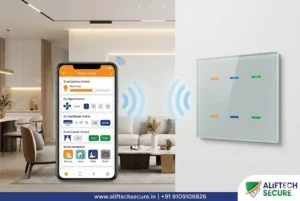
In Indian homes the answer is smart switches rather than smart bulbs. A smart bulb needs its wall switch left permanently on, which nobody in a household of four actually maintains.
Smart switches replace the existing switch and work with your existing fittings. Anyone can walk over and press it, exactly as before, and the same light also responds to the app, to Alexa or Google Home, or to a schedule.
That fallback is the single most important design decision in the whole system. A grandmother who presses the switch and gets light will accept everything else. One that does not respond kills adoption for the entire household.
For a 3BHK with six rooms, budget ₹8,000 to ₹20,000 on switches depending on brand and nodes per switch. Wipro, Philips, Legrand and Aqara all have workable India support.
Fans and ACs
Fans use a regulator rather than a plain switch, so they need a smart fan controller in place of the regulator, giving speed control from the app.
ACs work through an IR blaster, a small device that copies your existing remote and can then be scheduled or triggered remotely. Roughly ₹2,000 to ₹3,000 per AC, and it works with almost any unit that has a remote.
Scenes are the actual product
Switching one light from your phone is a novelty that wears off in a fortnight. Scenes are what make the system feel like a system.
A Morning scene brings up kitchen and bathroom lights at a set time. An Away scene shuts everything off as you leave. A Night scene kills the whole house except the corridor. That is when people stop noticing the technology and start relying on it.
Security: The Part Families Actually Use
Video doorbell
This is the most-used device in most Indian smart homes, and it is rarely the one people expect.
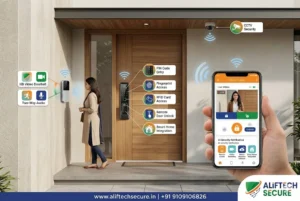
It replaces the existing bell push and adds a camera, microphone and speaker. Somebody rings, your phone shows live video, and you can see and speak to them from the kitchen or from the office.
For households with elderly parents or children coming home from school, it stops being a security device within a week and becomes a daily convenience. Options run ₹5,000 to ₹12,000. Our video door phone range covers wired options too.
Smart lock
A smart lock replaces the deadbolt on your main door and still takes a physical key as backup, while adding fingerprint, PIN and phone unlock.
The practical cases are specific: elderly family members who forget keys, and unlocking remotely when children arrive home. ₹8,000 to ₹18,000 depending on brand and security rating.
Two indoor cameras
One covering the main living area and one near the entrance corridor gives you remote monitoring through the same phone. Modern units record to a memory card or a cloud plan, detect motion, and send alerts.
Buy BIS-registered models. Since 1 April 2026, cameras that do not meet MeitY’s Essential Requirements cannot be sold in India, so ask for the BIS registration number for the exact model rather than trusting the brand name. Our guide to the 2026 CCTV import and BIS rules explains what changed.
AC Scheduling, Curtains and Energy
AC scheduling
The most common Indore use case is simple: the bedroom AC comes on twenty minutes before bedtime and goes off at a set hour, without anyone remembering.
Remote switch-off is the second. Realising at the office that the AC has been running since morning, and turning it off from there, has obvious value through an Indore summer.
Motorised curtains
These sound like indulgence and have a real function here. Closing curtains automatically when afternoon sun hits west-facing windows keeps the room cooler and reduces AC load.
₹12,000 to ₹20,000 per track depending on window size, so two tracks fit inside a ₹1 lakh budget but will consume a quarter of it. Worth deciding whether you want that quarter spent on curtains or on more rooms of lighting.
Energy monitoring
Smart plugs with monitoring show what each appliance actually draws. Not glamorous, though finding out what a geyser costs on standby usually changes behaviour faster than any advice does.
A note on savings claims. You will see figures of 15% to 30% off your bill quoted widely in this market. Research supports large savings on lighting energy specifically, with LBNL’s meta-analysis of 240 estimates giving 24% to 38% depending on strategy, while WBCSD puts whole-building energy management at 5% to 10% of energy cost. Those are different numbers measuring different things, and the second is the one that describes your bill. Our energy saving automation guide works through the arithmetic.
Where the Money Goes
| Item | Indore cost |
|---|---|
| Smart switches, 3BHK | ₹8,000 to ₹20,000 |
| Fan controller, per room | ₹2,000 to ₹4,000 |
| IR blaster for AC, each | ₹2,000 to ₹3,000 |
| Video doorbell | ₹5,000 to ₹12,000 |
| Smart door lock | ₹8,000 to ₹18,000 |
| Indoor camera, each | ₹3,000 to ₹8,000 |
| Motorised curtain, per track | ₹12,000 to ₹20,000 |
| Smart plug with monitoring | ₹1,500 to ₹3,500 |
| Hub or gateway, if needed | ₹3,000 to ₹8,000 |
| Professional installation | ₹8,000 to ₹15,000 |
Two Packages for a 3BHK
₹60,000 to ₹75,000: the practical core
Smart switches across six rooms, fan controllers for four bedrooms and the living room, IR blasters for two ACs, a video doorbell, a smart lock, a voice assistant, and professional installation with app setup for everyone in the house.
This covers every room with something that works daily. Nothing here is decorative.
₹85,000 to ₹1 lakh: add cameras and curtains
Everything above plus two indoor cameras, one motorised curtain track for the living room, and energy monitoring plugs on two heavy appliances.
That reaches lighting, climate, security, access and energy awareness. Beyond this the returns get thinner until you are spending considerably more.
Wired versus wireless
Wired systems using KNX or DALI are more reliable and need complete rewiring, which means they belong in new construction. A 3BHK wired system starts near ₹3 lakh.
For a furnished apartment, wireless retrofit is the only practical choice at this budget, and the performance gap barely shows for the things households actually use.
Starting Smaller
The system is modular, so starting with one area costs nothing in wasted equipment later.
Living room and entrance first. Smart switches for the living room, a video doorbell and a smart lock. ₹15,000 to ₹25,000. These are the parts of the house everyone uses and every visitor sees, so the family decides quickly whether it likes the idea.
Then add rooms. Each bedroom costs ₹3,000 to ₹6,000 for a switch and fan controller, each AC ₹2,000 to ₹3,000 for an IR blaster. Devices join the same app and the same voice assistant, so a bigger system does not feel more complicated.
Curtains and cameras as phase two. Both need more involved fitting, curtain track measurement and camera positioning, so they suit a dedicated visit six months later rather than being added piecemeal.
Frequently Asked Questions
Do I need to break walls or rewire my flat?
No, and this is the most common worry we hear. Wireless systems use your existing wiring and simply replace switches, the lock and other devices. No walls are opened and no new cable is run. Installation usually completes in a single day for an apartment. Do check one switchboard for a neutral wire before ordering.
Will the system work during a power cut?
Smart switches run off your mains circuit, so they go offline exactly as ordinary switches do. Smart locks normally have battery backup, so fingerprint and PIN keep working. The app and hub also go offline. Everything reconnects automatically within seconds once power returns.
Can my elderly parents use it?
Yes, provided it is set up with them in mind. Switches still work at the wall exactly as before, the voice assistant covers most functions verbally, and the app is for remote use rather than daily use. Elderly family members often become the heaviest users of the video doorbell, since seeing and speaking to a visitor without walking to the door is immediately useful.
What happens if the internet goes down?
Pressing a switch at the wall works regardless. Smart locks with fingerprint or PIN also work without internet. Voice control and remote app access need a connection. Scenes running through a local hub usually continue, while cloud-dependent ones do not, so ask your installer which type your hub uses before finalising the design.
How much will it cut my electricity bill?
Less than most vendors claim. The real savings come from AC scheduling and from lights and fans no longer running in empty rooms. Research supports 24% to 38% off lighting energy from controls, while whole-building energy management is benchmarked at 5% to 10% of energy cost. Ask for a calculation against your own bills rather than a percentage.
Making the Decision
An hour at your apartment settles most of this. What is practical, what your family will actually use, and what it costs for your specific layout.
Start with the living room and entrance if you are unsure. See how the household responds over a few weeks. Then expand, because the system was built to grow room by room and nothing you buy first gets wasted.
| AlifTech Secure — Indore Call / WhatsApp: +91 9109106826 www.aliftechsecure.in | aliftechsecure@gmail.com 112 Basement, Akbar Ali Complex, MG Road, Palasia Square, Indore — 452001 |
| Book a Free Smart Home Consultation in Indore We visit your home, understand your needs, and design a system within your budget. No obligations. Call / WhatsApp: +91 9109106826 | www.aliftechsecure.in |
AlifTech Secure | Home & Office Automation, Indore MP |+91 9109106826 | www.aliftechsecure.in

