
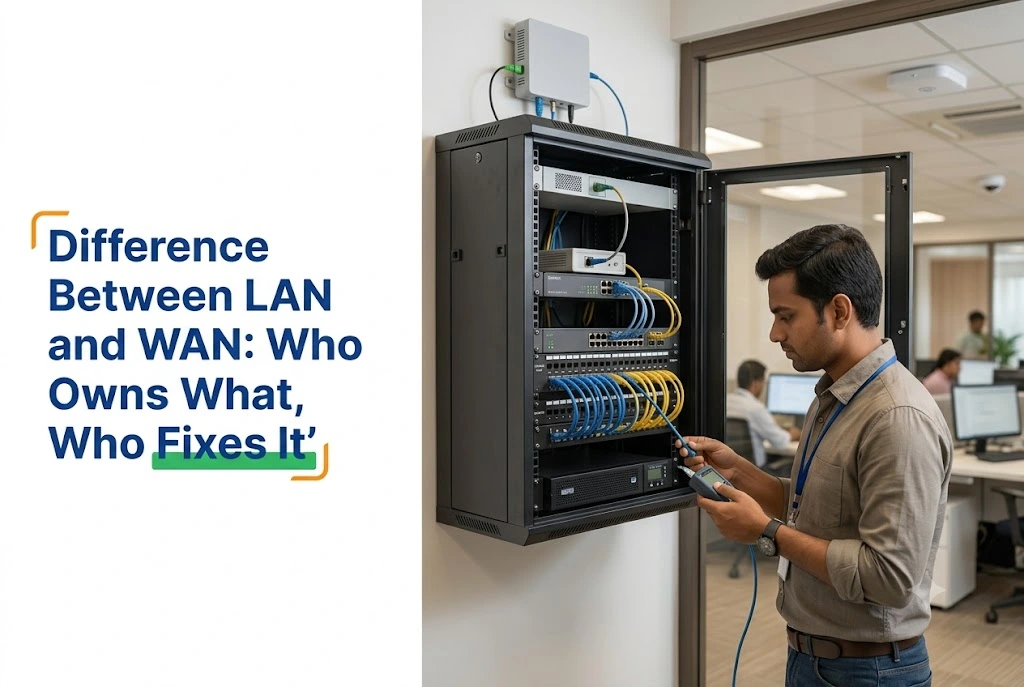
The difference between LAN and WAN decides who you call when the network dies. A LAN is the network inside one building — your cabling, your switches, your Wi-Fi. A WAN joins that building to another, and most of it belongs to a licensed operator rather than to you.
Quick answer: A LAN covers one site and you own all of it. A WAN links sites and you rent most of it. TEC’s structured cabling GR defines that line at the building entrance, where router or leased-line gear faces the public network. Inside that line a horizontal cable run must not exceed 90 metres.
Most office network arguments are boundary arguments. The video call stutters, the plant’s accounts software freezes, and two people blame different things. One says the switch. The other says the internet. Both are guessing, because nobody agreed where your network stops and the operator’s starts. That boundary is not an opinion: the Telecommunication Engineering Centre, which writes India’s telecom standards, has put it in writing.
TL;DR
- A LAN is one site, a WAN joins sites, and that is why it comes down to ownership.
- TEC puts the handover at the building entrance.
- A fixed horizontal run must not exceed 90 metres whichever cable you use, or 84 metres at 40 °C.
- India had 46.54 million fixed wired access internet subscribers in early 2026, against 1,046.26 million wireless.
What is the difference between LAN and WAN?
Formally, the difference between LAN and WAN is reach: a LAN covers one premises, a WAN spans the distance between them. The line that matters in practice is ownership, because reach decides who owns the cable. A Local Area Network is the outlet at each desk, the cable in the ceiling, the switches, the access points. You own all of it.
A Wide Area Network is the span between them. Indore office to Pithampur plant. Head office to a Bhopal branch. You buy that span as a service, and the fibre in the ground is not yours.
TEC’s Generic Requirements for a LAN Switch, TEC 48060:2026, says it plainly: “A LAN switch is a local area networking device operating at Layer 2 (and in some cases Layer 3) of the seven layer ISO-OSI model.” Note “local area”. That is a technical requirements standard for service-provider networks, not a law binding your office.
Where does your LAN actually end?
At the building entrance. TEC’s GR/SLC-01/02, a 2005 design standard for Indian telecom networks rather than a law binding your office, splits a site into six sub-systems and defines the first: “Building entrance shall be the place where-in the interface equipment to the public network is positioned. The example for this is interface to the WAN through Routers/Leased lines etc.”
Note the modality. “Shall be the place” deems what the entrance is; it does not tell you to do anything.
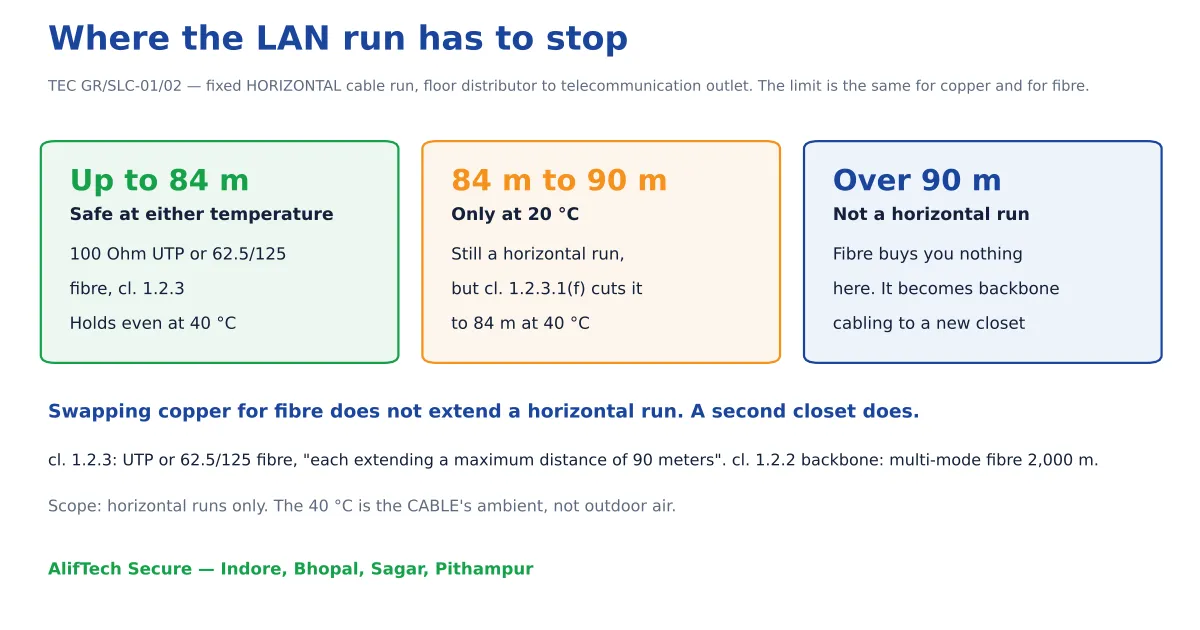
The LAN side has a hard dimension. Clause 1.2.3.1(f) says each run of fixed horizontal cable “shall not exceed 90 meters (at 20 degrees Celsius, if the temperature is 40 degrees the length shall not cross 84 meters)”. Note what it does not say. Clause 1.2.3 allows UTP or 62.5/125 fibre as horizontal media, “each extending a maximum distance of 90 meters”, so fibre buys nothing here. A longer span becomes backbone cabling (Hindi) to a new closet, where clause 1.2.2 allows multi-mode fibre 2,000 metres, or a wireless link.
Which faults are LAN faults and which are WAN faults?
Start with the blast radius. One site broken and the other fine is a LAN fault. Both sites up but unable to see each other is a WAN fault. Everything local working while only internet-facing things fail points at the edge — the router or firewall.
Scale explains why branch links behave so differently. TRAI’s report for January–March 2026 counts 46.54 million fixed wired access internet subscribers against 1,046.26 million wireless. Those are all-India access-side counts, not leased-circuit counts, but they explain why a second site in MP is so often reached over radio — and radio fails differently.
| Symptom | Usually | First check |
|---|---|---|
| One desk dead, floor fine | LAN | Patch lead, then port |
| Both sites online, cannot see each other | WAN | Circuit status, both ends |
| Footage plays locally, not remotely | WAN upload | Upload bandwidth |
| Fine until about 10 a.m. daily | LAN | Device count, channel load |
Across 585+ AlifTech installations, far more “internet is down” calls end at a dead patch lead than at the operator. The timestamp tells you which: a LAN fault starts when something physical changed.
What do you buy for the LAN side and the WAN side?
Different boxes, different duties. The LAN side is switches, cabling and access points, sized by ports and distance. The WAN side is a router or firewall, plus a contract. A managed switch (Hindi) earns its price on the LAN side and does nothing for a slow line.
One buying check applies to both sides, and few buyers ask. TEC’s Mandatory Testing and Certification scheme rests on the Indian Telegraph (Amendment) Rules, 2017, which TEC summarises as requiring that “every telecom equipment must undergo” testing and certification “prior to sale, import of use in India” [sic]. It bites phase by phase, on notified products only, and TEC publishes exemptions specific to LAN switches. So ask which phase and which parameters a model is certified against, not simply whether it has a certificate.
| Attribute | LAN | WAN |
|---|---|---|
| Reach | One premises | Between premises |
| Who owns it | You | A licensed operator |
| Kit you buy | Switches, cabling, access points | Router or firewall |
| Distance rule (TEC GR/SLC-01/02, fixed horizontal run, any medium) | 90 m, or 84 m at 40 °C | The operator’s problem |
How do you link two offices without breaking a compliance rule?
Two obligations already bind you if you are a body corporate, single site or not. A second site is where people discover it.
Regulatory note. The CERT-In directions of 28 April 2022 bind “All service providers, intermediaries, data centres, body corporate and Government organisations” — five classes, not one. Direction (iv) requires them to “mandatorily enable logs … for a rolling period of 180 days … within the Indian jurisdiction”.
Clock sync is the second. Direction (i) requires them to sync clocks to the NTP server of NIC or NPL, “or with NTP servers traceable to these NTP servers”. Get it wrong and the 180 days cannot be lined up, and those logs “should be provided to CERT-In along with reporting of any incident or when ordered / directed by CERT-In”. Distance is allowed for: entities “having ICT infrastructure spanning multiple geographies may also use accurate and standard time source other than NPL and NIC … their time source shall not deviate from NPL and NIC”.
What does a real Indore-to-Pithampur network look like?
Two LANs with a rented link — the shape the state uses at scale. The MP government’s Madhya Pradesh State Wide Area Network, run by MPSeDC, reports 401 PoPs on its vertical connectivity and “around 7500 offices” on one converged network. That is all a WAN is.
From site. On a Pithampur plant we cabled, the office block and the shop floor sat 140 metres apart across an open yard. Fibre was proposed to stretch the run. It does not: 90 metres is the horizontal limit whichever cable you pull. A second closet fixed it.
From site. A New Palasia head office with a Sagar branch logged “WAN down” every evening. The circuit was clean. Both ends sat on their factory-default clock, so an evening peak at one site read as an outage at the other.
Indore adds a wrinkle: here that entrance is often a plastic box behind reception, sharing a socket.
Key Takeaways
- Ask first: is one site broken, or the link?
- Measure your longest run first. Past 90 metres you need another closet, not a different cable.
- Treat the building entrance as a real location: enclosure, socket, UPS.
- Point every site at one time source so logs correlate.
- Ask which MTCTE phase a model is certified against.
- Keep 180 days of logs in India if CERT-In’s classes cover you.
Frequently Asked Questions
Is Wi-Fi a LAN or a WAN?
Wi-Fi is part of your LAN. An access point is a radio extension of the same local network your cabling serves, which is why a Wi-Fi complaint rarely involves the operator. When devices struggle at the same hour, check channel load.
How far can a LAN cable run before I need another closet?
Ninety metres, whichever cable you use. TEC’s GR/SLC-01/02 caps a fixed horizontal run at “90 meters” for both UTP and fibre, dropping to 84 metres where the cable sits at 40 degrees. That is per horizontal run, not end to end.
Do I need a router if I already have a switch?
Yes. A switch moves frames inside one network — TEC 48060:2026 describes its basic function as forwarding “Ethernet frames from one port to another”. Crossing from your LAN to anything outside needs a router or firewall at the building entrance.
Is a VPN between two offices a WAN?
Functionally yes. A site-to-site VPN builds a private path over a public circuit, so it behaves like a WAN link while riding someone else’s network. The difference is accountability: a failed circuit gives you an SLA, a failed VPN two complaints.
Is India’s internet mostly wireless?
Overwhelmingly. TRAI’s report for January–March 2026 counts 46.54 million fixed wired access internet subscribers against 1,046.26 million wireless. These are all-India access-side counts, not leased-circuit counts, so they describe the market your branch link is bought in, not the link.
Who is responsible when the link between my two sites fails?
Split it at the building entrance. Everything inside, your router configuration included, is yours. The circuit belongs to the operator and carries an SLA. Log the fault at both ends, with matching timestamps, before you raise the ticket with them.
The boundary is the whole answer
The difference between LAN and WAN is not a quiz question. It tells you whether to send a technician or to raise a ticket, and who carries the clock when something fails at 6 p.m. on a Friday. TEC has drawn that line at the building entrance, and the 90-metre horizontal limit applies whichever cable you pull. Walk your own site with those facts and the guessing stops. You will know which faults your technician can close by lunchtime and which belong to an operator — the difference between an hour of downtime and a day.
More than one site in MP? We will walk both ends and tell you which side the fault is on. Free survey in Indore, Bhopal and Pithampur — call +91 91091 06826, WhatsApp us, or book one.

