
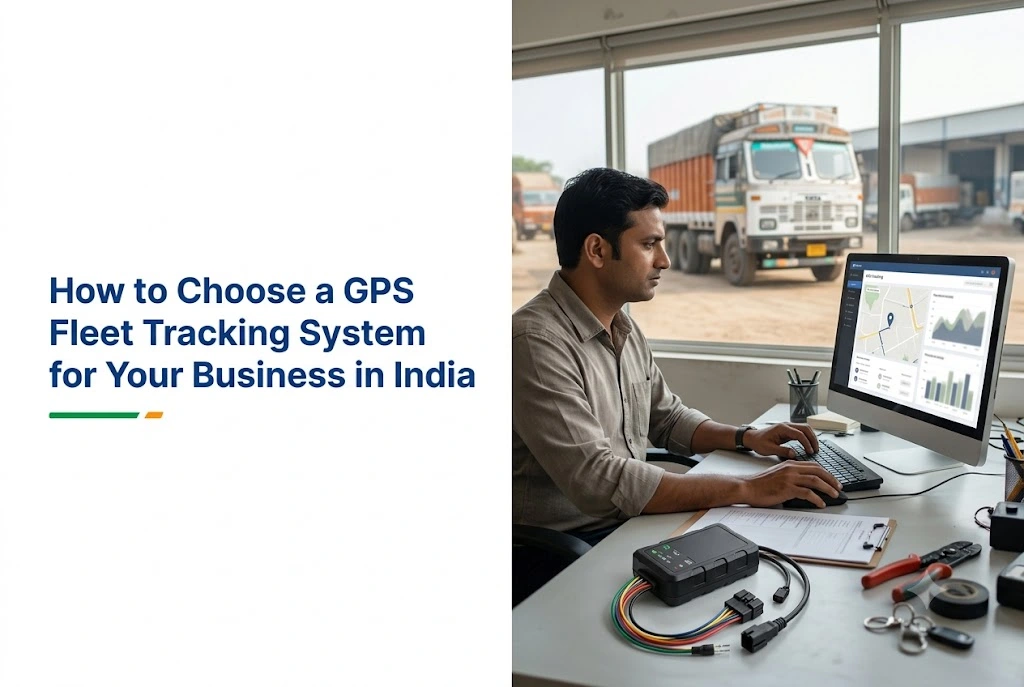
By AlifTech Secure | FleetNow GPS — Vehicle Tracking Solutions, Indore | May 2026 | www.aliftechsecure.in
Most fleet owners start this decision by comparing feature lists. That is the wrong end.
The owners who are still happy with their system a year later started somewhere else: with the thing that was actually costing them money, and with the compliance question that narrows the field before any feature matters.
This guide covers how to work through it in that order, what to compare once compliance is settled, what it costs, and the mistakes that lead fleet owners to change vendors inside twelve months.
Quick Answer
- Start with your actual problem, not a feature checklist.
- AIS-140 certification comes first for any yellow-plate vehicle. It narrows the shortlist before anything else.
- Past 10 vehicles, a full fleet platform earns its cost over individual trackers.
- Fitment is not registration. The device has to appear on your Vahan record to count.
- 10-vehicle fleet, year one: roughly ₹1 to ₹2 lakh. Ongoing: ₹35,000 to ₹70,000 a year.
Start With the Problem, Not the Feature List
Before comparing a single vendor, answer honestly: what is costing you money or sleep right now?
Fuel disappearing is a different problem from a missed delivery window. A compliance deadline creates different pressure from a driver safety incident. Each points at a different system specification, and buying the wrong one is how fleet owners end up with an expensive dashboard nobody opens.
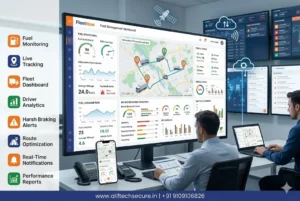
Fleet size matters just as much. A basic tracker covers the essentials for a handful of vehicles. Past roughly ten, centralised dashboards, automated reporting and managing drivers and routes from one place start paying for themselves, because juggling ten separate device apps stops being viable.
Knowing which category you are in saves time and stops you paying for capability you will never use.
Compliance First: AIS-140 and Vahan
For commercial vehicles this is not one question but two, and most buying guides only cover the first.
The device has to be certified
Any commercial vehicle with a yellow number plate needs an AIS-140 certified VLTD, not a generic tracker. This is enforced through RTO checkposts and at fitness certificate renewal, so a system that cannot satisfy it puts the fleet at risk regardless of how good its other features are.
Ask for the certification specifically, by device model, and confirm it with your vendor in writing rather than accepting a general assurance. Certification is granted per device model, so a manufacturer having certified products does not mean every model in their range is one.
And it has to reach your Vahan record
This is the part that catches operators out, and it is worth understanding before you buy anything.
Buying a certified device and having it fitted is not the same as being compliant. The fitment has to be done by an empanelled installer, because a private mechanic’s work carries no legal standing however good the wiring is. Then the device details have to appear on your vehicle’s record on the Vahan portal.
So the question to put to a vendor is not “is this device certified” but “do you handle fitment and Vahan linkage, and will you confirm when the record shows.” Our guide to Parivahan GPS IMEI registration walks through that process, and the AIS-140 compliance guide covers the wider requirement.
One more cost people forget. The M2M SIM has to stay active, since a device that stops transmitting is treated the same as no device when fitness renewal arrives.
Features Worth Comparing, Once Compliance Is Settled
Refresh rate
Every system offers real-time tracking, though the actual update interval varies. Some platforms report every 5 to 10 seconds while moving, others less often to save data cost.
For most Indian fleets, 10 to 30 seconds is adequate. Faster matters for high-value cargo or passenger transport, where precise live position genuinely changes a decision in the moment.
Fuel monitoring
If fuel loss is a concern, and for most trucking and logistics operators it is, look for a system with a proper fuel sensor rather than fuel estimation from engine data.
A dedicated sensor reads actual tank level, so it catches siphoning events that engine-based estimation misses entirely. This is separate hardware from the tracker, and it is the single most common thing left out of a quote. We covered why in our piece on GPS tracking and fuel costs.
Geofencing and route alerts
Geofencing draws virtual boundaries around delivery zones, restricted areas or customer sites, and alerts you when a vehicle enters or leaves.
Route deviation alerts work alongside it, flagging unauthorised detours. Those often correlate with fuel loss or personal use, so the two features tend to earn their keep together rather than separately.
Driver behaviour
Harsh braking, rapid acceleration and overspeeding feed into a score per driver. That turns a vague sense of which drivers are reckless into documented evidence you can use in a coaching conversation.
Some insurers now offer better commercial premiums for fleets running active driver monitoring, so it is worth asking your insurer before assuming the feature only affects fuel.
Maintenance and diagnostics
Advanced systems pull engine diagnostic data and flag maintenance on actual condition rather than fixed mileage intervals. For larger fleets this prevents both over-servicing healthy vehicles and under-servicing developing problems.
Smaller fleets often find this unnecessary, since manual tracking stays manageable at low vehicle counts.
Choosing the Hardware
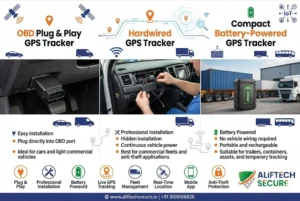
| Hardware type | Suits | Note |
|---|---|---|
| OBD plug-in | Quick deployment, vehicles reassigned often, non-commercial use | Not acceptable for AIS-140 compliance |
| Hardwired, AIS-140 certified | Commercial vehicles, high-value assets | Required for compliance, tamper-resistant |
| Battery-powered | Trailers, containers, construction equipment | Reports less often to preserve battery |
| Solar-powered | Remote sites, long-duration outdoor assets | Suits assets that move infrequently |
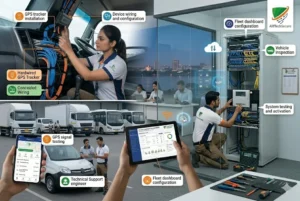
OBD devices plug into the diagnostic port with no wiring, so they install and move quickly. For commercial vehicles needing compliance, though, a hardwired certified device is the standard rather than a plug-in unit.
Hardwired units are permanently connected to the vehicle’s electrical system, which makes them harder to remove or tamper with. That is exactly why certified VLTDs use this approach, and it is why professional installation matters more here than for plug-in alternatives.
Battery-powered trackers fill the gap for anything without an engine to draw power from. They report location less frequently to preserve battery life, which suits assets that sit still more than they move.
Evaluating the Platform and the Vendor
Hardware is half the system. The platform and the relationship behind it decide whether you get value from the data.
Test the dashboard with the person who will use it
A feature-rich dashboard your team finds confusing delivers less than a simple one they open daily.
Request a demo, and have the actual fleet manager test it, not just whoever signs the cheque. Adoption problems after installation almost always trace back to a decision made without the daily user in the room.
Mobile access that actually covers what you need
Most fleet managers check status away from a desk. Confirm the mobile app handles alerts, reports and responding to issues, not only viewing location on a map.
Integration with what you already run
If you use dispatching software, payroll systems or job management tools, check whether the platform connects to them. A system requiring manual data transfer between platforms creates exactly the inefficiency tracking is meant to remove.
Confirm the connection works before committing rather than discovering the gap afterwards.
Local support, and how fast
When a device stops transmitting or a SIM lapses, how quickly does the vendor respond?
A vendor working through a distant call centre often means days for what should be a same-day fix. For fleets around Indore and Pithampur, genuine local presence resolves things considerably faster, and this becomes the most important factor the first time something breaks. Ask about response times and local availability before signing.
What It Costs
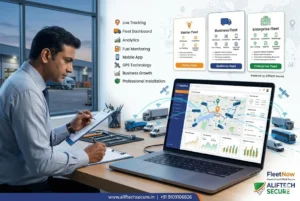
Pricing varies by hardware tier, bundled services and vendor margin, so treat any single figure with caution.
| Cost component | Approximate |
|---|---|
| AIS-140 certified hardware | ₹3,500 to ₹6,000 per device |
| Professional installation | ₹500 to ₹1,500 per vehicle |
| SIM and data | ₹100 to ₹300 per vehicle per month |
| Platform access | ₹50 to ₹200 per vehicle per month |
| 10-vehicle fleet, year one | ₹1 lakh to ₹2 lakh |
| 10-vehicle fleet, ongoing annual | ₹35,000 to ₹70,000 |
Advanced platforms with fuel analytics, maintenance scheduling and driver scoring sit at the upper end of the platform range. Larger fleets negotiate better per-unit pricing, so request volume quotes once you pass 20 to 25 vehicles.
Our GPS device price guide breaks the components down further.
The lowest per-device price rarely represents the best value. Weak data accuracy or slow support costs more in operational disruption than the upfront saving is worth. Compare on total first-year cost, support quality and certification status together.
Four Mistakes That Cause Vendor Switches
These are the patterns behind fleet owners who change supplier within a year.
Choosing on price without checking compliance. The cheapest device is often uncertified or on an outdated standard version. The saving disappears the first time a vehicle is stopped at a checkpost or a fitness renewal is refused.
Buying more platform than the fleet needs. A five-vehicle operation does not need predictive maintenance analytics. Equally, a fifty-vehicle logistics company should not settle for a basic dashboard. Matching the tier to actual size avoids both overpaying and outgrowing the system within a year.
Skipping the hands-on demo. Committing on a sales presentation alone, without the daily user testing it, frequently causes adoption problems. A dashboard that looks impressive in a pitch can prove slow in use, and testing catches that before hardware goes onto vehicles.
Ignoring support quality until something breaks. Response time rarely factors into the buying decision, then becomes the only thing that matters during an outage. Ask specifically, in advance.
Frequently Asked Questions
How many vehicles justify a full fleet platform over basic trackers?
Past roughly ten vehicles, centralised reporting, automated alerts and dashboard management deliver measurably better return than managing individual trackers separately. Below that, a simpler system with core tracking, AIS-140 compliance and basic alerts usually covers operational needs without paying for enterprise features.
Can one system handle both compliance and fuel monitoring?
Yes, and that is the smarter approach. A properly specified AIS-140 certified device with integrated fuel sensor support covers both the legal requirement and operational fuel monitoring through one installation and one dashboard, rather than two disconnected systems with separate costs.
What is the difference between OBD and hardwired devices for commercial use?
OBD devices plug into the diagnostic port and install without wiring, but AIS-140 compliance requires a hardwired, tamper-resistant installation rather than a plug-in unit. For non-commercial tracking such as company cars, OBD offers a faster and more flexible option.
How long does installation take for a 10-vehicle fleet?
Professional fitment of hardwired certified devices usually takes one to two days depending on vehicle access and scheduling. Vahan registration and dashboard setup add a few more days. Plan roughly a week from order to a fully operational, registered and compliant system.
Should I choose the vendor with the lowest quote?
No. The lowest per-device price rarely reflects total value once data accuracy, support responsiveness and certification validity are counted. A cheaper device with weak support or uncertain certification creates disruption and compliance risk that costs more than the initial saving. Compare total first-year cost alongside support and certification.
Choosing With Confidence
The owners still satisfied a year later did three things: they started from their real problem rather than a feature list, they had their actual team test the dashboard before committing, and they chose a partner with genuine local support instead of the cheapest quote.
So begin with a conversation about what is costing you time or money right now. The right system follows from that rather than from a comparison table.
| FleetNow GPS by AlifTech Secure — Indore Call / WhatsApp: +91 9109106826 www.aliftechsecure.in | aliftechsecure@gmail.com 112 Basement, Akbar Ali Complex, MG Road, Palasia Square, Indore — 452001 |
| Get a Free Fleet Tracking Consultation Tell us your fleet size and main challenge — we recommend the right system, not the most expensive one. Call / WhatsApp: +91 9109106826 | www.aliftechsecure.in |
AlifTech Secure | FleetNow GPS — Vehicle Tracking Solutions, Indore MP | www.aliftechsecure.in | +91 9109106826

