
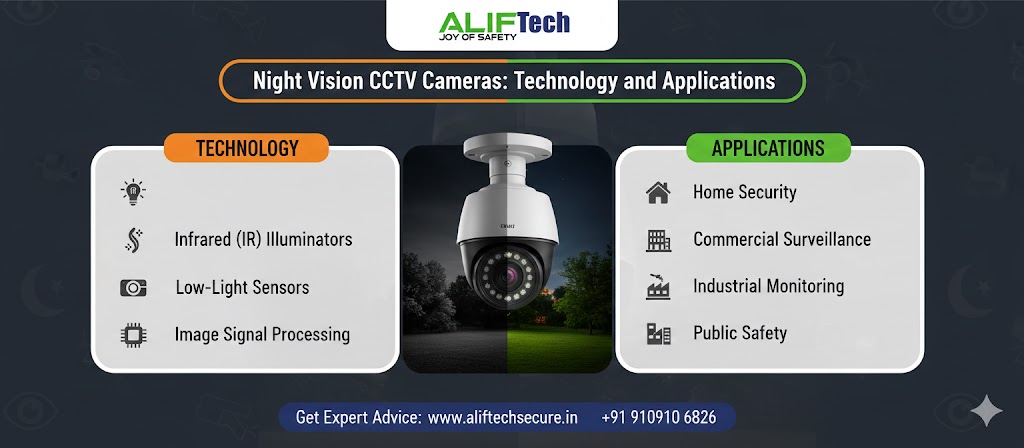
Night Vision CCTV Cameras: Technology and Applications
A camera that produces excellent daytime footage can be useless at 2 AM, which is when most incidents happen.
That gap is what night vision exists to close, and it is where most buyers get the specification wrong. They compare resolution and ignore how the camera behaves once the light goes.
This guide covers the four night vision technologies, what the numbers on a spec sheet actually mean, and the mistakes that produce unusable night footage from otherwise good cameras.
Quick Answer
- Infrared works in complete darkness, but the footage is black and white.
- Starlight cameras keep colour in very low light, though they need some ambient light.
- Colour night vision uses white light, so it identifies clothing and vehicles but is visible.
- Manufacturer IR range is optimistic. Expect 60 to 70 percent of the claimed figure.
- Never point an IR camera through glass. The infrared reflects straight back.
The Four Technologies
Infrared, the standard answer
IR LEDs around the lens emit light your eye cannot see, and the sensor reads what bounces back. It works in total darkness and creates no visible glow to annoy anyone.
The footage is black and white. There is no colour information in IR mode, so you get a shape and a face but not the colour of a shirt or a car.
One detail worth knowing before you buy. IR LEDs come in two wavelengths. 850nm illuminates better and reaches further, but the LEDs show a faint red glow when active. 940nm is completely invisible and reaches roughly 30 to 40 percent less far.
Choose 850nm unless you specifically need the camera to be undetectable at night.
Starlight, for colour in near-darkness
Starlight cameras use larger sensor pixels that collect more light, combined with processing that amplifies what little there is. They hold colour down to very low light levels, roughly 0.001 to 0.008 lux.
That colour matters more than people expect. A description of “a man in a blue shirt beside a white car” is far more useful than “a person beside a vehicle.”
The trade-off: starlight cameras cost roughly two to three times an equivalent IR camera, and they still need some ambient light. Moonlight or a street lamp is enough. Complete darkness is not, which is why most starlight cameras also carry IR as a fallback.
Colour night vision, using white light
Warm white LEDs switch on in darkness and the camera records in full colour. The visible light also acts as a deterrent, since anyone approaching knows they are lit and recorded.
Where it works: shop fronts, parking areas, commercial entrances, anywhere the light is not a nuisance.
Where it does not: residential areas where the light will annoy neighbours or residents, and covert positions where you would rather the subject not know.
Our WiFi cameras and IP cameras both include colour night vision options.
Thermal, for perimeters
Thermal cameras read heat rather than light, so darkness, smoke and fog make no difference to them at all.
They suit long perimeters, chemical or fuel storage, and any boundary where you need to know someone is there rather than who they are. Thermal gives you a heat shape, not a face or a number plate.
Cost puts them in a different category, from around ₹50,000 to well past ₹5 lakh, so they belong on specific high-risk stretches rather than general coverage.
| Technology | Colour at night | Works in total darkness | Relative cost |
|---|---|---|---|
| Infrared | No | Yes | Lowest |
| Starlight | Yes | Needs some ambient light | 2 to 3 times IR |
| Colour night vision | Yes | Yes, using its own white light | Moderate |
| Thermal | Heat image only | Yes | Highest |
Reading the Spec Sheet
IR range, and why the number is optimistic
Range depends on how many LEDs the camera has, how powerful they are, the lens focal length, the weather, and how reflective the surfaces in view happen to be. A white wall bounces IR back far better than a dark boundary fence.
Manufacturers state range under ideal conditions. At your actual site, expect around 60 to 70 percent of the claimed figure.
So a camera advertised at 50 metres realistically covers 30 to 35. Plan for that rather than for the box.
Test at the actual position before signing off an installation. Our placement guide covers what else to check.
Lux rating
Lux measures light sensitivity, and lower numbers mean better low-light performance.
| Lux | Real-world equivalent |
|---|---|
| 0.0001 | Moonless night |
| 0.001 | Moonlight |
| 0.01 | Deep twilight |
| 0.1 | Street lighting |
| 1 | Dim indoor lighting |
| 10 | Well-lit indoor area |
Match the rating to your actual conditions. A camera rated 0.1 lux needs street lighting to work properly, so putting one on an unlit rear boundary produces nothing.
Smart IR
Without it, a person walking close to the camera turns into a white blur while the background stays dark. The LEDs are running at full power regardless of distance.
Smart IR adjusts intensity based on how far away the subject is, so close subjects stay visible and distant ones still get enough light. It also extends LED life.
This is worth insisting on. The overexposed white blob is one of the most common complaints about night footage, and it is entirely avoidable.
Camera Types at Night
Bullet cameras carry more LEDs in their longer housing, and the shape channels IR forward, so they reach furthest. Typical range 30 to 100 metres or more. Best for perimeters, gates and driveways.
Dome cameras have shorter IR range, usually 15 to 50 metres, and the dome cover can cause internal IR reflection if it is dirty or poorly designed. Better indoors and where you want the camera to be discreet.
PTZ cameras carry powerful IR arrays reaching 50 to 200 metres, with auto-tracking that works at night. They suit large yards where someone is actively monitoring, or where preset tours cover the ground. Our PTZ range covers these.
Where Night Vision Fails
Four causes account for almost every complaint we get about night footage.
Pointing through glass
IR reflects off glass and bounces straight back into the lens. The result is a white wash and no usable image at all.
A camera behind a window will not work at night. Mount it outside, or use a camera with the IR disabled and rely on ambient light.
Mounting too close to a wall
An IR camera fixed tight against a wall lights the wall, and that reflection floods the sensor. Keep at least a metre of clearance from any large reflective surface in the camera’s field of view.
Dirty lenses and dome covers
Dust on the lens scatters IR light. On a dome camera the effect is worse, because the cover sits directly in the light path.
In Indore conditions, an outdoor lens needs cleaning quarterly at minimum, and monthly during dusty months. This is the single cheapest thing that improves night footage.
Spiders and insects
IR LEDs attract insects, and a spider building a web across the lens produces constant motion alerts and blocked footage.
Cleaning solves it. So does adjusting motion sensitivity, or using cameras with object classification that only alerts on people and vehicles.
Mounting and Placement
Mount at 2.4 to 3 metres for most positions, which keeps the camera above reach while holding faces in the usable part of the frame. Above roughly 4.5 metres you record the tops of heads.
Angle depends on height and distance. A camera at 2.5 metres covering a doorway three metres away needs roughly 10 to 15 degrees of downward tilt. A longer approach needs less. Check the live feed with somebody standing where a person would stand, and adjust until the face sits in the middle of the frame.
For number plates at a gate, drop to 1.2 to 1.8 metres looking along a narrow lane. A camera at four metres angled down captures vehicle roofs and no readable plate.
Consider existing light sources. A street lamp in the frame causes glare and defeats the sensor’s exposure. Angle away from it.
Test at night before signing off. Daytime footage flatters every installation. Walk the coverage area after dark while someone watches the feed.
What It Costs
| Tier | Price | What you get |
|---|---|---|
| Budget | ₹1,500 to ₹4,000 | Basic IR to 20 to 30 metres, 1080p, 0.1 lux, suits lit areas only |
| Mid-range | ₹4,000 to ₹12,000 | IR to 30 to 50 metres, up to 4MP, Smart IR, 0.01 lux, weather resistant |
| Premium | ₹12,000 to ₹40,000 | Starlight or colour night vision, 4K, IR past 80 metres, AI detection |
| Professional | ₹40,000 to ₹2 lakh+ | Advanced starlight, thermal options, IR past 100 metres, plate capture |
One thing worth spending on. If the position matters, meaning your gate, your entrance or your stockroom door, put the money there and economise on the general coverage cameras. A budget camera on a critical position is a false economy that only shows up when you need the footage.
Our CCTV camera set price guide covers full kit costs.
And check certification before paying. Since 1 April 2026, cameras sold in India must meet MeitY’s Essential Requirements, so ask for the BIS registration number for that exact model. Our guide to the 2026 CCTV import and BIS rules covers what changed.
Keeping Night Vision Working
Monthly: wipe the lens with a microfibre cloth. Check for webs.
Quarterly: clean the housing and dome cover properly, and check for insect nests behind the camera.
Twice a year: review coverage. Vegetation grows, and a branch that was clear in March blocks the view by August.
Annually: check firmware, and verify the IR LEDs still fire. On an 850nm camera you can see the faint red glow when they activate.
An AMC covers this, and it matters more for night vision than for daytime footage, because a dirty lens degrades night performance far faster than it degrades day performance.
Frequently Asked Questions
How far can a night vision camera actually see in the dark?
Budget models cover 10 to 20 metres, standard cameras 30 to 50, and professional models 80 to 150 or more. But expect around 60 to 70 percent of the manufacturer’s claim in real conditions, since range figures are measured under ideal circumstances with reflective surfaces in view.
Do night vision cameras work in complete darkness?
Infrared cameras do, using their own invisible illumination. Starlight cameras need some ambient light such as moonlight or a distant street lamp, and most carry IR as a fallback for total darkness. Thermal cameras work in absolute darkness because they read heat rather than light.
Is colour night vision better than infrared?
For identification, yes, since clothing colour and vehicle colour help enormously. But colour night vision uses visible white light, which is unsuitable for residential areas and covert positions. Infrared works in complete darkness and disturbs nobody. Choose by position rather than by which sounds better.
Why does my night footage show white spots or a white glare?
Almost always IR reflection. Check whether the camera points at glass, sits too close to a wall, or has a dirty lens or dome cover. Insects near the lens also reflect IR and appear as bright moving blobs. Reposition and clean before assuming the camera is faulty.
Can a night vision camera see through a window?
No. IR reflects off glass and bounces back into the lens, producing a white wash. Mount the camera outside, or if it must sit indoors looking out, disable the IR and rely on outside lighting.
What is the difference between 850nm and 940nm infrared?
850nm gives better illumination and longer range, but the LEDs show a faint red glow when active. 940nm is completely invisible and reaches roughly 30 to 40 percent less far. Choose 850nm unless the camera genuinely needs to be undetectable at night.
How long do IR LEDs last?
Quality LEDs run 50,000 to 100,000 hours, which is five to eleven years of nightly operation. Cheaper LEDs fail sooner, and Smart IR extends life by not running them at full power constantly. If night footage has gradually darkened over years, ageing LEDs are a likely cause.
The Short Version
Choose infrared for total darkness, starlight where some ambient light exists and colour matters, and colour night vision where visible light is acceptable.
Expect real range to be about two thirds of the claimed figure. Insist on Smart IR. Never point through glass. And clean the lens quarterly, because that costs nothing and does more for night footage than any upgrade.
Book a free CCTV site survey in Indore. We check the light conditions at each position, including how they change through the day, and specify night vision to match rather than fitting the same camera everywhere.
Certified cameras with documentation, correct mounting heights and angles, IR reflection checked at installation, and a night-time walkthrough before we call the job complete. Our AMC keeps lenses clean and IR working, which is where night vision quietly degrades.
See our IP camera range, our installation service across Indore and MP, or get in touch.
Call or WhatsApp +91 91091 06826.

