
By AlifTech Secure | Access Control Solutions, Indore | June 2026 | www.aliftechsecure.in
Introduction
An employee taps a card and walks in. It is not them. A colleague handed the card over at the gate, and nobody will ever know.
That single problem is why offices in Indore keep asking whether to move from cards to biometrics. But the honest answer is not “biometric is better.” It depends on which door you are talking about, and on something most vendors will not mention: biometric data brings legal obligations that a plastic card does not.
Quick Answer
- Biometric stops buddy punching completely, costs more per door, and makes you a Data Fiduciary.
- RFID card is cheap and fast, but cards get shared, lost and cloned.
- Card plus PIN sits between the two, though it still verifies a credential rather than a person.
- Match the method to the zone. Most offices should mix, not pick one.
- Fingerprint fails in dusty or wet conditions. Face recognition does not.
What Each System Actually Verifies
The difference comes down to one question: is the system checking a person, or a thing that person is carrying?
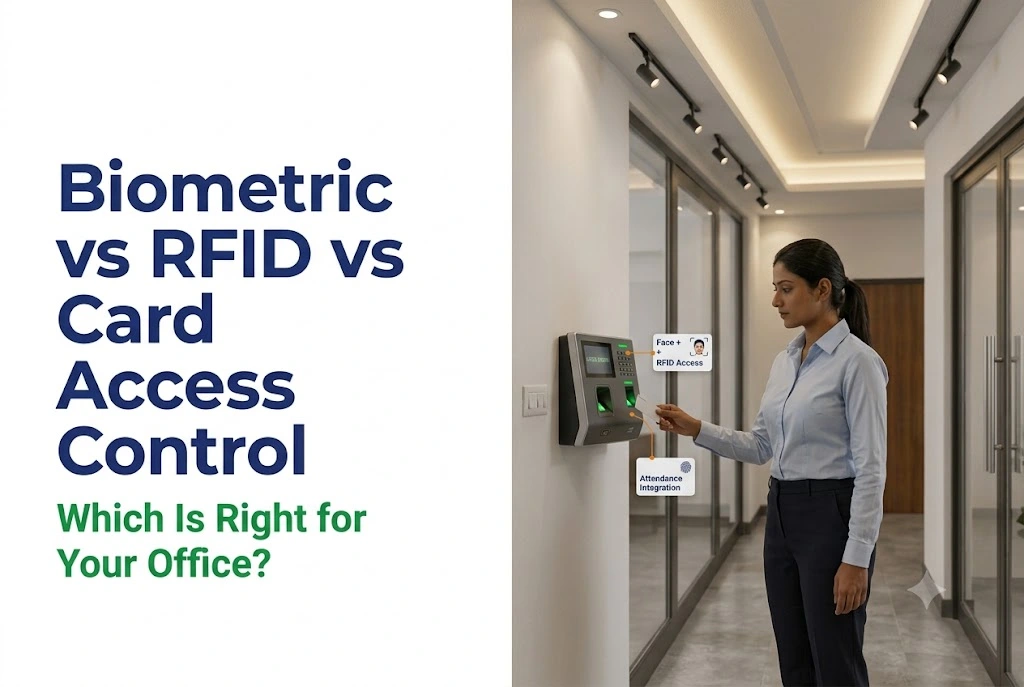
Biometric reads a physical trait, fingerprint, face or iris, and compares it against a stored encrypted template. Since the trait belongs to the person, it cannot be handed over at the gate.
RFID card reads a chip. The system confirms the card is authorised, not that the right person is holding it. Fast and simple, and that simplicity is also the weakness.
Card plus PIN adds something the person knows to something they carry. Better than card alone, though both can still be passed to a colleague together.
Biometric vs RFID vs Card: Full Comparison
| Factor | Biometric | RFID card | Card plus PIN |
|---|---|---|---|
| What it verifies | The person | The credential | Credential plus a secret |
| Security level | Highest | Basic | Moderate |
| Buddy punching | Not possible | Common | Possible if both are shared |
| Cost per door | ₹8,000 to ₹25,000 | Lower upfront | Slightly above card only |
| Recurring cost | None | Card replacements | Card replacements |
| Speed at peak entry | Fast with face, slower with fingerprint | Fastest | Slowest, PIN entry takes time |
| Dusty or wet sites | Fingerprint struggles, face works | Unaffected | Unaffected |
| Payroll integration | Direct | Possible | Possible |
| Lost credential | Nothing to lose | Reissue and revoke | Reissue and revoke |
| Data protection duty | You become a Data Fiduciary | Minimal | Minimal |
| Best for | Restricted zones, factories, banks | General entry, schools, campuses | Mid-security doors |
The Cost Nobody Puts in the Comparison
Biometric brings a legal dimension that cards do not, and it belongs in the decision rather than in a footnote.
Employee fingerprints and face templates are digital personal data. Once you collect them you are a Data Fiduciary under the Digital Personal Data Protection Act, and your employees are Data Principals. The Act makes no distinction between customer data and employee data, and the same penalties apply.
The reassuring part
Section 7 provides a legitimate use covering employment purposes, so attendance, payroll and workplace safety generally do not require individual consent. You still owe employees a clear notice about what you collect and why.
The parts that need work
Deletion. Access logs, meaning who entered and when, can be retained for audit. The biometric template itself should be deleted when access is revoked. Most offices never delete anything, which is the most common gap.
Contractors and visitors. Every enrolment is a fresh processing event. Temporary staff need consent before enrolment and deletion when the contract ends.
Scale. Organisations processing biometric data at scale are flagged in the DPDP framework as likely candidates for Significant Data Fiduciary status, which brings an India-based Data Protection Officer, annual independent audits and annual impact assessments. A factory enrolling several thousand workers fits that description.
So here is the practical consequence. RFID cards carry almost none of this. That is a legitimate reason to use cards on general doors and reserve biometrics for the zones where identity certainty actually matters, rather than enrolling everyone into everything.
We cover the compliance side further in our guide to attendance machines and salary software.
Honest Pros and Cons
Biometric
Good: cannot be shared, lost or cloned. No recurring card cost, which matters for large teams. Direct payroll integration. Face recognition works in dusty factory conditions where fingerprints fail.
Less good: ₹8,000 to ₹25,000 per door. Fingerprint readers struggle with wet, dirty or worn hands. Enrolment takes time and has to be done properly. And you take on the data obligations above.
RFID card
Good: lowest upfront cost, so it suits large campuses and schools. Fastest at peak entry. Deploys immediately with no enrolment. Works in any environment.
Less good: cards get shared, so buddy punching stays possible. Replacements are a recurring cost. A lost card is an open door until someone revokes it.
Card plus PIN
Good: a lost card alone is useless. No biometric enrolment or data duties.
Less good: PIN entry slows the queue, people forget PINs, and both credentials can be handed over together. It raises the bar without verifying a person.
Five Mistakes Offices Make
1. Buying on price alone. The cheapest device often lacks payroll integration or cloud management, so you save ₹4,000 and lose two hours a month forever.
2. Ignoring the environment. Fingerprint readers fail in wet and dusty conditions. Factories and labs need face recognition, and finding this out after installation is expensive.
3. Not planning for growth. A system sized for ten people gets slow and costly at fifty. Ask about user capacity and controller expansion before buying.
4. Skipping integration. Access control that does not talk to your HR or payroll system creates the same manual work every month.
5. Using one method everywhere. A server room and a main entrance do not need the same thing. Mixing methods is cheaper and more secure than standardising on either.
Which System for Your Office
Small office, 10 to 30 people
A fingerprint device at the main door, integrated with attendance software. Budget ₹8,000 to ₹15,000. One entry point rarely justifies anything more complex, and the attendance integration is where the daily value sits.
Medium office, 30 to 100 people
Face recognition at the main entry, since it is faster for larger teams and unaffected by dirty hands. Then RFID cards on general floors and biometrics only on restricted zones like accounts or the server room. This mix costs less than biometrics everywhere and reduces how much biometric data you hold.
Factory or warehouse
Face recognition or palm vein, because fingerprint readers will not survive the conditions. Combine access with attendance so one device handles both. Above a hundred workers, centrally managed access control saves real administrative time. We covered a live example in our Pithampur biometric attendance write-up.
Bank, hospital or high-security site
Multi-factor, meaning biometric plus card or biometric plus PIN, on the doors that matter. Integrate access logs with CCTV so every entry has a matching image, since logs alone tell you a credential was used, not who used it.
For genuine duress scenarios, ask your vendor about duress codes specifically. Adding a second factor does not help if someone is being forced to open a door, because they can supply both factors. A duress code silently raises an alarm while appearing to grant access, and that is a different feature you have to ask for by name.
Frequently Asked Questions
Is biometric access control legal for employees in India?
Yes. Section 7 of the DPDP Act provides a legitimate use covering employment purposes, so attendance and access generally do not need individual consent. You must give employees a clear notice about what is collected and why, and consent is required for visitors and contractors.
Can RFID cards be cloned?
Basic low-frequency proximity cards can be copied with inexpensive equipment. Encrypted high-frequency smart cards are considerably harder to duplicate. If you are staying with cards for security-relevant doors, ask your supplier which type you are actually being quoted.
Which works better in a dusty factory, fingerprint or face?
Face recognition, clearly. Fingerprint readers fail on dirty, wet or worn hands, which describes most shop-floor workers by mid-shift. Failed scans create queues at shift change, and queues are what push supervisors into marking attendance manually.
Do I have to delete biometric data when an employee leaves?
Delete the biometric template when access is revoked. Access logs showing who entered and when may be retained for security and audit purposes. Set a written retention period rather than keeping everything indefinitely, which is where most offices fall short.
Can I mix biometric and card access in one building?
Yes, and for most offices that is the better design. Cards on general doors, biometrics on restricted zones. It costs less than biometrics throughout and limits how much biometric data you are responsible for holding.
The Short Version
There is no single best system, only a best fit per door.
Biometrics remove buddy punching entirely and cost more, both in money and in data obligations. Cards are quick and cheap but verify plastic rather than people. Card plus PIN sits between them.
For most Indore offices, face recognition on restricted zones with RFID cards for general entry gives the right security where it matters and keeps the rest simple.
| Book a Free Access Control Site Visit We visit your office, assess your requirements, and recommend the right system within your budget. Call / WhatsApp: +91 9109106826 | www.aliftechsecure.in | Quick Installation Available |
AlifTech Secure | Access Control & Security Solutions, Indore MP | 91 9109106826 www.aliftechsecure.in


1 Comment. Leave new
[…] guide on biometric, RFID and card access covers which credential type suits which […]